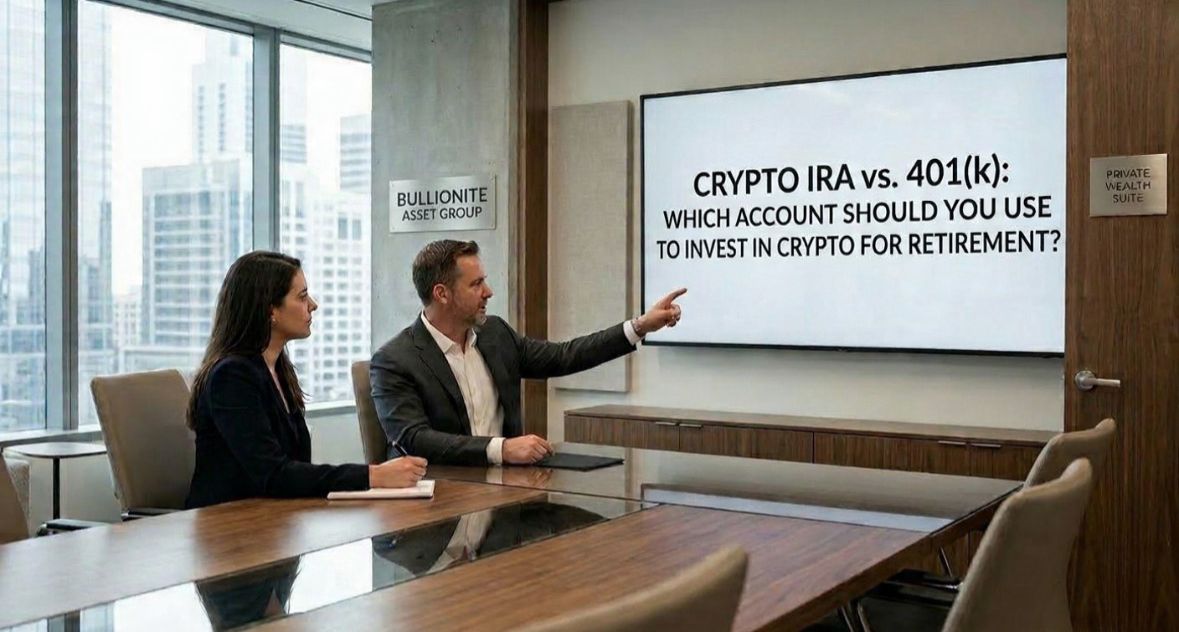
Crypto IRA vs 401(k): Which Account Should You Use to Invest in Crypto for Retirement?
Who Controls Your Crypto Investment Options in a 401(k) vs a Crypto IRA?
In a 401(k), your employer’s plan administrator decides which investments appear on the menu. For most American workers, that menu contains mutual funds, target-date funds, and company stock — and very rarely any direct cryptocurrency. According to a 2024 survey, fewer than 1% of employers had added crypto ETFs to their 401(k) menus, even after the SEC’s approval of spot Bitcoin ETFs in January 2024.
A crypto self-directed IRA flips that dynamic entirely. Because the IRS defines a self-directed IRA (SDIRA) as any IRA in which the account holder, not a financial intermediary, selects the investments, you can hold cryptocurrencies directly alongside real estate, precious metals, and other alternative assets. The IRS confirmed in IRS Notice 2014-21 that virtual currency is treated as property for federal tax purposes, which means it can be held inside a self-directed IRA without triggering prohibited transaction rules under IRC §4975 — as long as a qualified custodian holds the assets.
This distinction in investment control is not trivial. A Bitcoin ETF inside a 401(k) gives you price exposure to Bitcoin, but you cannot withdraw the underlying asset as crypto, only as cash. A crypto IRA holding actual Bitcoin allows a qualified in-kind distribution, giving you direct ownership of the coins at retirement age.
The Department of Labor (DOL) issued Compliance Assistance Release 2022-01 cautioning 401(k) plan fiduciaries to exercise “extreme care” before adding cryptocurrency to a 401(k) menu, which has contributed to the slow adoption. The DOL’s primary concern: most crypto assets lack the pricing transparency and valuation standards required for ERISA-compliant 401(k) administration.
Self-directed IRAs are not subject to ERISA, which is precisely why they are the dominant vehicle for direct crypto retirement investing.
Bottom line: if your goal is to hold Bitcoin, Ethereum, Solana, or any altcoin directly inside a retirement account, a crypto self-directed IRA is — for the vast majority of investors — the only realistic path available today.
2026 Contribution Limits: How Much Can You Actually Put Into a Crypto IRA vs a 401(k)?
The IRS announced updated retirement contribution limits for 2026 in IR-2025-111 (November 13, 2025). These numbers matter enormously when comparing crypto IRAs to 401(k)s because the contribution ceiling directly caps how much capital you can shelter from taxes.
| Account Type | Under 50 (2026) | Age 50+ (Catch-Up) | Age 60-63 (Super Catch-Up) | Employer Match? |
| Crypto Self-Directed IRA (Traditional or Roth) | $7,500 | $8,600 (+$1,100) | Same as 50+ (no super C/U) | No |
| 401(k) — Traditional or Roth | $24,500 | $32,500 (+$8,000) | $35,750 (+$11,250) | Yes — typical 50%-100% |
| Solo 401(k) — Self-Employed (Employee + Employer) | $24,500 employee / Up to $73,500 total* | Up to $81,250 total* | Up to $81,250 total* | Self-funded |
| SEP IRA (Self-Employed) | Up to $72,000 (25% of comp) | Same | Same | No |
The 401(k) contribution ceiling is 3.3x higher than a crypto IRA’s. For investors who can max both, the optimal sequence is: (1) contribute to the 401(k) up to the employer match, (2) max the crypto Roth IRA for tax-free direct crypto exposure, and (3) if funds remain, return to the 401(k) to hit the full limit.
Self-employed investors operating as sole proprietors or single-member LLCs have a compelling edge: the Solo 401(k) permits both an employee deferral ($24,500) and an employer profit-sharing contribution (up to 25% of net self-employment income), pushing the 2026 ceiling to $73,500. A self-employed crypto investor who has also set up a crypto self-directed Solo 401(k) may outperform a W-2 employee’s IRA-only strategy significantly.
One critical point the IRS contribution limit table does not capture: IRA limits apply across ALL your IRAs combined. If you contribute $5,000 to a traditional IRA, you can only add $2,500 more to a Roth IRA in 2026 — the $7,500 ceiling is shared.
What Does the Tax Math Actually Look Like for Crypto in a Roth IRA vs a 401(k)?
The tax advantage difference between a crypto Roth IRA and a traditional 401(k) is not academic — it is potentially hundreds of thousands of dollars. Here is a worked example using realistic crypto appreciation assumptions.
Scenario: $10,000 invested in Bitcoin, growing 10x over 20 years to $100,000
| Account Type | Tax on Contribution | Tax During Growth | Tax on $100k Withdrawal | Net Received | Tax Bill |
| Taxable Brokerage Account | After-tax $10k | Capital gains taxed annually | $21,600 (at 24% LTCG bracket) | $78,400 | $21,600 |
| Traditional IRA / 401(k) | Pre-tax $10k | Tax-deferred, no annual tax | $24,000 (at 24% ordinary income) | $76,000 | $24,000 |
| Roth IRA (Crypto SDIRA) | After-tax $10k | Tax-free growth | $0 (qualified distribution) | $100,000 | $0 |
| Roth 401(k) (if employer offers) | After-tax $10k | Tax-free growth | $0 (qualified distribution) | $100,000 | $0 |
Assumptions: 24% marginal tax rate, 20% LTCG rate, qualified Roth distribution (account open 5+ years, age 59½+). For illustration only; individual results vary.
The Roth crypto IRA wins decisively for younger investors or anyone expecting large crypto appreciation. The entire $90,000 gain is sheltered from taxation, compared to a $24,000 tax bill in a traditional 401(k). The advantage only grows with higher appreciation: a 20x gain ($10k to $200k) creates a $45,600 traditional IRA/401(k) tax obligation versus $0 in a Roth IRA.
The traditional IRA or 401(k) makes strategic sense if you are in a high tax bracket today (35–37%) and expect to be in a significantly lower bracket in retirement — for example, dropping from 37% to 22%. In that case, deferring taxes now and paying at a lower rate later produces a net positive.
“An IRA is a great option for saving for retirement because you have a lot of control over what you’re invested in, you may be eligible for some great tax breaks, and you can open an account on your own without relying on your employer.”
Tony Molina, CPA and Product Evangelist, Wealthfront
Does the 401(k) Employer Match Override the Crypto IRA Tax Advantage?
The employer match is the 401(k)’s most powerful feature — and it is the one genuine argument where the 401(k) outperforms a crypto IRA on a risk-adjusted basis. A 50% match on contributions up to 6% of salary means an employee earning $80,000 who contributes $4,800 (6%) receives an instant $2,400 from the employer, a guaranteed 50% return before any market movement.
No crypto IRA can replicate a guaranteed 50–100% return on Day One. This is why the recommended sequence for most investors is:
- Step 1: Contribute to your 401(k) up to the full employer match. Do not leave this money on the table.
- Step 2: Max your crypto Roth IRA ($7,500 in 2026) for direct, tax-free crypto exposure.
- Step 3: If you have additional capital, return to the 401(k) to increase contributions toward the $24,500 limit.
- Step 4: For self-employed investors — consider a Solo 401(k) with cryptocurrency access, which combines employer match flexibility with higher contribution ceilings.
The question changes if your 401(k) plan offers no employer match at all. In that scenario, the crypto IRA’s tax-free growth and direct crypto access become substantially more compelling relative to the administrative constraints of the 401(k). Learn more about crypto IRAs.
It also changes for investors who are self-employed. Without an employer to provide a match, the comparison shifts toward whichever account structure maximizes (a) contribution headroom and (b) crypto investment flexibility simultaneously — which often points toward a Solo 401(k) with checkbook control, or a combination of both account types.
“Investing for the long term should always take precedence over investing for the short term. The advantages of a 401(k) or IRA, including a company match, should be pursued before allocating short-term, fun money.”
Lindsey Bell, Chief Markets and Money Strategist, Ally Invest
How Do You Roll a 401(k) Into a Crypto Self-Directed IRA Without Paying Taxes?
Rolling a 401(k) into a crypto self-directed IRA is non-taxable when executed as a direct rollover under IRC §402(c). The IRS does not treat a direct trustee-to-trustee transfer as a distribution, so no taxes or penalties are triggered. Here is the process:
- Step 1 — Open the SDIRA: Establish a self-directed IRA with a qualified custodian that supports cryptocurrency investments. Account setup typically takes 5–10 business days.
- Step 2 — Request a Direct Rollover: Contact your current 401(k) plan administrator and request a direct rollover (not a 60-day rollover) to the new SDIRA custodian. The check is made payable to the new custodian ‘FBO [Your Name] IRA’, never to you personally.
- Step 3 — Fund Arrival and Verification: The custodian receives the rollover funds (typically 7–14 business days). Confirm the funds appear in your new SDIRA account before placing any trades.
- Step 4 — Purchase Cryptocurrency: Submit a buy direction to the custodian, or if using a checkbook IRA LLC, access the funds directly through your LLC bank account and purchase crypto on a qualified exchange.
- Important — The 60-Day Rule: If a 401(k) plan sends you the check directly (an indirect rollover), the plan must withhold 20% for federal taxes. You then have 60 days to deposit 100% of the original distribution, including the withheld amount from your own funds, into the IRA to avoid taxes and penalties. Using the direct rollover method eliminates this complication entirely.
Traditional-to-Traditional and Roth-to-Roth rollovers are the cleanest from a tax standpoint. A Traditional 401(k) rolling into a Roth crypto IRA is a Roth conversion — taxes are owed on the converted amount in the year of conversion, but all future growth is then tax-free. For investors who can absorb the tax bill today (particularly in years of lower income), a Roth conversion of a legacy 401(k) into a crypto Roth IRA is a powerful long-term strategy.
Crypto IRA Fees vs 401(k) Fees: Which Account Costs You More Over 30 Years?
Fees are where crypto IRAs attract the most criticism — and where informed decision-making matters most. 401(k) plans have their own fee problem (expense ratios, plan administration fees), but they are structured differently from SDIRA fees.
| Fee Type | Crypto Self-Directed IRA (Custodian-Controlled) | Crypto IRA (Checkbook LLC) | 401(k) (Employer Plan) |
| Account Setup | $0–$395 one-time | $1,000–$1,500 (LLC setup) | $0 (employer-paid) |
| Annual Admin Fee | $195–$595 flat or tiered | $299–$499 flat annual | $0–$50 (varies by plan) |
| Trading/Transaction Fee | 0.5%–2.5% per trade | Exchange fee only (e.g. 0.1%–1%) | Embedded in fund expense ratios |
| Fund Expense Ratios | Not applicable | Not applicable | 0.03%–1.50% of assets annually |
| Custody/Storage | Included or $0–$100/yr | Investor selects exchange | Plan sponsor covers |
| Total Est. Annual Cost ($50k crypto position) | ~$800–$1,800/yr (1.6–3.6%) | ~$400–$600/yr (0.8–1.2%) | ~$150–$750/yr (0.3–1.5% ER) |
Estimates based on publicly available 2025–2026 fee schedules. Actual costs vary by provider and account size. The checkbook LLC approach requires higher upfront cost but substantially lower per-trade and per-year fees at scale.
The checkbook IRA LLC structure — where the SDIRA owns a single-member LLC and you as manager control a business bank account that purchases crypto — is the most cost-efficient path for active crypto investors. It eliminates the custodian from individual trade decisions, allows 24/7 trading on any exchange, and replaces per-trade fees with a flat annual custodian fee. The setup cost of $1,000–$1,500 is typically recovered within 18–24 months of trading activity.
One nuance: the 401(k)’s embedded fees are less visible than SDIRA fees but are not lower in all cases. A 401(k) invested in actively managed mutual funds at 1.0–1.5% annual expense ratios can erode returns more aggressively than a flat-fee crypto IRA custodian. Index fund options within 401(k)s (0.03–0.15% expense ratios) represent the gold standard for low-cost retirement investing.
“The Solo 401(k) is the best way to invest in crypto with retirement funds if you have self-employment income, especially if you plan to invest in other alternative assets as well.”
Adam Bergman, Esq., Founder, IRA Financial — Tax Attorney and Author of Nine Books on Self-Directed Retirement. See also: IRA Financial 2026 contribution limits guide (irafinancial.com/blog/2026-401k-ira-contribution-limits/)
“Not Your Keys, Not Your Coins”: How Crypto Custody Works in a Self-Directed IRA
This is the most discussed concern among crypto-native investors — and it deserves a direct, honest answer. In a custodian-controlled crypto IRA, the custodian holds the private keys, not you. This is a compliance requirement, not an optional feature: IRS rules prohibit you from personally holding any IRA asset, and cryptocurrency is no exception.
The moment you take personal possession of IRA-held crypto, even temporarily, the IRS treats it as a distribution, triggering income tax plus a 10% early withdrawal penalty if you’re under 59½. This is non-negotiable.
What the custody reality means in practice:
- Institutional cold storage: Reputable crypto IRA custodians store the majority of assets in offline, air-gapped cold storage, typically 90–98% of holdings. This is consistent with institutional-grade security standards.
- No FDIC or SIPC insurance: Unlike cash or securities, cryptocurrency held in an IRA is not insured by the FDIC or SIPC. Some custodians carry commercial crime insurance (typically $100M–$700M in coverage), but policy limits and per-account maximums vary significantly. Always ask for written proof of insurance coverage. For additional investor guidance, see the SEC.gov Investor Alert on Crypto in Retirement Accounts.
- Custodian bankruptcy risk: If your custodian becomes insolvent, your IRA assets should be held in segregated accounts (not co-mingled with custodian assets), which provides substantial protection. The FTX collapse in 2022 highlighted the difference between exchange-held assets and qualified custodian-held assets, a critical distinction. IRA custodians operating as regulated trust companies are held to higher fiduciary standards than crypto exchanges.
- Checkbook LLC workaround: Investors who prefer greater control can establish a checkbook IRA LLC structure. Here, the IRA owns an LLC, the LLC opens accounts on exchanges of your choice, and you as manager execute trades 24/7, while the IRA custodian maintains technical title. This approach gives operational control without the IRS defining the action as personal custody.
The custody trade-off is real: a crypto IRA means surrendering direct key control in exchange for tax-advantaged growth. Whether that trade-off is worthwhile depends on the size of the expected tax benefit relative to the investor’s assessed custody risk. For a $500,000 Roth IRA growing to $5 million tax-free, the math heavily favors accepting custodial custody.
Which Investor Profile Actually Benefits From a Crypto IRA Over a 401(k)?
There is no universal answer — the right account structure depends on your employment situation, income level, tax bracket, crypto allocation strategy, and retirement timeline. The table below maps investor profiles to optimal account strategies.
| Investor Profile | Primary Goal | Recommended Structure | Why |
| W-2 Employee with employer match | Maximize total retirement savings | 401(k) to full match + Crypto Roth IRA | Capture free money first; Roth IRA for tax-free crypto gains |
| W-2 Employee no employer match | Tax-free crypto growth | Crypto Roth IRA first; 401(k) for additional savings | No match means IRA advantages outweigh 401(k) |
| Self-Employed / Freelancer | High contribution cap + crypto access | Solo 401(k) with crypto access | $73,500+ total limit; both roles as employer |
| High Earner (MAGI > $168k) | Deferred crypto growth + income tax benefit | Traditional crypto SDIRA + Backdoor Roth conversion | Roth income limit bypassed via backdoor method |
| Near-Retiree (55+) with legacy 401(k) | Tax efficiency on exit | Roth conversion of 401(k) to crypto Roth IRA | Pay taxes now; shield appreciation from RMDs |
| Crypto-Native Investor | Maximum control over 50+ coins | SDIRA with Checkbook LLC | 24/7 trading, any exchange, flat-fee structure |
One scenario that surprises many investors: the self-employed sole proprietor who contributes to a Solo 401(k) as both employee AND employer can shelter more income than any other structure, up to $73,500 in 2026, while simultaneously accessing alternative assets including crypto if the plan document permits it. At BullioniteAssetGroup, our advisory team regularly helps clients structure Solo 401(k)s to include digital assets alongside real estate and precious metals.
Key Takeaways
✓ Crypto IRAs (SDIRAs) support 45–250+ cryptocurrencies; most 401(k)s offer zero direct crypto or only a Bitcoin ETF at select employers
✓ 2026 IRA limit: $7,500 ($8,600 age 50+) vs 401(k) limit: $24,500 ($32,500 age 50+) — the 401(k) ceiling is 3.3x higher
✓ Roth crypto IRA = tax-free growth AND tax-free withdrawals; ideal for investors expecting explosive appreciation
✓ The employer match is the 401(k)’s strongest argument — a 50% match is a guaranteed 50% return before any market gain
✓ You cannot transfer existing Bitcoin into an IRA — you must contribute cash and buy crypto inside the account
✓ Crypto IRA custodians hold your private keys — not you — which addresses compliance but raises legitimate security questions
✓ A direct 401(k) rollover to a crypto self-directed IRA is non-taxable when done correctly (IRS IRC §402(c)) ✓ Checkbook control IRA LLC reduces custodian fees and lets you buy/sell crypto on any exchange, 24/7
| Not Sure Which Account Structure Is Right for You? BullioniteAssetGroup’s SDIRA specialists provide free consultations to help you evaluate whether a crypto self-directed IRA, Solo 401(k), or hybrid approach fits your retirement goals — and walk you through the rollover or setup process step by step. Schedule Your Free IRA Consultation at BullioniteAssetGroup.com |
Disclosure: This article is for educational purposes only and does not constitute tax, legal, or investment advice. BullioniteAssetGroup is a self-directed IRA consulting firm. Readers should consult a qualified CPA, tax attorney, or financial advisor before making retirement investment decisions. Non-compliance with IRS rules can result in full IRA disqualification and significant penalties.
Published: March 2026 | Next Review: August 2026
FAQ's
Can I transfer Bitcoin I already own into a crypto IRA?
No, and this is one of the most common misconceptions. The IRS does not permit in-kind transfers of cryptocurrency into an IRA. You cannot move Bitcoin from Coinbase or a hardware wallet into an IRA. Instead, you must (1) sell the crypto in a taxable account, potentially triggering capital gains tax, (2) contribute cash to your SDIRA up to the annual limit, and (3) repurchase the cryptocurrency inside the tax-advantaged account. If you have a large legacy crypto holding outside an IRA and want tax-sheltered exposure going forward, the annual contribution limit means building up the IRA position gradually over multiple years.
Does my 401(k) plan allow crypto investments?
Probably not as direct crypto ownership. Fewer than 1% of employer 401(k) plans offered direct cryptocurrency exposure as of 2024, despite the SEC’s approval of spot Bitcoin ETFs. Some plans administered by Fidelity allow employees to allocate a portion of their 401(k) to Bitcoin through a dedicated window, but this remains exceptional. Your best approach: check your plan’s Summary Plan Description (SPD) or contact HR to ask whether crypto ETFs (such as iShares IBIT or Fidelity’s FBTC) appear on the investment menu. If they don’t, you cannot add them unilaterally, but you can lobby HR to update the plan’s investment options. For most investors, the practical answer is: use a crypto IRA for direct digital asset exposure and the 401(k) for everything else.
Can high earners contribute to a Roth crypto IRA?
Not directly. If your Modified Adjusted Gross Income (MAGI) exceeds $168,000 (single, 2026) or $252,000 (married filing jointly, 2026), you are ineligible for direct Roth IRA contributions. However, the ‘backdoor Roth IRA’ strategy allows high earners to circumvent the income limit legally: contribute to a non-deductible traditional IRA (no income limit applies), then convert it to a Roth IRA. The conversion is taxable only on pre-tax amounts. High earners with existing pre-tax IRA balances need to account for the ‘pro-rata rule,’ which can increase the taxable portion of the conversion. A qualified CPA should model this strategy before execution.
Are there required minimum distributions (RMDs) on a crypto IRA?
Yes, traditional crypto IRAs are subject to the same RMD rules as traditional IRAs. Under the SECURE 2.0 Act, RMDs must begin at age 73 (or 75 for those born after 1960). The RMD is calculated on the prior year-end fair market value of all your traditional IRA assets combined, including cryptocurrency. Crypto’s volatility creates a practical challenge: if Bitcoin drops 50% in value after December 31 (the valuation date), your required distribution may exceed the proportional value of your current holdings. Roth IRAs have no RMDs during the owner’s lifetime, making the Roth crypto IRA the cleaner structure for long-term accumulation without forced liquidation.
Have Questions About Your Self-Directed IRA?
Schedule a free 30-minute consultation with Bullionite Asset Group. No pitch, no pressure, no referral commissions.

As the Founder and Chief Investment Officer of Bullionite and Bullionite Asset Group, I’ve built my career on a simple premise understanding the intersection of macroeconomics, commodities, and digital assets to stay ahead of the curve, not under it. My focus is on navigating the complexities of the world’s largest markets spanning the US, the Middle East, and Asia to identify high-value opportunities for alternative investment.
With a specialized focus on Self-Directed IRAs (SDIRAs), I help investors move beyond traditional 401ks by integrating assets like precious metals and cryptocurrency into their retirement strategies. Based in Newport Beach, California, I am dedicated to bridging the gap between traditional finance and the evolving landscape of new age digital assets, ensuring that every strategic move is backed by deep market insight and a commitment to long-term growth.