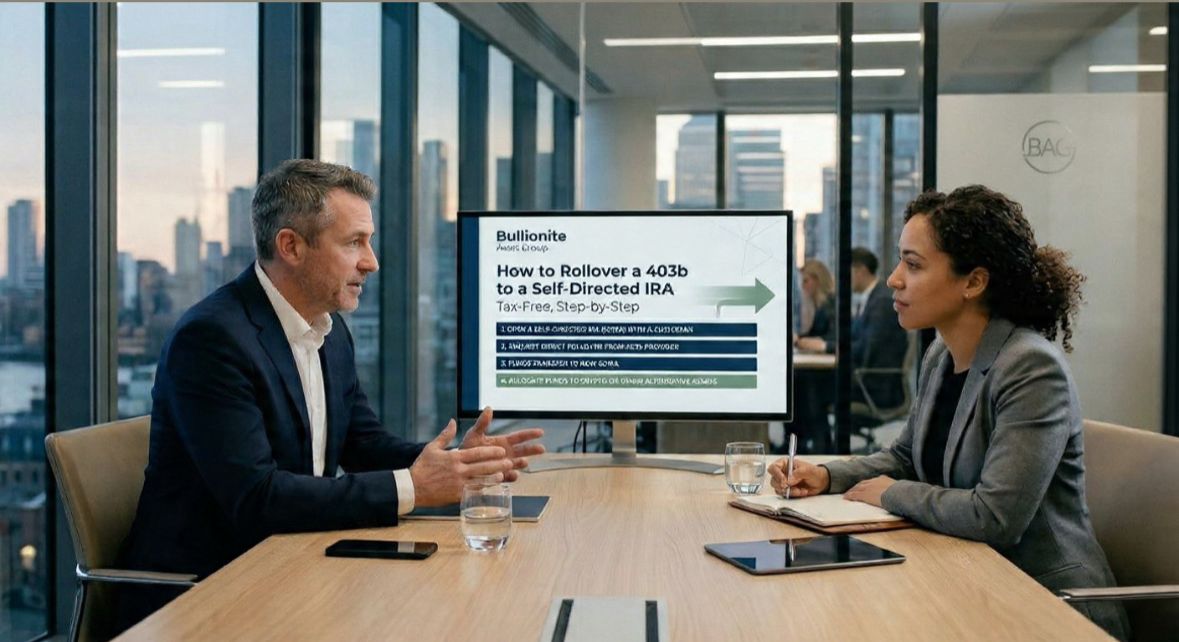
How to Rollover a 403b to a Self-Directed IRA (Tax-Free, Step by Step)
TL;DR
Yes, you can roll over a 403b to a self-directed IRA without taxes or penalties, as long as you use a direct rollover. The process takes 7 to 21 business days. You choose a specialized SDIRA custodian, open the right account type, then instruct your 403b plan administrator to wire or mail funds directly to that custodian. Once the money lands, you can invest in real estate, precious metals, private notes, cryptocurrency, and dozens of alternative asset classes not available in a standard 403b. The one rule that trips most people up: never take the funds personally if you can avoid it. The 20% withholding trap on indirect rollovers has cost investors thousands. Teachers using TIAA face an extra hurdle with annuity contract restrictions. This guide covers every step, every fee, every mistake, and everything you can invest in once your 403b lands in a self-directed IRA.
Can You Roll a 403b into a Self-Directed IRA?
The short answer is yes. A 403b is a qualified retirement plan under IRC Section 403(b), and the IRS allows it to roll directly into a Traditional Self-Directed IRA without triggering a taxable event. The rollover is explicitly permitted in IRS Publication 590-A and confirmed by the IRS Rollover Compatibility Chart.
The key is matching account types. A pre-tax 403b becomes a Traditional SDIRA. A Roth 403b rolls into a Roth SDIRA. You cannot roll pre-tax 403b funds into a Roth SDIRA without paying conversion taxes on the amount transferred. That distinction matters because the wrong match creates a taxable event and potentially a 6% annual excise tax on excess contributions, an expensive mistake documented repeatedly in investor forums.
Here is a quick eligibility table based on IRS rollover rules:
| Your 403b Type | Eligible SDIRA Account | Tax Due at Rollover? | Can Roll While Employed? |
| Pre-tax (Traditional) 403b | Traditional Self-Directed IRA | No (if direct rollover) | Usually No (see below) |
| Roth 403b | Roth Self-Directed IRA | No (if direct rollover) | Usually No |
| Pre-tax 403b | Roth SDIRA (conversion) | Yes — ordinary income tax on converted amount | Usually No |
| 403b after leaving employer | Traditional or Roth SDIRA | No (direct rollover) | Yes — you left employment |
| In-service 403b (age 59.5+) | Traditional SDIRA | No (if direct rollover) | Yes — age 59.5 rule applies |
IRS Source: The IRS rollover compatibility rules are published at IRS.gov/pub/irs-tege/rollover_chart.pdf. Always confirm current rules before initiating a rollover.
Direct Rollover vs Indirect Rollover from a 403b: Which Should You Use?
There are two ways to move your 403b into a self-directed IRA. One of them has a trap that has cost investors real money. You need to know the difference before you make a single phone call to your plan administrator.
Direct Rollover (Trustee-to-Trustee Transfer)
Your 403b plan administrator sends the funds directly to your new SDIRA custodian. You never touch the money. There is no withholding, no 60-day deadline, and no limit on how many direct rollovers you can do in a year. This is the method you should almost always use.
The funds arrive either as a wire transfer to your custodian or as a check made payable to “[Custodian Name] FBO [Your Name] IRA.” That FBO designation is critical. It tells the IRS the money went from one retirement account to another, not to you personally.
Indirect Rollover (The 20% Withholding Trap)
With an indirect rollover, your 403b plan administrator cuts a check payable to you. Federal law requires them to withhold 20% of the distribution for taxes. You then have exactly 60 days to deposit the full original amount into your new SDIRA, including the 20% that was withheld.
Example: You have $120,000 in your 403b. The plan sends you a check for $96,000 after withholding $24,000. To avoid taxes and penalties, you need to deposit the full $120,000 into your SDIRA within 60 days. That means you need to come up with $24,000 from your own pocket to make up the withheld amount. The $24,000 withheld gets reconciled when you file your tax return, but in the meantime, you are funding the gap yourself.
Miss that 60-day deadline and the entire distribution becomes taxable income. If you are under age 59.5, add a 10% early withdrawal penalty on top of that. On $120,000, that is a potential tax hit of $36,000 or more.
Bottom line: Use a direct rollover every time. There is no scenario in which an indirect rollover is the better choice for a 403b-to-SDIRA transfer.
How to Rollover a 403b to a Self-Directed IRA: The Step-by-Step Process
Step 1: Choose a Self-Directed IRA Custodian
Not every IRA custodian handles alternative assets. Many mainstream brokerages do not offer self-directed IRAs for real estate, private equity, or precious metals. You need a specialized SDIRA custodian, a type of trust company that accepts and administers alternative investments and is familiar with the IRS compliance requirements that come with them.
When evaluating custodians, ask these specific questions:
- Do you accept 403b direct rollovers?
- What is your annual fee structure (flat fee vs asset-based)?
- How long does your processing window take for real estate purchases?
- Do you offer checkbook control IRA/LLC structure?
- What is your transaction fee per investment?
When comparing custodians, focus on five things: whether they explicitly support the investment type you have in mind (real estate, metals, private lending); their annual fee structure (flat-fee custodians tend to be more cost-efficient for larger balances than asset-based models); how fast they process investment direction forms; whether they support checkbook control LLC structures; and the quality of their compliance team. Call at least two custodians before opening an account. Ask specifically whether they have processed 403b rollovers before and how long funding typically takes after the rollover check arrives.
Step 2: Open the Right Account Type
Once you choose a custodian, you open a Traditional SDIRA to receive a pre-tax 403b rollover. The application takes 5 to 10 business days and requires a government-issued ID, Social Security number, and your beneficiary designation. Most custodians offer online onboarding.
Crucially: open the account before contacting your 403b administrator. You need the account number and custodian delivery instructions in hand before you initiate anything.
Step 3: Initiate the Rollover with Your 403b Plan Administrator
Contact your 403b plan administrator, not your new custodian, to start the process. This distinction confuses a lot of people. The rollover must be initiated from the sending side.
You will need to provide:
- Your new SDIRA account number
- Your SDIRA custodian’s name, address, and wiring instructions
- The rollover amount (full balance or partial)
- Confirmation that this is a direct rollover, not a distribution
- Spousal waiver if required by your plan (common in ERISA-governed 403b plans)
Your plan administrator submits the paperwork and either wires funds directly to your custodian or mails a check. The check will read “[Custodian Name] FBO [Your Name] IRA.” If the check is payable to you personally, stop. Do not deposit it to your bank account. Contact your plan administrator immediately and request they issue a new check correctly.
Step 4: Confirm Receipt and Begin Investing
Once funds land in your SDIRA, your custodian posts the balance to your account. At this stage, the money is in cash and earns nothing until you direct it into an investment. Submit your first investment direction form to the custodian. For real estate, this is a Buy Direction Letter. For precious metals, it is a Purchase Direction Letter.
403b Rollover Timeline: How Long Does It Actually Take?
One of the most common questions we see from 403b holders is how long they will be out of the market during a rollover. The honest answer: it depends on your 403b custodian and payment method.
| Rollover Method | Typical Timeline | Market Exposure Risk |
| Direct wire transfer (modern custodian) | 7-10 business days | Low |
| Direct rollover by mailed check | 10-21 business days | Medium |
| TIAA Traditional annuity (standard) | Up to 84 months (7 years) | High — phased payout |
| TIAA Traditional (exit fee option) | 120 days with 2.5% fee | Low with cost |
| Indirect rollover window | Up to 60 days from receipt | High — must self-manage |
The Bogleheads community has documented cases where investors with millions held at custodians like Ascensus were forced to liquidate positions and wait for paper checks. With a large balance, breaking the rollover into phases, moving the most volatile positions first while keeping others invested, is a sound risk-management strategy.
Teachers and Nonprofit Employees: The TIAA Annuity Lockup Nobody Warns You About
If your 403b is held at TIAA and includes the TIAA Traditional Annuity, you need to read this section before you do anything else.
The TIAA Traditional Annuity is designed for long-term accumulation, and its payout structure reflects that. By default, TIAA distributes Traditional Annuity balances over 84 months, roughly 7 years, in equal installments. If you want to move that money to a self-directed IRA on your own schedule, you have two options:
- Wait out the 84-month payout. Each monthly payment counts as a direct rollover and can be deposited into your SDIRA with no taxes or penalties. This is the most tax-efficient option if your balance is large.
- Pay a 2.5% surrender fee to take the full balance within 120 days of separating from your employer. On $200,000, that is a $5,000 fee, but it ends the lockup immediately.
TIAA’s equity funds (like CREF Stock Account) have no such restriction. Only the TIAA Traditional Annuity balance is subject to the 84-month rule. Many teachers do not realize this distinction until they are mid-rollover and discover half their balance is locked.
“The most common misunderstanding I see with 403b rollovers from nonprofit and school district employees is around TIAA Traditional. People assume a 403b rollover is simple and fast, then discover their largest holding takes years to move. The 120-day option with the 2.5% fee exists for exactly this reason, and for many people, it is worth it to get clean control of their retirement funds.” — Adam Bergman, Tax Attorney, Self-Directed IRA Specialist
Can You Rollover a 403b to a Self-Directed IRA While Still Employed?
Generally, no. Most employer-sponsored 403b plans prohibit in-service rollovers to outside IRAs unless you have reached a specific age or a triggering event applies.
The exceptions that may allow an in-service 403b rollover include:
- You have reached age 59.5, at which point most plans allow in-service distributions
- Your plan includes a specific in-service rollover provision (check your Summary Plan Description)
- Your employer has terminated the 403b plan and is winding it down
- You have experienced a qualifying hardship distribution under your plan rules
For public school employees, government workers, and church employees, check the specific language in your plan document. Government-sponsored 403b plans follow different rules than private nonprofit 403b plans. A church plan, for example, may not be subject to ERISA at all, which changes some of the creditor-protection considerations when moving to an IRA.
Key distinction: Once you separate from your employer, through retirement, resignation, or termination, the rollover eligibility is clear. You can roll the entire 403b balance into a self-directed IRA as a direct rollover with no restrictions.
Rolling a 403b Into a Roth Self-Directed IRA: When the Conversion Math Works
Rolling a traditional pre-tax 403b directly into a Roth SDIRA is a Roth conversion. You pay ordinary income taxes on the converted amount in the year of conversion. Whether this makes sense depends entirely on your current tax bracket versus your expected tax bracket in retirement.
The math gets interesting in two scenarios. First, if you are in a temporarily low-income year, such as the gap between leaving employment and starting a new job, or in early retirement before Social Security kicks in, you might convert a chunk at a lower rate than you would face later. Second, if you expect tax rates to rise meaningfully by the time you take distributions, converting now locks in today’s rate.
A 403b-to-Roth SDIRA conversion used for real estate is particularly powerful. Every dollar of rental income and every dollar of appreciation in a Roth SDIRA grows completely tax-free. When you eventually sell that property inside the Roth IRA after age 59.5, you owe zero federal taxes on the gain. Compare that to the same property in a Traditional SDIRA where distributions are taxed as ordinary income at whatever rate applies when you withdraw.
Illustration: Convert $150,000 from a 403b to a Roth SDIRA at age 52 while in the 22% tax bracket. Tax cost: $33,000. Invest those funds into an income-producing alternative asset. If the investment grows to $490,000 over 15 years through income and appreciation, you owe zero federal taxes on the entire amount when you withdraw after age 59.5. The same outcome in a Traditional SDIRA would face ordinary income tax on every withdrawal, potentially $100,000 or more at a 25% marginal rate in retirement. The conversion cost of $33,000 bought you over $100,000 in future tax savings.
403b Rollover Mistakes That Trigger IRS Penalties
Moving your 403b to a self-directed IRA opens up investment options that a standard 403b never offered. It also opens you up to prohibited transaction rules under IRC Section 4975 that do not apply when your money sits in a mutual fund. These are the mistakes that cost investors the most.
Mistake 1: Rolling Roth Funds Into a Traditional IRA
If you have a Roth 403b and roll it into a Traditional IRA instead of a Roth IRA, you have created an excess contribution in the Traditional IRA. The Roth distribution must be reported as taxable income, and the excess contribution carries a 6% annual excise tax for every year it remains in the wrong account. This has happened to real investors, documented in detail in IRS forums and the Bogleheads community.
Mistake 2: Doing an Indirect Rollover When You Already Used One That Year
The IRS limits indirect (60-day) rollovers to one per 12-month period across all your IRAs combined, not per account. This rule comes from the 2014 Tax Court decision in Bobrow v. Commissioner, which clarified that the one-rollover-per-year rule applies in aggregate. Violate it and the second rollover is a taxable distribution plus the 10% early withdrawal penalty if you are under 59.5.
Mistake 3: Prohibited Transactions After the Rollover
Once your 403b money is in an SDIRA and invested in, say, a rental property, the IRS rules become your primary operating constraint. You cannot personally use the property (no vacation stays). You cannot hire family members as contractors or property managers at below-market rates. You cannot use your own labor to renovate the property. Any of these actions constitutes a prohibited transaction under IRC Section 4975. The penalty is full disqualification of the IRA, triggering taxes on the entire account value in that year.
IRS Resource: Review the full list of prohibited transactions and disqualified persons at IRS.gov/retirement-plans/prohibited-transactions before making any SDIRA investment.
“The most important thing for investors to understand about self-directed IRAs is that the flexibility comes with compliance responsibility. Every investment decision needs to pass a prohibited transaction analysis. When in doubt, get a written opinion from a qualified retirement plan attorney before proceeding.” — Mat Sorensen, Attorney, Self-Directed IRA Author and Specialist
Mistake 4: Missing Form 5498 / 1099-R Reporting
Your 403b plan administrator will issue a Form 1099-R showing the distribution. Your SDIRA custodian reports the rollover receipt on Form 5498, which does not arrive until late May, after most people have already filed their tax return. If you fail to note on your return that the distribution was rolled over within 60 days, the IRS may issue a deficiency notice claiming you owe tax on the full amount. Always report the rollover explicitly on Form 1040, even when no tax is due.
What to Invest in After Your 403b Rolls Into a Self-Directed IRA
This is the question most articles skip. The rollover is a means to an end. What you actually do with the money inside the SDIRA determines whether all this effort is worth it.
Self-Directed IRA Real Estate Investing
Real estate is the most popular SDIRA investment and the one most likely to deliver meaningful long-term tax advantages. Rental income flows back to your IRA tax-deferred. Appreciation compounds inside the account. When you sell, the gain stays in the IRA rather than triggering a capital gains event.
The key restrictions: the property must be a purely investment asset. No personal use. All expenses are paid from the IRA. All income returns to the IRA. Title is held in the custodian’s name FBO your IRA. The custodian does not manage the property, you direct a property manager to handle operations on behalf of the IRA.
Non-recourse financing is available for SDIRA real estate, meaning you can leverage a purchase beyond your IRA balance. However, the leveraged portion of any income is subject to Unrelated Business Income Tax (UBIT) under IRC Section 514. UBIT applies only to the debt-financed portion, not the full rental income. For most investors, the math still favors leveraged IRA real estate as long as the debt ratio stays below roughly 50%.
Precious Metals IRA After a 403b Rollover
Physical gold, silver, platinum, and palladium can be held in an SDIRA as long as they meet IRS purity standards: .995 for gold, .999 for silver, .9995 for palladium and platinum. Coins must be IRS-approved (American Gold Eagle, Canadian Maple Leaf, etc.). The metals must be stored at an IRS-approved depository, not in your home safe.
A gold and silver IRA after a 403b rollover gives you exposure to precious metals’ historically inverse relationship with the dollar and equity markets, providing portfolio diversification that a standard 403b mutual fund lineup never could.
Checkbook IRA After 403b Rollover: Maximum Investment Control
For investors who want to move quickly on deals without waiting for custodian approval on each transaction, the checkbook control IRA is the logical next step after a 403b rollover. In this structure, your SDIRA owns an LLC, the LLC holds a dedicated bank account, and you act as manager of that LLC.
You can write checks directly from the LLC bank account to close on real estate deals, make private loans, or invest in startups without submitting a direction form to the custodian for each transaction. Setup typically costs $1,500 to $2,500 for the LLC formation and operating agreement, plus custodian fees. The compliance requirements are stricter, so working with an SDIRA attorney during setup is strongly recommended.
“Checkbook IRA structures offer real speed advantages for real estate investors who need to close quickly. But they also carry greater compliance risk. The manager of the LLC must be disciplined about keeping personal funds completely separate from IRA funds and must understand the prohibited transaction rules cold.” — Jennifer Calloway, JD, Retirement Plan Compliance Attorney
Other Alternative Investments via SDIRA
Beyond real estate and metals, an SDIRA can hold: private equity and venture capital, promissory notes and private lending, tax liens and tax deeds, hard money loans, cryptocurrency, private company stock, oil and gas interests, and foreign real estate. The IRS prohibits only a short list: life insurance, collectibles (art, wine, coins that do not meet IRS standards), S corporation stock, and certain derivative structures.
The BullioniteAssetGroup 403b-to-SDIRA Readiness Score
Before you initiate a rollover, run through these five questions. Each question is worth 20 points. A score of 80 to 100 means you are ready to proceed. A score of 60 to 79 means you have one or two items to address first. Below 60 means you need more planning before moving forward.
| Question | Yes = Points | No / Partial = Points |
| Have you separated from the employer sponsoring the 403b? | 20 pts | 0 pts (check in-service rules) |
| Is your 403b balance $50,000 or more? | 20 pts | $25k-$49k = 10 pts |
| Do you have a specific alternative investment in mind? | 20 pts | Researching = 10 pts |
| Are your near-term finances stable without this money? | 20 pts | 0 pts (keep in 403b) |
| Have you consulted a CPA about Roth conversion vs Traditional rollover? | 20 pts | Scheduled = 10 pts |
This is the BullioniteAssetGroup SDIRA Readiness Score, a framework we use in initial consultations to make sure clients are in the right position before a rollover. Many investors rush the process only to discover they needed to address one of these factors first.
Solo 401k vs Self-Directed IRA After a 403b Rollover: Which Is Right for You?
If you are self-employed or have earned income from a side business after leaving your nonprofit or school employer, a Solo 401k is worth comparing to an SDIRA before you commit to a custodian.
| Feature | Traditional SDIRA | Self-Directed Solo 401k |
| 2026 Contribution Limit (under 50) | $7,000/year | $70,000 total (employee + employer) |
| Checkbook Control | Via LLC structure | Built-in (no LLC needed) |
| UBIT on Leveraged Real Estate | Yes (applies) | Exempt (key advantage) |
| Participant Loans | Not allowed | Up to $50,000 or 50% of balance |
| Roth Option | Yes (Roth SDIRA) | Yes (Roth Solo 401k) |
| Eligible for 403b Rollover | Yes | Yes (if self-employed) |
| Backdoor Roth Impact | Creates pro-rata issue | No impact (keeps IRA clean) |
The UBIT exemption for Solo 401k plans is a major difference. When your Solo 401k uses a non-recourse loan to buy real estate, the rental income is not subject to UBIT. The same property inside a Traditional SDIRA would trigger UBIT on the debt-financed portion. For investors who plan to use leverage heavily in real estate, the Solo 401k frequently wins the tax comparison.
Key Takeaways
- A 403b can roll directly into a Traditional Self-Directed IRA tax-free using a direct rollover. Pre-tax 403b funds go to a Traditional SDIRA. Roth 403b funds go to a Roth SDIRA.
- Always use a direct rollover (trustee-to-trustee). The 20% withholding on indirect rollovers creates a cash-flow problem most investors do not anticipate until it is too late.
- Teachers and nonprofit employees with TIAA Traditional Annuity balances face an 84-month payout restriction. Either plan around it or pay a 2.5% exit fee for immediate access.
- You typically cannot roll a 403b while still employed unless you are age 59.5 or your plan includes a specific in-service provision.
- After the rollover, you can invest in real estate, precious metals, private lending, cryptocurrency, and dozens of alternative assets unavailable in a standard 403b.
- The checkbook IRA structure (SDIRA-owned LLC) gives you direct investment control without per-transaction custodian approval, useful for real estate investors who need to close quickly.
- The Solo 401k is a meaningful alternative to an SDIRA for self-employed investors, offering higher contribution limits, built-in checkbook control, and UBIT exemption on leveraged real estate.
- Run the BullioniteAssetGroup SDIRA Readiness Score before initiating a rollover. Rushing the process without addressing tax planning, investment selection, or employment status creates avoidable problems.
Disclosure: This article is for educational purposes only and does not constitute tax, legal, or investment advice. BullioniteAssetGroup is a self-directed IRA consulting firm. Readers should consult a qualified CPA, tax attorney, or financial advisor before making retirement investment decisions. Non-compliance with IRS rules can result in full IRA disqualification and significant penalties.
Published: March 2026 | Next Review: August 2026
Primary Sources & Further Reading
IRS Publications & Official Resources:
IRS Publication 590-A: Contributions to Individual Retirement Arrangements
IRS Rollover Compatibility Chart (PDF)
IRS: 403(b) Tax-Sheltered Annuity Plans
IRS: Exceptions to Tax on Early Distributions
IRS: Prohibited Transactions in Self-Directed IRAs
IRS Form 5498: IRA Contribution Information
FINRA: Self-Directed IRAs – Investor Insights
DOL/EBSA: Understanding Your Retirement Plan Rights and Protections
FAQ's
Will I pay taxes on a 403b rollover to a self-directed IRA?
No, not if you use a direct rollover and match the account types correctly. A pre-tax 403b rolling into a Traditional SDIRA is tax-free. The IRS treats it as a continuation of tax-deferred savings, not a distribution. The only scenario where taxes apply is if you are converting to a Roth SDIRA, which triggers ordinary income tax on the converted amount. The rollover itself is reported on Form 1099-R with a distribution code indicating a direct rollover, and there is no tax due.
How long does a 403b rollover to a self-directed IRA take?
A standard direct rollover from a 403b to an SDIRA takes 7 to 21 business days from when the plan administrator processes your request. The timeline depends on whether your custodian receives a wire transfer or a mailed check, and on how quickly your 403b plan administrator processes outgoing rollovers. TIAA Traditional Annuity balances are the major exception, with payouts spread over 84 months unless you pay a 2.5% exit fee for a 120-day lump-sum exit. During the transit window, your funds are temporarily out of the market, which is why some investors break large rollovers into phases.
Can I rollover my 403b to a self-directed IRA while I am still working?
In most cases, no. Employer-sponsored 403b plans restrict rollovers to qualifying events: separation from service, retirement, reaching age 59.5, plan termination, or certain hardship provisions. If you are still employed and under 59.5, check your Summary Plan Description for any in-service withdrawal provision. Some plans allow it under specific conditions. Government 457b plans have different rules from 403b plans. Church plans may be exempt from ERISA entirely and follow their own guidelines. When in doubt, contact your HR benefits administrator and ask specifically whether in-service distributions to an IRA are allowed.
What can I invest in after rolling my 403b into a self-directed IRA?
Essentially any asset class the IRS does not explicitly prohibit. That list includes real estate (single-family, multifamily, commercial, raw land), precious metals (gold, silver, platinum, palladium meeting IRS purity standards), private equity, venture capital, promissory notes, private lending, tax liens, hard money loans, cryptocurrency, oil and gas, foreign real estate, and private company stock. The IRS prohibits life insurance, collectibles, S corporation stock, and certain derivative instruments. Everything else is permissible as long as it does not involve a prohibited transaction with a disqualified person.
What is the 20% withholding trap and how do I avoid it?
If you take an indirect rollover from your 403b, meaning the funds are paid to you personally rather than directly to your new custodian, your plan administrator is legally required to withhold 20% for federal taxes. You then have 60 days to deposit the full original amount, including the withheld 20%, into your new SDIRA. If you only deposit the net amount you received, the withheld 20% is treated as a distribution, triggering income tax plus a 10% early withdrawal penalty if you are under age 59.5. You avoid this entirely by using a direct rollover. Request that your 403b plan administrator send funds directly to your SDIRA custodian. There is no withholding requirement on a direct rollover.
I have a TIAA 403b. How does the rollover to a self-directed IRA work?
TIAA 403b accounts often contain two distinct components: CREF equity funds (which have no rollover restrictions) and TIAA Traditional Annuity (which has a surrender restriction). CREF equity funds can be rolled over immediately as a direct rollover with no fees and no lockup period. TIAA Traditional Annuity has two options: a phased payout over 84 months (7 years), with each installment treated as a direct rollover to your SDIRA, or an immediate full payout within 120 days of employment termination by paying a 2.5% surrender charge. For a $100,000 TIAA Traditional balance, the immediate exit costs $2,500. Many investors accept the 84-month payout for large balances and use the CREF funds to start investing in their SDIRA immediately.
Will rolling my 403b to a traditional IRA affect my ability to do a backdoor Roth IRA?
Yes, it can. The backdoor Roth IRA strategy relies on the fact that you have no pre-tax IRA balances. If you roll your 403b into a Traditional SDIRA, those pre-tax dollars create an IRA balance subject to the pro-rata rule. This means your non-deductible IRA contributions cannot be cleanly converted to Roth without proportionally including the pre-tax balance in the taxable calculation. If backdoor Roth contributions are part of your tax strategy, consider rolling your 403b into a new employer’s 401k or Solo 401k instead, which would keep your IRA clean. Alternatively, accept that backdoor Roth conversions will have a pro-rata tax component until you have exhausted your pre-tax IRA balance.
What are the risks of investing my 403b rollover in real estate through an SDIRA?
SDIRA real estate investing carries three types of risk that standard 403b mutual fund investing does not. First, liquidity risk: you cannot easily access the money if you need it quickly. A property takes time to sell. Second, prohibited transaction risk: if you or any disqualified person interacts with the property outside strict IRS rules, the entire IRA can be disqualified, triggering taxes on the full balance. Third, leverage risk: if you use a non-recourse loan to partially fund a purchase, the UBIT rules reduce the effective return. These risks are manageable with proper planning, a good custodian, a property manager, and an SDIRA attorney reviewing your transaction structure before you close. They are real risks, though. Investors who enter SDIRA real estate without understanding the prohibited transaction rules are in genuine danger of a costly compliance failure.

As the Founder and Chief Investment Officer of Bullionite and Bullionite Asset Group, I’ve built my career on a simple premise understanding the intersection of macroeconomics, commodities, and digital assets to stay ahead of the curve, not under it. My focus is on navigating the complexities of the world’s largest markets spanning the US, the Middle East, and Asia to identify high-value opportunities for alternative investment.
With a specialized focus on Self-Directed IRAs (SDIRAs), I help investors move beyond traditional 401ks by integrating assets like precious metals and cryptocurrency into their retirement strategies. Based in Newport Beach, California, I am dedicated to bridging the gap between traditional finance and the evolving landscape of new age digital assets, ensuring that every strategic move is backed by deep market insight and a commitment to long-term growth.