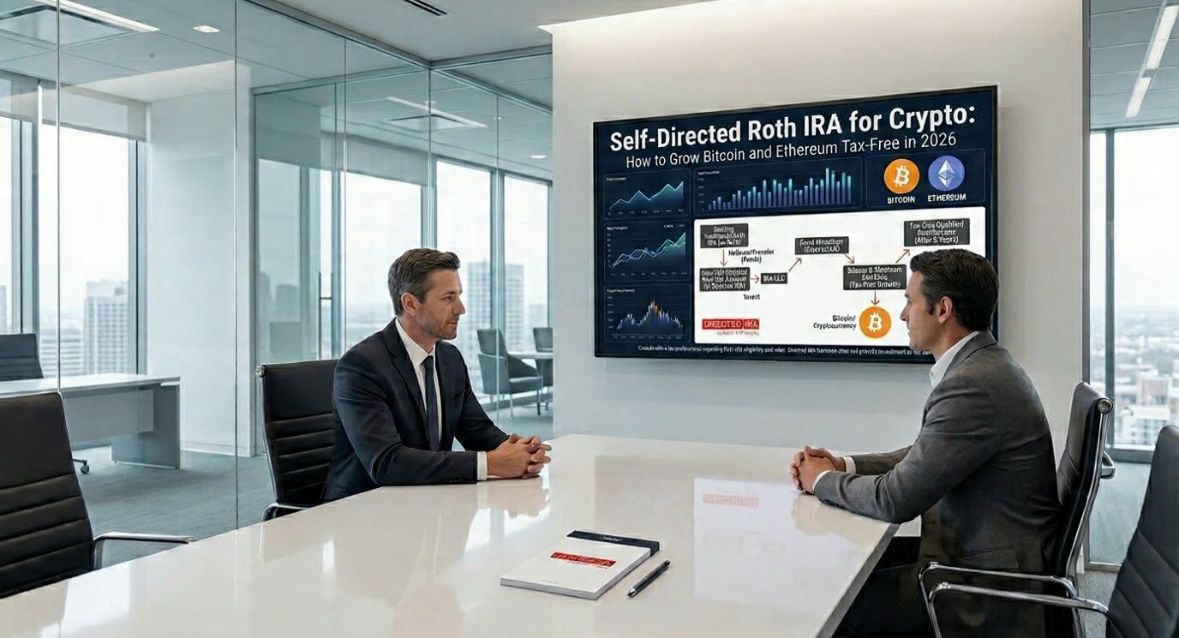
Self-Directed Roth IRA for Crypto: How to Grow Bitcoin and Ethereum Tax-Free in 2026
TL;DR
A self-directed Roth IRA for crypto works like a standard Roth IRA but uses a specialized custodian that permits digital assets. You fund it with cash (after-tax), buy crypto through the custodian’s approved exchange, and all growth is tax-free on qualified withdrawal. The IRS treats cryptocurrency as property under Notice 2014-21, making it eligible for IRA ownership. The two biggest setup decisions are picking a custodian with flat fees rather than percentage-based fees, and understanding exactly which transactions will disqualify your account entirely. This guide covers both in complete detail, along with the step-by-step rollover process, staking rules, and 2026 contribution limits straight from the IRS.
What Is a Self-Directed Roth IRA for Crypto, Exactly?
Most Roth IRAs at traditional brokerages cap you at stocks, bonds, ETFs, and mutual funds. A self-directed Roth IRA changes that. The ‘self-directed’ part means your custodian permits alternative assets, including digital currencies, real estate, private equity, and precious metals.
The IRS does not prohibit cryptocurrency in IRAs. IRS Notice 2014-21 confirmed that virtual currency is treated as property for tax purposes. Because IRAs can hold property, Bitcoin and Ethereum are fully permitted assets. The only digital assets that create issues are NFTs the IRS classifies as collectibles under IRC §408(m). Most mainstream cryptocurrencies don’t fall into that category.
There’s one critical structural difference from a standard Roth: you can’t hold the private keys yourself. Your IRA, not you personally, must be the legal owner of the crypto. A qualified custodian holds the assets on behalf of your account. Some custodians use exchange-based custody where your IRA holds a trading account. Others use institutional cold storage. Either way, the assets must be titled in the custodian’s name ‘for the benefit of’ your IRA.
This matters for compliance. The McNulty v. Commissioner case (2021) reinforced that IRA owners cannot take physical possession of IRA assets without triggering a taxable distribution. For crypto, that means no moving coins to a personal hardware wallet, even temporarily.
How Much Does a Self-Directed Roth IRA for Crypto Actually Save You?
The math on this deserves specific numbers, because ‘tax-free’ sounds abstract until you see what it means over a real investment horizon.
Say you’re 38 years old. You roll $60,000 from an old employer 401k into a self-directed Roth IRA, paying the conversion taxes in cash from a separate account. You allocate 70% to Bitcoin ($42,000) and 30% to Ethereum ($18,000). Using a very conservative 15% average annual return over 27 years, that $60,000 grows to approximately $1.87 million by age 65.
In a taxable brokerage account, every rebalancing trade triggers capital gains. Long-term capital gains at the 20% federal rate would cost you $374,000 on the final balance alone, not counting the drag of annual tax payments along the way. In a Roth IRA: zero. That’s not an estimate. That’s the tax code.
Now consider active crypto traders. If you’re rotating between BTC and ETH quarterly in a taxable account, every swap is a taxable event even if no cash leaves the account. The IRS confirmed this in Revenue Ruling 2023-14. Inside a Roth SDIRA, you can swap between any IRS-compliant assets as many times as you want with no tax consequence whatsoever.
“The single biggest tax planning opportunity for crypto investors today is not choosing the right coin. It is choosing the right account structure before the gains happen.” — Adam Bergman, JD, Founder of IRA Financial and author of nine books on self-directed retirement accounts.
Beyond pure appreciation, consider staking rewards. A proof-of-stake asset generating 4-6% annual yield on a $500,000 Roth IRA position produces $20,000-$30,000 per year in rewards, all flowing back into the account tax-free. In a taxable account, those rewards are taxed as ordinary income in the year received under Rev. Rul. 2023-14.
Self-Directed Roth IRA vs Bitcoin ETF in a Roth IRA: Which Is Better?
This is the question most competitors don’t answer clearly. In 2026, you can now hold Bitcoin ETFs from Fidelity, BlackRock, and others inside a standard Roth IRA. So why bother with an SDIRA?
Here’s the honest comparison:
| Factor | Bitcoin ETF (Regular Roth) | Self-Directed Roth IRA (SDIRA) | |||
| Asset ownership | ETF shares, not actual BTC | Direct cryptocurrency ownership | |||
| Coins available | BTC, ETH, LTC (limited) | 45-250+ coins depending on custodian | |||
| Annual fees | ETF expense ratio 0.12-0.25% | Flat $100-$595/yr + trading fee | |||
| Staking rewards | Not available | Yes, through custodian infrastructure | |||
| Setup complexity | Same as any Roth IRA | Specialized custodian, 1-2 weeks | |||
| Account setup | Any brokerage | Specialized SDIRA custodian |
The Bitcoin ETF inside a regular Roth is perfectly valid if you want BTC and ETH exposure with zero setup friction. The SDIRA wins when you want direct ownership of altcoins, staking rewards, DeFi exposure, or when you’re rolling over an old 401k and want to choose your own custodian and asset mix.
One often-missed point: Bitcoin ETFs charge annual expense ratios on your entire balance every year. On a $500,000 holding, even 0.25% is $1,250 annually. An SDIRA with a flat $150 custodian fee and 1% per trade only costs you on trades you actually execute.
How to Open a Self-Directed Roth IRA for Crypto: Step-by-Step in 2026
The process is simpler than most people expect. Plan for two to four weeks from decision to first trade.
Step 1: Choose a Crypto-Compatible SDIRA Custodian
Not every SDIRA custodian supports digital assets. You need one that explicitly lists cryptocurrency as a permitted investment and has a working relationship with a regulated exchange. Key factors to compare: annual flat fee vs percentage-based fee structure, the exchange they use, which coins they support, whether they permit staking, and customer support responsiveness.
Avoid custodians that charge percentage-based asset valuation fees. If your IRA grows from $50,000 to $500,000, a 0.5% annual fee grows from $250 to $2,500 per year without a single additional trade.
Step 2: Open and Fund the Account
You fund a self-directed Roth IRA in three ways:
- Direct contribution: Up to $7,500 per year in 2026 ($8,600 if age 50 or older) per the IRS. Roth income limits apply: phase-out begins at $153,000 MAGI for single filers and $242,000 for married filing jointly in 2026.
- Traditional-to-Roth conversion (Backdoor Roth): Roll over a traditional IRA or pre-tax 401k into a Roth SDIRA. You owe income tax on the converted amount in the year of conversion, but all future growth is permanently tax-free. This strategy has no income limit, making it the primary path for high earners who exceed direct Roth contribution thresholds.
- Roth-to-Roth transfer: Move an existing Roth IRA from another custodian to your new crypto SDIRA. No taxes owed. The five-year holding clock does not restart on contributions already made. Custodian-to-custodian transfers are not subject to the one-rollover-per-12-months rule.
Step 3: Submit a Direction of Investment (DOI) Form
Once funded, you don’t log into an exchange and buy directly. You submit a Direction of Investment form to your custodian specifying the asset, amount, and exchange. Processing takes 2-5 business days. Your custodian executes the trade and holds the asset in your IRA’s account, not yours personally.
Step 4: Manage and Report
Your custodian files Form 5498 annually to report IRA holdings and contributions. You receive Form 1099-R for any distributions. Under the IRS’s new 1099-DA reporting requirements (effective 2025), crypto exchanges report digital asset transactions to the IRS. Trades within an IRA are not taxable events, but your custodian’s annual fair market value report is what the IRS uses for your account records.
Which Cryptocurrencies Can You Hold in a Self-Directed Roth IRA?
Short answer: most of them. The IRS has not issued a comprehensive approved-coins list. The exclusion categories under IRC §408(m) for collectibles cover artwork, stamps, antiques, gems, and certain coins. The IRS has not classified Bitcoin, Ethereum, XRP, Solana, Litecoin, Cardano, or most mainstream altcoins as collectibles.
What’s definitively off-limits in any IRA:
- Life insurance policies
- S-corporation stock
- Alcoholic beverages as investments
- NFTs the IRS classifies as collectibles (those with no utility value)
What’s a gray area:
- NFTs with governance utility — the IRS has not finalized guidance
- Certain crypto-adjacent structured products — confirm with your custodian’s compliance team
Most custodians maintain approved coin lists. The asset availability varies by platform. If a specific coin matters to your strategy, confirm it’s listed before you open the account.
Prohibited Transactions That Will Disqualify Your Crypto Roth IRA
This section matters more than any other in this guide. A single prohibited transaction doesn’t just trigger a penalty. Under IRC §4975, the entire IRA is treated as distributed as of January 1 of the year the violation occurred. You owe income tax on the full balance at ordinary income rates, plus a 10% early withdrawal penalty if you’re under 59½.
These are the violations that end up costing people hundreds of thousands of dollars:
1. Buying crypto from yourself: You cannot sell cryptocurrency you personally own into your IRA, even at fair market value. The IRA must buy from unrelated third parties through approved exchanges.
2. Using IRA crypto for personal benefit: You cannot use Bitcoin held in your IRA to pay personal expenses, collateralize personal loans, or transfer to yourself temporarily.
3. Transactions with disqualified persons: You, your spouse, your parents, your children, and entities you control more than 50% are all disqualified persons under IRC §4975(e)(2). Your IRA cannot buy from or sell to any of them.
4. Self-dealing in checkbook IRA structures: If you use an IRA LLC (checkbook structure), you cannot pay yourself management fees, cannot lend from the LLC to family, and cannot use the LLC account for any personal transaction.
5. Commingling IRA and personal funds: Personal funds can never enter the IRA’s exchange account or LLC bank account. Even ‘temporarily’ moving money in and out counts as a prohibited transaction.
“The most common mistake we see is not intentional fraud. It is someone using IRA funds to cover a small maintenance cost for an IRA-owned asset, or wiring from the wrong account by mistake. The tax code treats that exactly like intentional self-dealing.” — Mat Sorensen, JD, CEO of Directed IRA and author of The Self-Directed IRA Handbook.
The IRS’s guidance on prohibited transactions is covered in detail in IRS Publication 590-A, which explicitly defines disqualified persons and the full consequences of a prohibited transaction. Read it before you make your first trade.
Can You Stake Crypto Inside a Self-Directed Roth IRA?
Staking is one of the most misunderstood topics in crypto IRAs, and the answer depends entirely on how the staking is structured.
Custodian-facilitated staking: Generally permitted. If your custodian’s platform supports proof-of-stake validation rewards and those rewards flow directly back into your IRA account, you’re likely compliant. The IRS treats staking rewards as income when received (Rev. Rul. 2023-14), but inside a Roth IRA that income is tax-free.
Personal DeFi staking: Almost certainly a prohibited transaction. If you’re personally signing transactions and directing staking activity using IRA assets, you’re providing a service to the IRA for which you’d be considered a fiduciary. That triggers the prohibited transaction rules.
What’s definitely off-limits inside any IRA:
- Margin trading
- Leveraged trading
- Crypto lending where rewards flow to you personally
- Using personal DeFi wallets funded by IRA assets
Before assuming your staking strategy works inside an IRA, ask your custodian directly: ‘Does your platform support on-chain staking for this asset, and do rewards credit to my IRA account?’ Get the answer in writing.
How to Roll Over a 401k Into a Self-Directed Roth IRA for Crypto
This is one of the most valuable moves available to investors with old employer 401k balances sitting in accounts they can’t control. Here’s exactly how it works.
Pre-tax 401k to Roth SDIRA: This is a Roth conversion. You roll the pre-tax funds and owe income tax on the full amount in the year of the rollover. Every gain on crypto after the conversion date is permanently tax-free. If you expect your crypto holdings to grow significantly over the next decade, paying the tax now to lock in tax-free treatment can be a substantial net win.
Roth 401k to Roth SDIRA: No taxes owed. Direct transfer of Roth dollars. The five-year Roth IRA clock starts fresh on the new account for earnings withdrawals (though your contribution basis from the 401k is always accessible penalty-free).
The rollover process step by step:
- Request a ‘direct rollover’ from your 401k plan administrator. Specify that funds should go directly to the receiving SDIRA custodian, not to you personally.
- Provide your new SDIRA custodian’s payment instructions: account number, routing details, and the ‘payable to’ instructions they give you.
- The 401k plan sends the funds directly. No 20% mandatory withholding, no 60-day clock, no risk of accidental distribution.
- Once received by the SDIRA custodian, submit your Direction of Investment form to begin purchasing crypto.
Do not take a personal distribution from the 401k intending to deposit it into your SDIRA within 60 days. While the 60-day rollover rule technically permits this, you’re limited to one such rollover per 12-month period under IRC §408(d)(3), and your 401k plan will withhold 20% for taxes that you’d need to make up from other cash.
IRS Publication 590-A covers rollover rules in detail and is the authoritative source on the one-per-12-months restriction and direct transfer exceptions.
Real-World Example
A 42-year-old client rolled $120,000 from a former employer’s 401k into a self-directed Roth IRA in 2022. She paid $27,800 in income taxes on the conversion using cash from a separate account, keeping the full $120,000 inside the Roth. She allocated 50% to Bitcoin, 30% to Ethereum, and 20% to a precious metals fund through the same SDIRA custodian. By early 2025, her Bitcoin position had grown to roughly $186,000 and her Ethereum to approximately $72,000. She’d made four rebalancing trades in three years. Tax cost on those trades inside the IRA: zero. Estimated tax on the same allocation held in a taxable brokerage: $51,000+ in long-term capital gains at her bracket.
Self-Directed Crypto IRA Custodian Fee Comparison: What You Actually Pay in 2026
This is information that’s scattered, hard to compare, and often buried behind ‘call for a quote’ walls. Here’s what the industry looks like in 2026:
| Custodian/Structure | Annual Fee | Trading Fee | Setup Fee | Coins | Exchange |
| Fidelity Crypto IRA (ETF structure) | $0 | 1% spread | $0 | BTC, ETH, LTC only | Fidelity Digital Assets |
| Directed IRA | $295 | 0.5% per trade | $50 | 60+ coins | Gemini |
| IRA Financial (IRAfi Crypto) | $100 | 1% per trade | $0 | 45+ coins | Bitstamp |
| Alto IRA | $10/month | 1% per trade | $0 | 250+ coins | Coinbase |
| Madison Trust | $225 | Varies | $50 | Broad alternatives | Multiple |
| Equity Trust | $595 | Varies | $50 | Via approved brokers | Multiple |
The fee structure matters enormously over a 30-year holding period. A percentage-based valuation fee grows automatically as your IRA grows, even if you never make a trade. On a $500,000 IRA, a 0.5% annual valuation fee is $2,500/year with zero trading activity. A flat $100 custodian fee plus 1% per trade is the most cost-effective structure for buy-and-hold investors.
For active traders rotating among coins frequently, even 1% per trade compounds into significant costs. If you trade 12 times per year on a $200,000 portfolio, that’s $24,000 in trading fees annually at 1%. Factor this into your strategy decision before opening an account.
Who Should Open a Self-Directed Roth IRA for Crypto (and Who Shouldn’t)
This strategy works well for:
- Investors under 45 with a 15+ year horizon who want tax-free compounding on high-growth assets
- People with old 401k balances from past employers who want to roll into a more flexible account
- Active crypto traders who currently pay short-term capital gains tax on every swap in a taxable account
- High earners above the Roth contribution income limit who can use the backdoor Roth conversion strategy
- Investors who want exposure to altcoins not available through Bitcoin ETFs
- Anyone who wants to combine crypto and precious metals inside a single tax-advantaged account
This strategy is less suited for:
- Investors within 5-10 years of retirement who need liquidity and can’t absorb crypto volatility in core savings
- People allocating their entire retirement to crypto with zero diversification into other assets
- Anyone planning to access the earnings before age 59½ (conversion amounts can be withdrawn penalty-free, but earnings require the five-year rule)
- People in very low income tax brackets today who may benefit more from pre-tax traditional IRA contributions
The self-directed Roth IRA for crypto is most powerful when you have time on your side and high expected returns on your crypto allocation. Locking in tax-free treatment on a volatile, high-growth asset class today is the kind of decision that’s difficult to reverse later.
The IRS’s official resource on Roth IRA rules and eligibility is IRS Publication 590-B, which covers qualified distributions, the five-year rule, and withdrawal sequencing in detail.
The 2026 Regulatory Landscape: What’s Changed for Crypto IRAs
The regulatory environment for crypto in retirement accounts shifted meaningfully in 2025 and early 2026. If you’ve been watching from the sidelines, here’s what changed.
IRS 1099-DA reporting (2025 forward): Starting in tax year 2025, crypto exchanges must report digital asset transactions to the IRS using the new 1099-DA form. This doesn’t create new tax obligations for IRA holders (trades inside an IRA are still non-taxable events), but it increases the IRS’s visibility into overall crypto activity. Custodians handle all reporting for your IRA account.
SEC and CFTC regulatory clarity: In early 2026, SEC Chair Paul Atkins publicly stated that ‘the time is right’ to permit cryptocurrency exposure in retirement plans. This represents a major shift from the prior administration’s stance, and industry observers expect clearer custodial guidelines for digital assets in regulated retirement accounts to follow.
SECURE 2.0 Roth catch-up requirement: Starting in 2026, employees with Social Security wages exceeding $150,000 in the prior year must make catch-up contributions to workplace plans on a Roth (after-tax) basis. This increases the attractiveness of Roth-structured accounts generally, including the self-directed Roth IRA for crypto.
The IRS Virtual Currency FAQ remains the authoritative source on how the agency treats cryptocurrency for tax purposes, including the property classification that makes crypto IRA ownership possible.
Key Takeaways
- A self-directed Roth IRA for crypto holds Bitcoin, Ethereum, and 45-250+ digital assets with all gains completely tax-free on qualified withdrawal
- You cannot contribute crypto directly — contributions must be in cash (up to $7,500 in 2026, $8,600 if age 50 or older per IRS Notice 2025-67)
- Private keys must stay with a qualified custodian; personal possession of IRA crypto triggers a taxable distribution
- Prohibited transactions under IRC §4975 can disqualify your entire IRA retroactively, triggering full taxation of the account balance
- Flat-fee custodians are almost always more cost-effective than percentage-based structures for growing accounts
- A 401k rollover into a Roth SDIRA triggers income tax on pre-tax amounts in the conversion year but permanently eliminates future tax on all growth
- Staking is generally permitted if done through custodian infrastructure with rewards flowing back into the IRA account
- The Bitcoin ETF in a regular Roth IRA is a simpler alternative for investors who only want BTC and ETH exposure without managing an SDIRA
- Backdoor Roth conversions allow high earners above the Roth income limits to still access tax-free crypto growth
- The 2026 regulatory environment is increasingly favorable for crypto in retirement accounts following SEC and CFTC signals
Disclosure: This article is for educational purposes only and does not constitute tax, legal, or investment advice. BullioniteAssetGroup is a self-directed IRA consulting firm. Readers should consult a qualified CPA, tax attorney, or financial advisor before making retirement investment decisions. Non-compliance with IRS rules can result in full IRA disqualification and significant penalties.
Published: March 2026 | Next Review: August 2026
FAQ's
Can I transfer crypto I already own into a self-directed Roth IRA?
No. This is one of the most common misconceptions and it’s also a prohibited transaction. The IRS requires that IRA contributions be made in cash. You cannot contribute crypto you personally own, regardless of its value or how long you’ve held it. To get crypto into your Roth SDIRA, you must fund the account with cash and then use that cash to purchase cryptocurrency through your custodian’s approved exchange. If you want to move gains you’ve already made into a tax-free structure, the path is to sell your crypto in your taxable account, pay the applicable capital gains tax, and then contribute the proceeds to your Roth IRA (subject to the annual contribution limit, or via a Roth conversion if you have a large balance to move).
What actually happens if I accidentally make a prohibited transaction?
The consequences are severe and immediate. Under IRC §4975, if you engage in a prohibited transaction with your IRA, the entire IRA is treated as having been distributed to you on January 1 of the year in which the violation occurred. The full fair market value of the IRA is taxable as ordinary income in that year. If you’re under age 59½, you also owe the 10% early withdrawal penalty on the entire amount. There’s no partial disqualification — the entire account loses its tax-advantaged status. This is why understanding prohibited transaction rules before your first trade is not optional. The IRS’s guidance on prohibited transactions is in IRC §4975 and covered in IRS Publication 590-A.
Are crypto gains in a Roth IRA really 100% tax-free? What are the conditions?
Yes, but two conditions must both be met for a ‘qualified distribution’ under IRC §408A. First, the Roth IRA must have been open for at least five years (the clock starts January 1 of the tax year in which you made your first contribution or conversion to that account). Second, you must be at least age 59½, permanently disabled, or a first-time home buyer (with a $10,000 lifetime limit on that exception). If both conditions are met, all withdrawals from a Roth IRA — including all crypto appreciation, trading gains, and staking rewards — are completely tax-free and penalty-free at the federal level. State tax treatment varies. See IRS Publication 590-B for the complete rules on qualified distributions.
Can I trade crypto 24/7 inside a self-directed Roth IRA?
It depends entirely on the custodian you choose. Traditional SDIRA custodians that use a Direction of Investment form model have business-hour processing times and transactions can take 2-5 days. Some newer platforms like IRA Financial’s IRAfi Crypto product offer 24/7 trading through their integration with regulated exchanges. If around-the-clock trading matters to your strategy, confirm the custodian’s trading hours and execution model before opening an account. Even on 24/7 platforms, institutional custody means you’re not holding keys yourself, so the experience is different from a personal exchange account.
Is my crypto safe if the SDIRA custodian goes out of business?
This is a real concern and one worth taking seriously. IRA custodians are not banks, so FDIC insurance does not apply. Your IRA assets are also not SIPC-protected. The protection you have depends on your custodian’s structure and insurance arrangements. Most institutional-grade crypto SDIRA custodians use cold storage with multi-signature custody and carry private commercial crime policies. Key questions to ask before choosing a custodian: How are assets held? Is there private insurance coverage, and what’s the per-account limit? What’s the custodian’s regulatory status? Are assets held in segregated accounts in your name or commingled? A custodian regulated as a state-chartered trust company (like Fidelity Digital Assets) has additional regulatory oversight compared to a less-regulated administrator.
Does a self-directed Roth IRA for crypto have required minimum distributions?
No. This is one of the most underappreciated advantages of the Roth structure for crypto investors with long time horizons. Traditional IRAs require you to start taking required minimum distributions (RMDs) at age 73, forcing you to sell assets on the IRS’s schedule regardless of market conditions. Roth IRAs have no RMDs during your lifetime. You can let your crypto holdings compound tax-free indefinitely, access them on your own timeline, and pass a significant balance to heirs (who inherit the tax-free status under certain conditions). For volatile assets like crypto that can swing dramatically in short periods, not being forced to sell at a specific age is a major structural advantage.
Can high earners who don't qualify for Roth IRA contributions still access a crypto Roth IRA?
Yes, through a backdoor Roth conversion. If your MAGI exceeds the 2026 Roth contribution limits ($168,000 for single filers, $252,000 for married filing jointly), you can still access a Roth SDIRA for crypto via two paths. The standard backdoor Roth involves contributing to a non-deductible traditional IRA (no income limit applies to contributions, only to deductibility) and then converting it to a Roth. You owe tax only on any gains between contribution and conversion, which is typically minimal if done quickly. The second path is converting an existing traditional IRA or pre-tax 401k balance directly to a Roth SDIRA. You pay income tax on the converted amount, but all future growth on that money is permanently tax-free. The mega backdoor Roth via after-tax 401k contributions is also available if your employer’s plan allows it, though that’s a separate strategy. The IRS confirmed there are no income limits on Roth conversions.
What is the difference between a crypto Roth IRA and just buying a Bitcoin ETF in my existing Roth IRA?
The fundamental difference is asset ownership and breadth. When you buy a Bitcoin ETF in a regular Roth IRA, you own shares in a fund that holds Bitcoin, not Bitcoin itself. You get price exposure without custody responsibility, and it’s available at any major brokerage. A self-directed Roth IRA holds actual cryptocurrency directly in your IRA’s name through a specialized custodian. You can access hundreds of coins beyond BTC and ETH, including altcoins not yet represented by ETFs. You can potentially earn staking rewards. And for some investors, direct ownership of a verifiable, on-chain asset feels materially different from a fund share. The tradeoff is more complexity, specialized custodians, and usually higher administrative fees. For most buy-and-hold investors who only want BTC or ETH, the Bitcoin ETF in a standard Roth IRA is simpler and often cheaper. For investors who want broader crypto exposure, staking, or more direct control, the SDIRA is the right structure.

As the Founder and Chief Investment Officer of Bullionite and Bullionite Asset Group, I’ve built my career on a simple premise understanding the intersection of macroeconomics, commodities, and digital assets to stay ahead of the curve, not under it. My focus is on navigating the complexities of the world’s largest markets spanning the US, the Middle East, and Asia to identify high-value opportunities for alternative investment.
With a specialized focus on Self-Directed IRAs (SDIRAs), I help investors move beyond traditional 401ks by integrating assets like precious metals and cryptocurrency into their retirement strategies. Based in Newport Beach, California, I am dedicated to bridging the gap between traditional finance and the evolving landscape of new age digital assets, ensuring that every strategic move is backed by deep market insight and a commitment to long-term growth.