401k Rollover to Self-Directed IRA: Take Full Control of Your Retirement
TL;DR
A 401k rollover to a self-directed IRA moves old employer retirement savings into an account where you choose every investment, including real estate, precious metals, private equity, and more. Done as a direct rollover, the transfer is completely tax-free and penalty-free. You need a triggering event first, most commonly leaving your job. From there you open a self-directed IRA with a qualified custodian, request the direct rollover from your plan administrator, and wait for funds to arrive. The 60-day window on indirect rollovers is hard and the IRS rarely grants waivers. Most investors should use the direct method. Below is the full playbook.
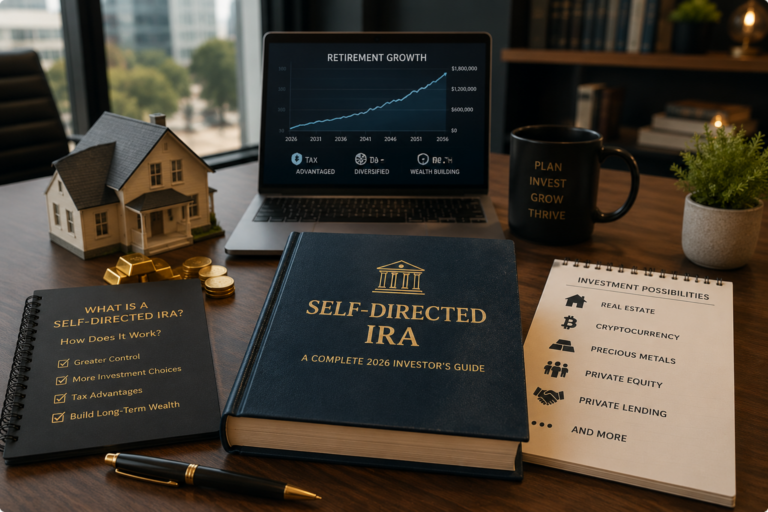
A 401k rollover to a self-directed IRA is the most direct path from a company retirement plan to a retirement account with real investment range. Your 401(k) almost certainly limits you to whatever mutual funds your employer selected. A self-directed IRA has no such restriction. Real estate, physical gold and silver, private loans, private equity, and cryptocurrency are all on the table, provided the IRS rules are followed.
That said, the process has several moving parts and two hard deadlines you do not want to miss. Get them right and the move is tax-free. Get them wrong and you could face income tax on the entire distribution, plus a 10% early withdrawal penalty if you are under 59½.
This guide covers every step, both rollover methods, how to choose a self-directed IRA custodian, what fees to expect, which investment strategies work best, and the most common mistakes people make before funds ever reach a custodian.
What Actually Qualifies as a 401k Rollover to a Self-Directed IRA
A rollover is the movement of funds from an employer-sponsored plan, like a 401(k), 403(b), or 457(b), into an individual retirement account. Self-directed IRAs are not a separate IRA category under the tax code. They follow the same IRS rules as traditional or Roth IRAs. What makes them self-directed is that the custodian permits alternative investments beyond the typical brokerage menu.
Per IRS Topic 413, a rollover is not taxable as long as you deposit the funds into another eligible retirement plan within the required timeframe. The rollover is reported on your federal return via Form 1099-R, but no taxes are owed if you follow the rules.
You generally need a triggering event to pull funds out of a 401(k):
- Separation from service: You left the employer sponsoring the plan, whether through resignation, layoff, or retirement.
- Age 59½ or older: Some 401(k) plans allow in-service rollovers at this age even if you are still employed. Check your plan’s Summary Plan Description to confirm.
- Plan termination: If your employer winds down the 401(k) plan, a distribution may be triggered regardless of your employment status.
If none of those apply, your funds stay put for now. The rollover conversation begins once you have a qualifying event.
Direct Rollover vs. Indirect Rollover: Which One Should You Choose
There are two ways to move 401(k) funds into a self-directed IRA. They are not equal in terms of risk, cost, or complexity.
Direct Rollover (Strongly Recommended)
With a direct rollover, funds move from your 401(k) plan directly to your SDIRA custodian. You never touch the money. The plan administrator sends a check payable to your new custodian or wires the funds directly. No taxes are withheld. No 60-day clock starts. This is a trustee-to-trustee transfer and the IRS treats it as a non-taxable event.
Indirect Rollover: The 60-Day Window and 20% Trap
With an indirect rollover, the 401(k) administrator distributes the funds directly to you. At that point the IRS requires mandatory 20% withholding. So if you had $200,000 in your 401(k), you receive a check for $160,000. You then have 60 days to deposit the full $200,000 into your SDIRA, which means you have to replace the missing $20,000 out of pocket. If you only deposit $160,000, the withheld $20,000 is treated as taxable income and may carry a 10% early withdrawal penalty.
On top of that, IRS Publication 590-A limits you to one indirect rollover per 12-month period across all your IRAs combined, not per individual account.
Direct vs. Indirect Rollover: Key Differences
| Factor | Direct Rollover | Indirect Rollover |
| Tax withholding | None | 20% mandatory withheld |
| 60-day deadline | No deadline | Yes, 60 days from distribution |
| Personal possession | No | Yes, temporarily |
| One-per-year limit | No limit | One per 12 months (all IRAs) |
| Risk of taxable event | Very low | High if deadline missed |
| Form 1099-R issued? | Yes (Code G) | Yes (Code 1 or 7) |
| Recommended for most? | Yes | Only in specific situations |
How to Rollover a 401k to a Self-Directed IRA: Step by Step
The process is more straightforward than it looks. Here is exactly how it works:
- Open your self-directed IRA with a qualified custodian. Not all IRA custodians allow alternative investments. Specialized self-directed IRA custodians hold assets like real estate, precious metals, and private loans. Have your government-issued ID, Social Security number, and beneficiary information ready. Account setup typically takes 3 to 10 business days.
- Request a direct rollover from your 401(k) plan administrator. Contact your former employer’s HR department or plan administrator and ask for their rollover forms. Tell them explicitly you want a direct rollover to avoid the 20% withholding. You will need your new SDIRA account number and the custodian’s mailing or wire address.
- Complete the required distribution paperwork. Fill out the plan’s distribution form. Specify direct rollover as the distribution type. Include the custodian name, address, and your new SDIRA account number. Double-check every field. Errors delay the transfer by weeks.
- Wait for the transfer to process. Direct rollovers typically take 2 to 4 weeks from the time the plan administrator processes your request. Wire transfers are faster than paper checks. Your SDIRA custodian will confirm when funds arrive.
- Direct your custodian to invest. Once funds are in your self-directed IRA, you instruct your custodian on where to invest. The custodian executes on your direction but does not advise on investment selection.
Important: If your 401(k) has both pre-tax and Roth (after-tax) buckets, the pre-tax portion must roll into a traditional SDIRA and the Roth portion into a Roth SDIRA. Mixing them triggers taxes.
How to Choose the Right Self-Directed IRA Custodian for Your 401k Rollover
This is one decision people get wrong most often, and the consequences stick around for years. The custodian you choose determines which assets you can hold, how fast transactions process, what you pay annually, and how much support you get when something goes sideways.
One critical distinction first: not all companies marketing self-directed IRA services are IRS-approved custodians. Some are administrators or facilitators that work with an underlying trust company. IRS-approved custodians are regulated under federal banking laws and state trust company statutes. Administrators rely on a custodian partner for actual asset custody. Both are legal, but the fee structure and accountability differ. Always verify whether the company you are working with is the actual custodian or a facilitator working through one.
Custodian vs. Administrator: Why the Distinction Matters
An IRS-approved custodian holds your assets directly, files required IRS reporting (Form 5498, Form 1099-R), and is regulated by state banking authorities or the Office of the Comptroller of the Currency. An administrator is a third party that handles the paperwork and client service side while partnering with a trust company for custody. Neither structure is inherently inferior, but administrators sometimes add a cost layer. Always ask: Who is the actual IRS-approved custodian for my account?
Five Questions to Ask Any Custodian Before You Transfer
- What specific asset types do you support? Not every custodian handles every alternative asset. Real estate, crypto, and private placements sometimes require different platforms or partner custodians.
- What is your transaction processing time? For real estate, a delay of two weeks waiting for a custodian to wire funds can kill a deal. Know the turnaround before you commit.
- Are you the IRS-approved custodian or an administrator? Clarify who actually holds and reports your assets to the IRS.
- What does your fee schedule look like beyond the annual fee? Transaction fees, wire fees, and asset-holding fees add up fast. Ask for a complete fee disclosure upfront.
- What is your rollover process and timeline? Some custodians assign a specialist to walk you through the 401(k) rollover. Others send you a PDF and leave you to it. For first-time SDIRA investors, hands-on support matters.
Self-Directed IRA Custodian Fees: What to Actually Compare Before You Rollover
Fee structures vary more across self-directed IRA companies than in almost any other financial services category. Unlike traditional brokerages where zero-commission trading has become standard, SDIRA custodians handle complex alternative assets that require hands-on administration. You will pay for that.
Here is the complete breakdown of fee types to understand:
- Setup or account establishment fee: One-time fee to open your SDIRA. Ranges from $0 to $300. Some custodians waive this as a promotion.
- Annual maintenance fee: The core recurring cost. Can be flat (same regardless of account value) or asset-based (scales with account size). Flat-fee structures are usually better for larger accounts.
- Asset holding fee: Some custodians charge per asset held inside the IRA, whether a property deed, a private note, or a metals position. This adds up quickly with diversified alternative holdings.
- Transaction fees: Charged each time the custodian processes a buy, sell, or distribution. Can range from $25 to $350 per transaction depending on asset type.
- Wire and check fees: Common fees of $15 to $40 per outgoing wire. Frequent real estate investors feel these the most.
- Termination fee: Charged if you close or transfer your account away. Can be up to $250. Worth knowing before you open.
Self-Directed IRA Custodian Fee Comparison (2026)
| Custodian | Setup Fee | Annual Fee | Best Known For |
| Equity Trust | $50-$75 | $249-$499 + asset-based maintenance | Largest SDIRA custodian; 40+ years in business |
| Madison Trust | $50 | $420/year ($105 per quarter) | Real estate; responsive customer service |
| IRA Financial | $0-$50 | ~$400 flat (checkbook included) | Checkbook IRA/LLC; private placements |
| IRAR Trust | $50 | Asset-based; competitive rates | Real estate |
| Directed IRA | $50 | Asset-based starting ~$360/year | Real estate attorneys founded; education-heavy |
| uDirect IRA | $50 | Asset-based; among the lowest | Low-cost option; limited crypto |
Note: Fee schedules change. Always request the current fee disclosure from any custodian before transferring funds. Ask specifically about fees for the asset types you plan to hold.
What You Can Invest in After Rolling Your 401k to a Self-Directed IRA
This is the point of the entire exercise. Your 401(k) likely restricted you to a list of mutual funds and target-date options your employer selected. A self-directed IRA removes that ceiling. Here is what becomes available:
Real Estate: Rental Properties, Commercial, and More
Real estate is the most popular alternative investment in self-directed IRAs. Your SDIRA can purchase residential rental properties, commercial buildings, duplexes, raw land, tax liens, and real estate notes. The property is titled in the custodian’s name for the benefit of your IRA. All rental income flows back into the IRA. All expenses, including property taxes, insurance, and repairs, are paid from IRA funds.
The tax math is compelling. Rent collected inside a Roth SDIRA accumulates completely tax-free. No annual income tax on rental income. No capital gains tax when the property sells, assuming the Roth account is qualified. In a traditional SDIRA, the growth is tax-deferred until distributions begin at age 73.
Key restrictions: You cannot personally use the property. Your family members (lineal descendants, ancestors, spouse) cannot live in it or work on it. All decisions go through the custodian. For investors who want faster transaction times on repairs and rental income, the checkbook IRA/LLC structure covered below solves this.
Precious Metals IRA: Rolling Your 401k into Gold and Silver
Rolling your 401k to a self-directed IRA is one of the only ways to hold physical gold, silver, platinum, and palladium inside a tax-advantaged retirement account. A standard 401(k) or brokerage IRA may offer gold ETFs, but those are paper proxies, not physical metal. An SDIRA with a precious metals custodian or precious metals dealer partner gives you direct ownership of IRS-approved bullion.
The IRS requirements for metals in an SDIRA are specific. Under IRC Section 408(m):
- Gold: Must be 0.995 fineness or higher. Eligible coins include the American Gold Eagle (which is an exception at .9167 fine), American Gold Buffalo, Canadian Gold Maple Leaf, and approved bars from LBMA-accredited refiners.
- Silver: Must be 0.999 fineness or higher. The American Silver Eagle is eligible.
- Platinum and palladium: Must be 0.9995 fineness or higher.
All metals must be stored at an IRS-approved depository, not at your home and not in a safety deposit box you control. Home storage gold IRA arrangements marketed online are not IRS-approved and carry significant legal risk. The IRS has repeatedly challenged these structures and courts have sided with the IRS.
The rollover process for precious metals after a 401k rollover: once your SDIRA is funded, you direct your custodian to purchase approved metals from an authorized dealer. The dealer ships directly to the depository. Your custodian holds the records. The metals are legally owned by your IRA.
Private Placements, Private Equity, and Private Lending
Your SDIRA can invest in private company equity (startups, LLCs, limited partnerships), private funds, and promissory notes where your IRA acts as the lender. Interest payments from private loans flow back into the IRA tax-deferred or tax-free. This category is popular among investors with deal flow access outside of public markets.
Cryptocurrency in a Self-Directed IRA After a 401k Rollover
A self directed IRA can hold Bitcoin, Ethereum, and other digital assets through custodians that support crypto. The tax advantage is real: crypto gains inside a Roth SDIRA accumulate completely tax-free. In a traditional SDIRA, you defer taxes until distribution. Compare that to holding crypto in a taxable brokerage account where every sale is a taxable event. Not every SDIRA custodian supports crypto, so confirm this feature upfront if digital assets are part of your strategy.
Self-Directed IRA with Checkbook Control: When to Set Up an IRA LLC
A standard self-directed IRA requires your custodian to process and approve every transaction. That works fine for long-term buy-and-hold investments. It becomes a problem when you are bidding on a property at auction, making time-sensitive real estate purchases, or managing frequent transactions on a rental property.
The solution is a checkbook control IRA, technically an IRA/LLC structure. Here is how it works: your SDIRA forms and owns a single-member LLC. You serve as manager of the LLC. The LLC opens a checking account at a bank. You can write checks directly from that account to fund investments without waiting for custodian processing on each transaction.
The IRS challenged this structure years ago and lost. The U.S. Tax Court upheld the checkbook IRA in Swanson v. Commissioner (106 T.C. 76, 1996), confirming that an IRA owning an LLC with the account holder as manager does not automatically create a prohibited transaction.
Checkbook IRA Benefits vs. Standard SDIRA
- Speed: You write the check. No custodian approval queue. For real estate deals requiring a $5,000 earnest money deposit within 24 hours, this is the difference between getting a deal and losing it.
- Cost reduction: Many custodians charge per-transaction fees of $50 to $200+ for each investment. The LLC consolidates multiple investments under one asset (the LLC itself), often reducing annual custodian fees significantly.
- Privacy: Investments are titled in the LLC’s name, not your IRA name or personal name.
- Complexity: You are responsible for maintaining strict separation between LLC funds and personal funds. Prohibited transaction rules still apply. Commingling funds or using the LLC account for personal expenses is a serious violation.
Setup costs for an IRA/LLC range from $500 to $1,500 for LLC formation and a compliant operating agreement. Annual state filing fees and ongoing LLC maintenance add to that. The structure makes sense for active investors making multiple transactions per year. For someone buying one real estate asset and holding it long-term, the standard custodian model is usually sufficient.
Solo 401k vs. Self-Directed IRA: Which Is the Better Move After Leaving Your Employer
If you are self-employed or own a small business with no full-time employees (other than a spouse), you have a second option worth considering before rolling your old 401(k) into a self-directed IRA: a self-directed solo 401(k).
Both accounts can hold alternative investments including real estate, precious metals, and private equity. The differences are significant enough that the right choice depends heavily on your situation.
Self-Directed IRA vs. Solo 401k: Side-by-Side Comparison
| Feature | Self-Directed IRA vs. Solo 401k |
| Eligibility | SDIRA: Anyone with earned income | Solo 401k: Self-employed only, no full-time W-2 employees |
| 2026 contribution limit | SDIRA: $7,500 (<50), $8,600 (50+) | Solo 401k: Up to ~$70,000+ depending on income |
| Accept 401k rollovers | Both: Yes, pre-tax 401k rolls into pre-tax account |
| Accept Roth IRA rollovers | SDIRA: Yes | Solo 401k: No (Roth IRA cannot roll into Solo 401k) |
| Participant loans | SDIRA: Not allowed | Solo 401k: Yes, up to $50,000 or 50% of balance |
| UBIT on leveraged real estate | SDIRA: Yes (UDFI applies) | Solo 401k: No (UBIT exemption under IRC 514) |
| Creditor protection | SDIRA: State law (varies) | Solo 401k: Federal ERISA (strongest available) |
| Checkbook control | SDIRA: Via LLC (added cost) | Solo 401k: Inherent with self-directed plan |
| Required minimum distributions | Both: Age 73 (traditional accounts) |
| Roth option | Both: Yes |
The solo 401(k) wins on contribution limits and the UBIT exemption for leveraged real estate. That exemption alone is worth tens of thousands of dollars over time for real estate investors who use non-recourse financing. The SDIRA wins on simplicity, eligibility, and flexibility around Roth rollovers.
If you are not self-employed, the SDIRA is your only alternative investment retirement vehicle after a 401k rollover. If you are self-employed, consult a CPA before choosing between the two structures. The tax implications differ substantially depending on your investment strategy.
Solo 401k to Self-Directed IRA Rollover Rules
If you have a solo 401(k) and want to move those funds into a self-directed IRA, the same direct rollover rules apply. The check goes from the solo 401(k) plan administrator to your SDIRA custodian. The one nuance: Roth funds inside a solo 401(k) can roll into a Roth SDIRA, but a Roth IRA cannot roll into a solo 401(k). The transfer direction matters for Roth funds.
401k Rollover to Self-Directed Roth IRA: The Tax Conversion Play
Here is a strategy more investors should consider. You can roll your pre-tax 401(k) funds into a self-directed Roth IRA. But it is a taxable conversion, not a tax-free rollover. You pay income taxes on the converted amount in the year of the conversion, and then everything grows completely tax-free. No required minimum distributions at 73. No taxes on qualified withdrawals in retirement.
This strategy works best when you expect to be in a higher tax bracket later in retirement than you are now, or when you have a year with unusually low income that lets you convert at a lower effective rate.
- You cannot move pre-tax 401(k) funds directly into a Roth SDIRA without paying taxes. The IRS treats it as a distribution from the traditional account followed by a contribution to the Roth.
- For 2026, Roth IRA income limits restrict direct contributions if your modified AGI exceeds $153,000 (single filer) or $236,000 (married filing jointly). But there are no income limits on Roth conversions. The backdoor Roth approach remains available regardless of income.
- If your 401(k) already has a Roth bucket, that portion can roll directly into a Roth SDIRA with no additional tax owed.
Get your CPA involved before doing a Roth conversion. The tax bill can be significant on larger balances, and poorly timed conversions can push you into a higher bracket or affect Medicare premium calculations in retirement.
How to Consolidate Multiple Retirement Accounts into One Self-Directed IRA
Many investors arrive at a self-directed IRA with money scattered across multiple accounts: a 401(k) from a job five years ago, a rollover IRA from a previous employer, maybe a SEP IRA from a freelance stretch. Consolidating these into a single self-directed IRA simplifies management, reduces administrative fees, and gives you a clearer picture of total retirement assets.
The rules depend on what you are moving:
- Traditional 401(k) to traditional SDIRA: Direct rollover. Tax-free. No limit on amount.
- Roth 401(k) to Roth SDIRA: Direct rollover. Tax-free. The Roth funds retain their Roth status.
- Traditional IRA to traditional SDIRA: This is a transfer (not a rollover) because both accounts are the same type. No 60-day rule. No one-per-year limit. Completely unlimited in frequency and amount.
- Roth IRA to Roth SDIRA: Same as above. A direct transfer between IRA custodians. Tax-free and unlimited.
- SEP IRA or SIMPLE IRA to traditional SDIRA: Transfer is permitted. SIMPLE IRA has a two-year waiting period from the date of the first SIMPLE IRA contribution before it can transfer to a non-SIMPLE IRA.
If you have outstanding 401(k) loans across old plans, address those before initiating consolidation. The unpaid loan balance typically becomes a taxable distribution when you leave the employer, unless you repay it before the rollover date or use the plan loan offset rollover window available under the Tax Cuts and Jobs Act.
Strategy: When consolidating multiple accounts, consider which assets should be in which account type. Pre-tax accounts are best for assets you expect to grow slowly (bonds, private notes). Roth accounts are best for high-growth assets like real estate or startup equity, where the eventual tax-free exit is most valuable.
Rollover Mistakes That Cost Investors Real Money
Most rollover problems are avoidable. Here are the ones that come up most often:
Missing the 60-Day Window on an Indirect Rollover
The IRS does not have much flexibility on this. Miss the 60-day deadline and the distribution becomes taxable income. Under 59½? Add a 10% penalty on top. The IRS does allow a self-certification waiver in certain circumstances, but you must meet specific criteria under Revenue Procedures 2020-46 and 2016-47. Do not rely on the waiver as a backup plan.
Rolling Pre-Tax Funds into a Roth Without Planning for the Tax Bill
A $300,000 Roth conversion creates $300,000 of ordinary income in that tax year. If you did not budget for a six-figure tax payment, the surprise is unpleasant. Partial conversions spread over multiple years are often a smarter approach than a single large conversion.
Leaving 401(k) Loans Open When You Rollover
If you have an outstanding 401(k) loan when you leave your employer, the unpaid balance is typically treated as a distribution. Under the Tax Cuts and Jobs Act, you have until the due date (including extensions) of your federal tax return for that year to roll the offset amount into an IRA to avoid taxes and penalties. This rule catches more people off guard than almost any other.
Choosing a Custodian That Does Not Support Your Asset Type
Not all self-directed IRA custodians support all alternative asset classes. If you plan to invest in real estate, confirm the custodian handles real estate transactions before transferring funds. The same applies to crypto and private placements. Switching custodians after the fact adds time, transfer fees, and potential complications.
Violating Prohibited Transaction Rules Under IRC Section 4975
Once funds are in your self-directed IRA, you cannot transact with disqualified persons. This means you cannot buy property from your parents, have your children do repairs on an IRA-owned property, or personally guarantee a loan inside the IRA. Violating IRC Section 4975 causes the entire IRA to be treated as distributed in the year of the violation, creating a massive, potentially irreversible tax event. The rules apply to the IRA/LLC structure as well.
Key Takeaways
- A 401k rollover to a self-directed IRA is tax-free when done as a direct rollover. Funds move custodian to custodian with no taxes withheld and no 60-day deadline.
- Indirect rollovers trigger 20% mandatory withholding and a hard 60-day deposit deadline. Miss the deadline and you owe taxes and potentially a 10% penalty.
- You need a triggering event (leaving your job, reaching 59½, plan termination) to initiate a 401(k) rollover. No event means no rollover yet.
- SDIRAs open the door to real estate, precious metals (gold and silver), private loans, private equity, crypto, and more, all under the same IRS rules as a standard IRA.
- Choosing the right self-directed IRA custodian matters more than most people realize. Fees, asset support, processing times, and whether they are an actual IRS-approved custodian all affect your investment results.
- Checkbook control via an IRA/LLC speeds up transactions and cuts per-deal custodian fees. It makes the most sense for active investors making multiple investments per year.
- If you are self-employed, a self-directed solo 401(k) may beat a self-directed IRA for real estate because it is exempt from UBIT on leveraged property income.
- Rolling pre-tax 401(k) funds into a Roth SDIRA is a taxable conversion, not a tax-free rollover. The tax bill arrives the same year you convert. The long-term benefit is tax-free growth and no required minimum distributions.
- Multiple old retirement accounts (401ks, IRAs, SEPs) can be consolidated into one self-directed IRA. Transfers between IRAs have no frequency limit and no 60-day rule.
Legal Disclaimer: This article is for educational purposes only and does not constitute financial, tax, or legal advice. Self-directed IRA investments involve risk, including the risk of prohibited transactions that can result in full IRA disqualification and significant tax liability. Consult a qualified CPA, SDIRA-experienced attorney, and/or financial advisor before making any rollover or investment decisions. All IRS rules referenced should be verified against current IRS publications, as tax law changes over time.
FAQ's
Can I rollover my 401k to a self-directed IRA without penalty?
Yes, if you do it as a direct rollover. The funds move directly from your 401(k) plan administrator to your SDIRA custodian. No taxes are withheld and no penalties are triggered. The move is reported on your tax return via Form 1099-R and Form 5498, but you owe nothing. The penalty exposure only comes with an indirect rollover where you miss the 60-day redeposit deadline, or if you attempt to roll over funds you are not yet eligible to distribute from your 401(k).
Can you rollover a 401k to a self-directed IRA while still employed?
Sometimes. Most 401(k) plans require separation from service before allowing a distribution. Some plans allow in-service rollovers once you reach age 59½, even if you are still with that employer. Check your plan’s Summary Plan Description or ask your HR department. If your plan does not permit in-service rollovers, you have to wait until you leave the employer.
Where is the best place to rollover a 401k to a self-directed IRA?
The best self-directed IRA custodian depends on what you plan to invest in. For real estate, custodians like Madison Trust, IRAR Trust, and Directed IRA are well-regarded for transaction support and processing times. For precious metals, look for custodians with established dealer relationships and approved depository partnerships. For crypto, a specialist like Bitcoin IRA may fit better than a generalist custodian. For checkbook control and private placements, IRA Financial is frequently cited. Compare fees, supported asset types, and actual IRS-approved custodian status before committing.
What is the difference between a rollover and a transfer for a self-directed IRA?
A rollover moves money from an employer plan (like a 401k) to an IRA. A transfer moves money from one IRA to another IRA with no change in account type. Transfers are cleaner because they are not subject to the one-per-year limit and have no 60-day window. If you already have a traditional or Roth IRA at a brokerage and want to move it to an SDIRA, a direct custodian-to-custodian transfer is usually the right call.
How long does a 401k rollover to a self-directed IRA take?
Plan on 3 to 6 weeks for a full direct rollover, though timelines vary. Your 401(k) plan administrator typically takes 1 to 3 weeks to process the distribution request and send funds. Your SDIRA custodian credits the account within a few business days of receiving the check or wire. Wire transfers are faster than paper checks. Delays happen most often when paperwork has errors, when the administrator requires a medallion signature guarantee, or when the 401(k) holds assets that need to be liquidated before transfer.
What are the IRS rules for precious metals in a self-directed IRA?
Under IRC Section 408(m), gold held in an IRA must meet 0.995 fineness (gold Eagles are a congressionally granted exception at .9167 fine). Silver must be 0.999 fine, platinum and palladium 0.9995 fine. All metals must be stored at an IRS-approved depository. Home storage is not permitted. The IRS has challenged home storage gold IRA arrangements in court and prevailed. Using a home safe or bank deposit box you personally control violates the rules and can trigger full IRA disqualification.
Can I invest in real estate immediately after a 401k rollover to a self-directed IRA?
Yes, once funds land in your self-directed IRA you can direct the custodian to purchase real estate. The property is titled in the custodian’s name for the benefit of your IRA. You submit a Buy Direction Letter and provide the purchase contract and other required documentation. Processing typically takes 3 to 5 business days for the custodian to wire funds to closing. If speed is a concern, the checkbook IRA/LLC structure lets you write a check directly from the LLC bank account without waiting for custodian processing.
Does rolling over a 401k affect my annual IRA contribution limit?
No. Rollover amounts do not count against your annual contribution limit. For 2026, the IRA contribution limit is $7,500 for individuals under age 50 and $8,600 for those 50 and older. You can roll $500,000 from a 401(k) into a self-directed IRA and still make your full annual contribution to that same IRA (income limits permitting for Roth IRAs). Rollover limits and contribution limits are completely separate.
What is a self-directed solo 401k rollover to a self-directed IRA?
If you have a solo 401(k) from a period of self-employment and now want to move those funds into a self-directed IRA, the process follows the same direct rollover rules. The solo 401(k) plan administrator sends a check or wire directly to your SDIRA custodian. One nuance: Roth funds inside the solo 401(k) can move to a Roth SDIRA. But Roth IRA funds cannot be rolled into a solo 401(k). The transfer direction for Roth funds only works one way.
Have Questions About Your Self-Directed IRA?
Schedule a free 15-minute consultation with Bullionite Asset Group. No pitch, no pressure, no referral commissions.

As the Founder and Chief Investment Officer of Bullionite and Bullionite Asset Group, I’ve built my career on a simple premise understanding the intersection of macroeconomics, commodities, and digital assets to stay ahead of the curve, not under it. My focus is on navigating the complexities of the world’s largest markets spanning the US, the Middle East, and Asia to identify high-value opportunities for alternative investment.
With a specialized focus on Self-Directed IRAs (SDIRAs), I help investors move beyond traditional 401ks by integrating assets like precious metals and cryptocurrency into their retirement strategies. Based in Newport Beach, California, I am dedicated to bridging the gap between traditional finance and the evolving landscape of new age digital assets, ensuring that every strategic move is backed by deep market insight and a commitment to long-term growth.