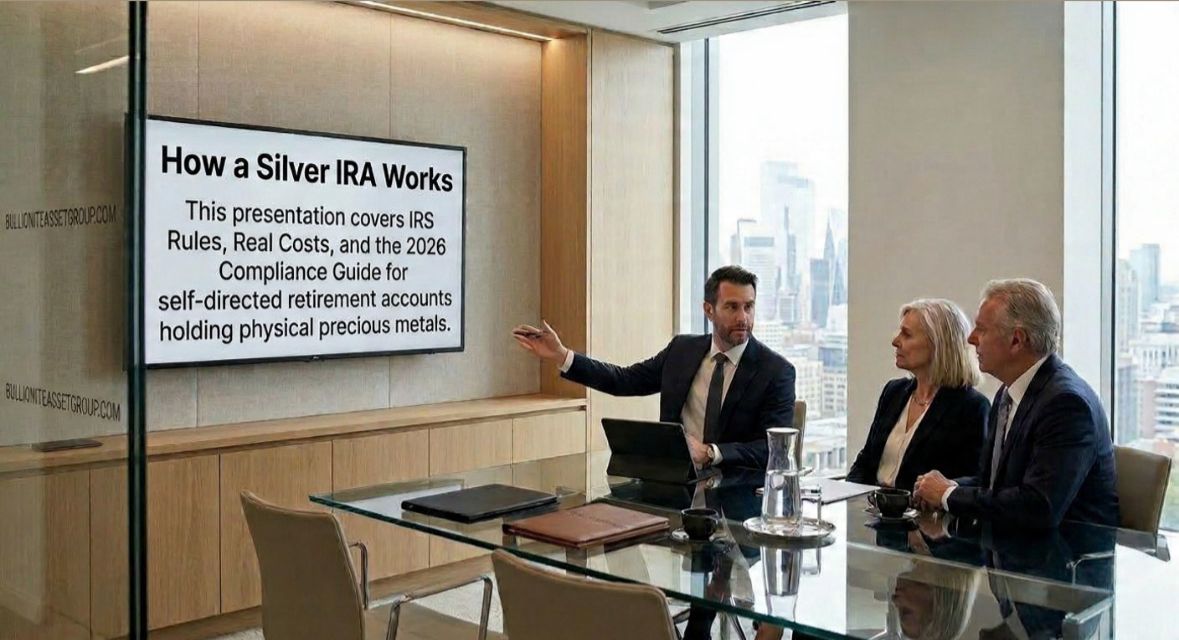
How a Silver IRA Works: IRS Rules, Real Costs, and 2026 Compliance Guide
TL;DR
A silver IRA is a self-directed IRA that holds physical silver bullion meeting IRS fineness requirements of .999 or higher — not silver ETFs, not mining stocks, not collectible coins. All silver must be stored at an IRS-approved depository. A Rhode Island couple owed more than $300,000 in penalties after storing $411,000 in metals at home. The IRS takes this seriously. Total annual carrying costs run $400-$700+ when you combine custodian fees and segregated storage, before accounting for dealer premiums on each purchase. For 2026, annual contribution limits are $7,500 (under age 50) and $8,600 (age 50 or older). You can also roll over an existing 401(k) or IRA without tax consequences. Silver pays no dividends. Its value in a retirement portfolio comes from price appreciation, portfolio diversification, and inflation hedging — not income generation.
A silver IRA doesn’t work the way most people think it does. Not when they first look into it.
They picture opening an account, buying a few coins online, storing some bars in a safe. What they actually get is a self-directed IRA holding physical bullion at an IRS-approved depository in Delaware or Texas — with a specialized custodian handling every transaction on their behalf and a fee structure that bears no resemblance to a standard brokerage account.
That gap between expectation and reality is exactly where costly mistakes happen. And they happen constantly. The CFTC has charged precious metals companies with more than $500 million in fraudulent sales over the past decade, with retirement savers as the primary targets.
This guide closes that gap. It covers exactly how a silver IRA works under current IRS rules, what silver qualifies under IRC §408(m), what it costs to own silver in a tax-advantaged account, and the compliance rules that — if you miss them — can cost you the entire tax benefit overnight.
What a Silver IRA Actually Is and What It Isn’t
A silver IRA is a type of self-directed IRA (SDIRA) that holds physical silver bullion as its core asset. The account follows all the same structural rules as a traditional or Roth IRA — the same contribution limits, the same distribution rules, the same RMD requirements at age 73. The difference is what sits inside it.
Standard IRAs hold paper assets: stocks, bonds, mutual funds, ETFs. A silver IRA holds tangible metal, physically stored in a licensed depository on your behalf. You own the silver through your IRA. You can’t touch it until you take a distribution.
A few things a silver IRA is NOT:
- A silver ETF account. Buying shares of a silver ETF inside a standard brokerage IRA gives you price exposure, but you don’t own physical metal. A silver IRA requires actual bullion — ounces sitting in a vault.
- A mining stock account. Holding shares in a silver mining company is a traditional paper investment. That’s not a silver IRA regardless of what the company does.
- A numismatics account. Rare proof coins and collectible silver pieces generally don’t qualify. This distinction costs people money every year when they assume all silver is the same.
The account is called self-directed because the IRS permits you to choose the underlying asset. But self-directed doesn’t mean unregulated. You’re still bound by IRC §408(m), which defines exactly which metals qualify and mandates how they must be held.
Traditional vs. Roth: Which Structure Fits Your Situation
A silver IRA comes in two main tax structures, and the right choice depends on your current tax bracket and your expected bracket in retirement.
With a Traditional Silver IRA, you contribute pre-tax dollars (deductibility depends on income and whether you have a workplace retirement plan), your metals grow tax-deferred, and you pay ordinary income tax when you take distributions. Required Minimum Distributions begin at age 73 under current IRS rules.
With a Roth Silver IRA, you contribute after-tax dollars. Your silver grows completely tax-free. Qualified withdrawals — after age 59½ and with the account open at least five years — are tax-free. No RMDs during your lifetime. For 2026 Roth contributions, single filers must earn below $153,000, and married joint filers below $242,000. See IRS Publication 590-A for current phaseout thresholds.
Neither structure is universally better. The right call depends on your current tax rate vs. expected retirement rate, your timeline, and whether you want to pass the account to heirs without RMD complications.
Which Silver Meets IRS Standards — and Which Gets Rejected
Not all silver qualifies. The IRS is specific.
Under IRC §408(m)(3), silver held in an IRA must meet a minimum fineness of .999 (99.9% pure) and come from a manufacturer accredited by NYMEX/COMEX, LBMA, LME, or a national government mint. That eliminates a large category of silver products people commonly assume qualify.
IRA-eligible silver coins include:
- American Silver Eagle (1 oz, ½ oz, ¼ oz, 1/10 oz) — U.S. Mint
- Canadian Silver Maple Leaf — Royal Canadian Mint
- Austrian Silver Philharmonic — Austrian Mint
- Australian Silver Kangaroo — Perth Mint
IRA-eligible silver bars and rounds include:
- Johnson Matthey silver bars (.999 fineness)
- PAMP Suisse silver bars (.999 fineness)
- Royal Canadian Mint silver bars
- Sunshine Minting silver bars and rounds
- Valcambi silver bars
IRA-ineligible silver that investors regularly try to include:
- 90% ‘junk silver.’ Pre-1965 U.S. dimes, quarters, and half-dollars are 90% silver by weight — far below the .999 minimum. They’re widely available and priced near spot, so clients ask about them constantly. They can’t go in an IRA.
- Most numismatic and proof coins. A 1996 American Silver Eagle Proof may carry a collector’s premium above spot, but IRA eligibility depends on purity and form, not rarity. Most numismatic silver fails the form test even when it meets the purity standard.
- Unrecognized foreign coins. Not every government mint produces IRA-eligible coins under U.S. rules. Confirm eligibility with your custodian before purchasing anything unfamiliar.
The American Silver Eagle: The Default IRA Silver Choice
The American Silver Eagle holds a unique position in U.S. precious metals law. Congress specifically authorized it for IRA inclusion. It strikes at .999 fine silver, carries full legal tender status, and comes from the U.S. Mint. For investors who want a simple, highly liquid, unambiguous IRA-eligible silver coin, the Silver Eagle is the standard starting point. It’s also the easiest to sell at fair market value when you eventually liquidate.
How to Open a Silver IRA and Fund It: Step-by-Step
Opening a silver IRA and completing a first purchase takes four to eight weeks from decision to delivery. Here’s the actual process with real costs and timelines.
Step 1: Select a Specialized Custodian (Weeks 1-2)
You can’t hold a silver IRA through Vanguard, Fidelity, or Schwab. These platforms don’t support physical precious metals. You need a self-directed IRA custodian — a specialized trust company approved by the IRS to hold non-traditional assets.
What custodians typically charge:
- Application and setup fee: $50-$100
- Annual administrative fee: $80-$300, depending on account size and fee structure
- Per-transaction purchase/sale fee: $35-$95 per execution
Evaluate custodians on response time, fee transparency, which depositories they partner with, and whether they allow you to source metals from any approved dealer or require you to purchase through an affiliate. Custodians that mandate using their own affiliated dealer create a conflict of interest worth understanding before you commit.
Step 2: Fund the Account (Days 5-15 After Approval)
Three funding methods exist:
- Direct transfer: Your current custodian wires funds directly to your new silver IRA custodian. No taxes, no penalties, no time window. This is the cleanest method and typically takes 5-10 business days.
- Rollover: You receive a distribution check, then deposit the full amount into your new IRA within 60 calendar days. Miss that window by even one day and the IRS treats the full amount as a taxable distribution — plus a 10% early withdrawal penalty if you’re under 59½. One indirect rollover is allowed per 12-month period. Use direct transfers to avoid this risk.
- Annual contribution: $7,500 for 2026 if you’re under 50; $8,600 if you’re 50 or older. This limit applies across all your IRAs combined. You can’t contribute $7,500 to a silver IRA and $7,500 to a Roth IRA in the same tax year.
Current contribution limits from the IRS IRA FAQ page.
Step 3: Direct the Metal Purchase (Weeks 3-4)
Once your account is funded, you direct your custodian to purchase IRS-eligible silver from an approved dealer. You submit a buy direction specifying the product, quantity, and agreed price. Your custodian executes the transaction on behalf of the IRA.
You don’t touch the metal at any point. Your custodian wires funds to the dealer. The dealer ships directly to the depository. Title is recorded in the custodian’s name for benefit of your IRA.
Dealer premiums above the silver spot price matter enormously. American Silver Eagles typically carry a 15-20% premium over spot due to their popularity and U.S. Mint production costs. Silver bars from major refiners may carry only 5-10%. That premium is your immediate cost-of-entry before any price appreciation occurs. If you pay a 20% premium, silver needs to rise 20% before you’re at breakeven.
Step 4: Confirm Depository Storage (Weeks 4-8)
After purchase, your metals ship to an IRS-approved depository. Major options include Delaware Depository, Brink’s Global Services, International Depository Services, and CNT Depository. Storage comes in two forms:
- Segregated storage: Your specific metals are identified, tagged, and stored separately from other investors’ holdings. When you sell or take distributions, you get your exact coins or bars back. Annual cost: $150-$300.
- Commingled storage: Your silver is pooled with other investors’ same-type holdings. You own a quantity, not specific pieces. Lower annual cost: $75-$150. On withdrawal, you receive equivalent metal, not your original pieces.
For most long-term retirement investors, segregated storage is the right choice despite the higher cost. It eliminates ambiguity about exactly what you hold.
The True Annual Cost of Owning Silver in an IRA
Most silver IRA articles list fees in isolation without showing what investors actually pay over time. Here’s the real cost picture for a $50,000 silver IRA:
| Cost Component | Annual Range | Notes |
| Custodian admin fee | $80 – $300 | Account maintenance and recordkeeping |
| Segregated storage | $150 – $300 | Your specific metals stored separately |
| Commingled storage | $75 – $150 | Pooled with other investors’ same-type metal |
| Purchase premium (one-time) | 3% – 25% per buy | Paid on each acquisition over spot price |
| Dealer spread on liquidation | 5% – 15% below spot | What you give up when selling |
| Wire and transaction fees | $25 – $95 per transaction | Per purchase or distribution |
| Total annual recurring fees | $230 – $600 | Excluding premiums paid on purchases |
At a $50,000 account, you’re paying 0.5%-1.2% annually in fixed costs before accounting for the premium you pay when you buy and the spread you give up when you sell. That’s not an argument against silver IRAs — it’s the honest context you need to evaluate the strategy.
Contrast this with a silver ETF in a standard brokerage IRA: a fund like SLV carries an expense ratio of approximately 0.50% annually, no custodian fee, no storage cost. Physical silver in an SDIRA costs more to own. What it offers in return is direct ownership of tangible metal — not a financial instrument with counterparty exposure.
In our advisory experience, clients who understand the full cost picture going in make much better decisions about allocation size than those who learn about storage fees after they’ve committed.
Mistakes That Cost Silver IRA Investors the Most
Mistake 1: Believing Home Storage Is Legal
Warning: This is the single most dangerous misconception in the precious metals IRA space. It has cost investors hundreds of thousands of dollars in a single year.
The internet is saturated with ‘home storage IRA’ and ‘self-storage IRA’ marketing implying that you can legally keep your IRA metals in a safe at home. You can’t.
IRC §408(m) requires that IRA precious metals be held ‘in the physical possession of a trustee’ — meaning an IRS-approved custodian at a licensed depository. Not you. Not your LLC. Not your safe deposit box.
Andrew and Donna McNulty of Rhode Island learned this through a U.S. Tax Court ruling. They stored approximately $411,000 in gold and silver American Eagle coins at home inside an LLC-structured IRA. The court ruled the arrangement constituted a taxable distribution. They owed more than $300,000 in taxes and penalties.
If you store IRA silver at home, the IRS will treat the full account balance as a taxable distribution in the year it happened. Under 59½? Add a 10% early withdrawal penalty on top of ordinary income tax.
The only legal path to physical possession is an in-kind distribution after age 59½, executed through your custodian.
Mistake 2: Buying Non-Eligible Silver
Pre-1965 90% silver coins, silver jewelry, sterling silverware — none of it qualifies. Most numismatic proof sets don’t qualify either. Confirm IRA eligibility in writing with your custodian before any purchase. Once non-eligible silver sits in your account, the IRS can treat the acquisition as a prohibited transaction, potentially disqualifying the entire IRA.
Mistake 3: Mishandling the 60-Day Rollover Window
A rollover gives you 60 calendar days from the day you receive the check. Miss it by one day — for any reason — and the IRS treats the full amount as a taxable distribution. There’s no appeal process for this. Use a direct transfer wherever possible. Custodian-to-custodian transfers have no time limit and no risk.
Mistake 4: Overpaying on Dealer Premiums
A 30% dealer premium means silver needs to rise 30% before you’re at breakeven. Compare dealer pricing on specific products before committing. For American Silver Eagles, 10-20% over spot is reasonable in normal markets. For silver bars from major refiners, 5-10% is typical. Anything materially above those ranges — especially from cold-calling salespeople — deserves skepticism.
The CFTC Customer Advisory on precious metals IRAs documents cases where investors lost one-third to one-half of their savings to undisclosed fees and markups.
Mistake 5: Over-Concentrating in a Single Asset
Most experienced financial planners suggest keeping 5-15% of a retirement portfolio in alternative hard assets including precious metals. Concentrating 80-100% of retirement savings in silver is not a diversification strategy — it’s a concentrated bet on one commodity. The fees, the lack of income, and the price volatility all compound when you go all-in.
Tax Treatment, RMDs, and How Distributions Work
Silver IRAs follow the same distribution rules as other IRAs, with one practical wrinkle when it comes to required minimum distributions.
| Traditional Silver IRA | Roth Silver IRA | |
| Contributions | Pre-tax (may be deductible) | After-tax (not deductible) |
| Growth | Tax-deferred | Tax-free |
| Withdrawals | Taxed as ordinary income | Tax-free (qualified) |
| RMDs | Begin at age 73 | None during owner lifetime |
| Early withdrawal penalty | 10% before age 59½ | 10% before age 59½ on earnings |
Taking RMDs When Your Asset Is Physical Metal
When you reach 73 and RMDs kick in, your Traditional silver IRA must distribute the calculated annual amount. Since your asset is physical metal, you have two options.
Option one: Sell the required amount through your custodian and take a cash distribution. Your custodian liquidates enough silver to cover the RMD, and you receive the proceeds. Straightforward.
Option two: Take an in-kind distribution — your custodian ships actual silver to you. This is a taxable distribution at the fair market value of the metal on the distribution date. You pay income tax on that value. You then own physical silver outright, free of IRA rules, and can store it however you choose.
In-kind distributions are underused. Investors who believe in long-term physical metal ownership often prefer receiving silver rather than liquidating a position they’ve held for decades. Both options are legal. Know which one your custodian supports before you reach 73.
Physical silver IRA position. Not a promise of returns just a way to model the actual math including costs.
When a Silver IRA Makes Sense and When It Doesn’t
Consider a silver IRA if:
- You have a meaningful retirement account — typically $50,000 or more — and want 5-15% allocated to a non-correlated hard asset. Fixed fee structures become proportionally smaller on larger balances.
- You’re converting to a Roth and want decades of tax-free appreciation on tangible assets. Silver’s long-term growth compounds particularly well inside a Roth structure.
- Your paper asset portfolio feels over-exposed to equity market risk and you want tangible offset without adding more stocks, bonds, or real estate.
- You’re within 10-20 years of retirement and want portfolio ballast that doesn’t correlate with S&P 500 performance.
Skip a silver IRA if:
- Your total retirement savings are under $25,000. The fixed fee structure consumes a disproportionate percentage of a small account.
- You need your retirement assets to generate income. Silver pays no dividends and no interest. If income is the priority, a real estate SDIRA or dividend equity strategy serves that goal better.
- You’re under 35 with a 30+ year runway and maximum growth is the priority. The compounding power of equities over three decades typically outperforms equivalent precious metals allocations by a significant margin.
- You’re reacting to a week of bad financial news. SDIRAs have setup timelines, liquidation timelines, and fee structures designed for long-term holders. They’re not a panic vehicle.
Key Takeaways
- A silver IRA requires .999 fine bullion from an approved mint or refiner — 90% junk silver and most numismatic coins don’t qualify, and buying ineligible metal triggers a taxable distribution.
- All IRA silver must be stored at an IRS-approved depository by a specialized custodian. Home storage is illegal under IRC §408(m) and has cost investors hundreds of thousands of dollars in penalties.
- For 2026, you can contribute up to $7,500 ($8,600 if you’re 50 or older) or roll over existing retirement funds via a direct custodian-to-custodian transfer to avoid the 60-day rollover window and its risks.
- Total annual carrying costs of $230-$600 in custodian and storage fees, plus dealer premiums of 5-20% per purchase, mean you need to hold long enough for appreciation to absorb the cost of ownership.
Disclosure: This article is for educational purposes only and does not constitute tax, legal, or investment advice. Precious metals IRA investing involves risk, including possible loss of principal. Consult a qualified CPA, tax attorney, or financial advisor before making retirement account decisions. BullioniteAssetGroup may offer consulting services related to topics discussed here.
FAQ's
Can I store my silver IRA at home?
No. IRC §408(m) requires IRA precious metals to be held ‘in the physical possession of a trustee’ — meaning an IRS-approved custodian at a licensed depository. Storing IRA silver at home, in a personal safe, or in a safe deposit box violates this requirement. The IRS will treat the stored metals as a taxable distribution in the year they were removed from proper custody, and if you’re under 59½, a 10% early withdrawal penalty applies on top of ordinary income taxes. The McNulty court case — $300,000+ in penalties on $411,000 in metals — is the clearest example of what home storage actually costs.
What silver actually qualifies for an IRA?
IRA-eligible silver must be .999 fine (99.9% pure) and produced by a government mint or a refiner/manufacturer accredited by NYMEX/COMEX, LBMA, or LME. This includes American Silver Eagles, Canadian Silver Maple Leafs, Austrian Philharmonics, and bars from refiners like PAMP Suisse, Johnson Matthey, and Sunshine Minting. Pre-1965 90% silver ‘junk’ coins don’t qualify. Most numismatic or proof coins don’t qualify based on form, even when they meet purity. Confirm eligibility with your custodian in writing before any purchase.
What's the difference between a silver IRA transfer and a rollover?
A direct transfer moves funds directly between custodians. You never receive a check. There’s no time limit, no tax withholding, and no annual limit on how many transfers you can do. A rollover means you receive a distribution check, then redeposit the full amount into a new IRA within 60 calendar days. You’re limited to one indirect rollover per 12-month period. If you miss the 60-day window or deposit less than the full amount, the IRS taxes the shortfall as a distribution. Direct transfers eliminate rollover risk entirely — use them whenever possible.
How much does a silver IRA cost per year?
Expect $230-$600 annually in recurring fees for a typical silver IRA, covering custodian administration ($80-$300) and segregated storage ($150-$300). On top of that, each purchase carries a dealer premium above spot price: 15-20% for American Silver Eagles, 5-10% for silver bars. Liquidation involves giving up 5-15% below spot to the buying dealer. On a $50,000 account, total recurring fees run 0.5%-1.2% per year before purchase and sale costs. Smaller accounts pay a higher proportional rate. These costs are real and worth modeling against expected appreciation before committing.
What happens to my silver IRA when I turn 73?
Required Minimum Distributions begin at 73 for Traditional silver IRAs. You must withdraw a calculated annual amount based on your account balance and IRS life expectancy tables. Because your asset is physical metal, you have two distribution options: sell enough silver to generate the required cash (custodian handles the sale), or take an in-kind distribution of the physical metal itself. In-kind distributions are taxable at fair market value on the distribution date. Roth silver IRAs have no RMDs during the owner’s lifetime.
Can I add silver I already own to my IRA?
No. The IRS prohibits contributing personal property to an IRA. You can’t transfer silver you currently own into your IRA account. The only way to get physical silver into a silver IRA is to direct your custodian to purchase it on behalf of the IRA from an approved dealer using IRA funds. Attempting to contribute personally-owned silver as an in-kind contribution would be a prohibited transaction under IRC §4975, potentially disqualifying the entire account.
Is a silver IRA the same as a silver ETF in my IRA?
No — they’re fundamentally different. A silver ETF held inside a standard brokerage IRA gives you price exposure through a financial instrument. You own shares, not metal. A silver IRA holds physical bullion at an IRS-approved depository. You own actual ounces. ETF holders face counterparty risk from the fund structure. Physical silver IRA holders face custodian risk and storage risk, but not ETF counterparty risk. ETFs are cheaper to hold annually (expense ratios typically 0.40-0.50%). Physical silver IRAs cost more but provide direct metal ownership. Both approaches can make sense depending on your goals.
What happens if I accidentally buy ineligible silver in my IRA?
The IRS treats the acquisition of a collectible inside an IRA as a taxable distribution equal to the cost of the collectible in the year of purchase — under IRC §408(m)(2). If your custodian processes a purchase of non-eligible silver (90% junk coins, unaccredited foreign coins, etc.), that purchase may be treated as a taxable distribution. This is why working with an experienced custodian who reviews all purchase orders for eligibility matters. Always confirm eligibility in writing before directing any purchase.
Can I take physical possession of my silver before I retire?
Yes, but it counts as a distribution. If you’re 59½ or older, you can request an in-kind distribution through your custodian. The fair market value of the metal on the distribution date becomes taxable income (for Traditional IRAs). If you’re under 59½, taking possession is a distribution subject to income tax plus the 10% early withdrawal penalty. There’s no way to take personal possession of IRA-held silver without triggering a distribution event. The custodian must physically arrange transfer of the metal to you or a buyer.
How is a silver IRA different from a gold IRA?
Structurally, they’re identical — both are self-directed IRAs holding IRS-approved precious metals at an approved depository through a specialized custodian. The differences are in the asset characteristics. Silver is more affordable per ounce, making it easier to build a position with smaller contributions. Silver is also more industrially volatile — demand from solar panels, electronics, and EV manufacturing creates price drivers that don’t affect gold the same way. Silver has historically outperformed gold in precious metals bull markets, but also underperformed more sharply in bear markets. Silver’s lower per-ounce value also means higher storage costs relative to the value stored — storing 100 oz of silver takes more physical space and costs more than storing an equivalent dollar value of gold.

As the Founder and Chief Investment Officer of Bullionite and Bullionite Asset Group, I’ve built my career on a simple premise understanding the intersection of macroeconomics, commodities, and digital assets to stay ahead of the curve, not under it. My focus is on navigating the complexities of the world’s largest markets spanning the US, the Middle East, and Asia to identify high-value opportunities for alternative investment.
With a specialized focus on Self-Directed IRAs (SDIRAs), I help investors move beyond traditional 401ks by integrating assets like precious metals and cryptocurrency into their retirement strategies. Based in Newport Beach, California, I am dedicated to bridging the gap between traditional finance and the evolving landscape of new age digital assets, ensuring that every strategic move is backed by deep market insight and a commitment to long-term growth.