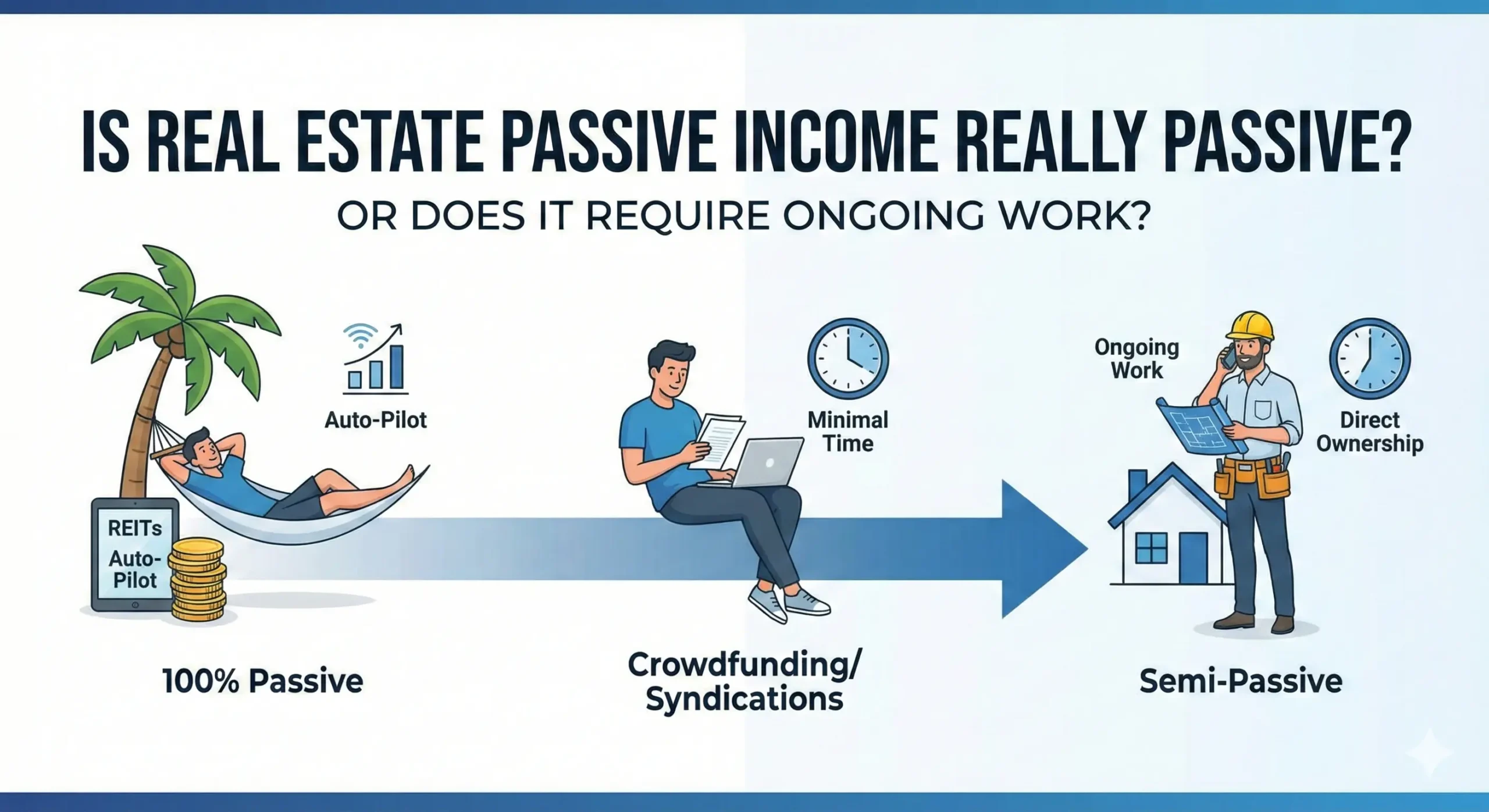
Is Real Estate Passive Income Really Passive or Does It Require Ongoing Work?
TLDR: Passivity levels vary dramatically by strategy. REITs are 100% passive (zero work). Crowdfunding platforms require 1-2 hours monthly. Syndications need 15-30 minutes quarterly. Direct IRA property ownership requires 3-5 hours monthly even with property managers. Choose strategy matching your available time and desire for involvement.
Real estate passive income exists on a spectrum from completely hands-off to semi-passive requiring periodic involvement. The term “passive” doesn’t mean zero work—it means minimal time commitment compared to active income sources or direct landlording.
Understanding exactly how passive each strategy is before you invest prevents the frustration of discovering your “passive” investment requires weekly attention you don’t have time to provide.
The Passivity Spectrum: From Zero Work to Moderate Involvement
Publicly Traded REITs: 100% Passive (0-1 hours annually)
REITs represent the most passive real estate investment possible. Buy shares through any brokerage account, receive automatic dividend deposits, and that’s it.
Annual time commitment:
- Initial research and purchase: 1-2 hours
- Ongoing monitoring: 0 hours (unless you actively trade)
- Tax reporting: 0 hours (1099 form handled by CPA or tax software)
Total: 1-2 hours per year, all front-loaded during purchase.
Dividends arrive automatically in your brokerage account. No decisions required. No communication necessary. No management involvement.
This is true “set it and forget it” investing. You can literally buy REIT shares and not think about them for years.
Real Estate Crowdfunding Platforms: Very Passive (1-2 hours monthly)
Platforms pool investor capital and handle all property operations. Your involvement is limited to reviewing periodic updates.
Quarterly time commitment (per platform):
- Read quarterly investor update email: 15-30 minutes
- Review property performance vs. projections: 15-30 minutes
- Note any concerns or changes: 15 minutes
Total: 1-2 hours per quarter per platform = 4-8 hours annually for single platform.
If you invest across 3-5 platforms, annual time commitment increases to 12-25 hours. Still minimal compared to active investing, but not zero.
The platform handles everything: property selection, due diligence, acquisition, management, disposition. You receive quarterly reports showing financial performance, property updates, and market conditions.
No decisions required unless the platform asks investor approval for major changes (rare—maybe once per investment over 5-7 years).
Individual Syndications: Highly Passive (15-30 minutes quarterly per deal)
Real estate syndication investments require slightly more attention than platforms because you’re evaluating individual deals rather than diversified funds.
Per-syndication time commitment:
Initial phase (before investing):
- Review offering documents: 2-4 hours
- Attend sponsor webinar: 1 hour
- Ask questions and verify details: 1-2 hours
- Complete subscription paperwork: 1 hour Total initial: 5-8 hours per syndication
During hold period (quarterly):
- Read investor update: 15-30 minutes
- Review financial statements: 15-30 minutes
- Compare performance to projections: 15 minutes Total ongoing: 1-2 hours per quarter per syndication
Annual activities:
- Compile K-1 tax forms: 30 minutes per syndication
- Review overall performance: 1-2 hours total portfolio
For a portfolio of 5 syndications: 25-40 hours initial diligence, then 20-40 hours annually for ongoing monitoring.
The sponsor handles all operations. You receive quarterly emails with financial results, property photos, market updates, and any changes to the business plan.
Real Estate Notes: Moderately Passive (30-60 minutes monthly)
Investing in real estate notes (lending money secured by property) requires more attention than equity investments.
Monthly time commitment:
- Verify borrower payment received: 5-10 minutes
- Update tracking spreadsheet: 5-10 minutes
- Follow up on late payments if necessary: 0-30 minutes (occasional)
- Review property condition (if performing inspection): 15-30 minutes (quarterly)
Annual time commitment:
- 12 months of monitoring: 6-12 hours
- Note servicing administration: 2-4 hours
- Tax reporting: 1-2 hours Total: 9-18 hours annually per note
Note investing requires active monitoring because borrower problems can arise. Late payments, property condition deterioration, or default risk need prompt attention to protect your investment.
Direct IRA Property Ownership: Semi-Passive (3-5 hours monthly)
Using self directed IRA to buy real estate directly requires ongoing involvement even with professional property management.
Monthly time commitment:
- Review property manager monthly report: 30-60 minutes
- Approve or decline maintenance requests over threshold: 30-90 minutes
- Handle tenant issues escalated by manager: 0-60 minutes (variable)
- Coordinate with custodian for expense payments: 30-60 minutes
- Review financial performance and bank balances: 30 minutes
Quarterly time commitment:
- Property condition review via photos or video tour: 1-2 hours
- Strategy discussion with property manager: 30-60 minutes
- Market analysis and rent adjustments: 1-2 hours
Annual time commitment:
- Tax preparation and custodian coordination: 3-5 hours
- Major capital expenditure planning: 2-4 hours
- Property management review: 1-2 hours
- Annual compliance verification (prohibited transactions): 2-3 hours
Total annual time commitment: 40-70 hours for single IRA-owned property.
This is significantly less than personal property ownership (200-300 hours annually) but far more than syndications or platforms.
The Bottom Line: Choose Strategy by Available Time
Real estate passive income can be genuinely passive (REITs requiring essentially zero time) or semi-passive (direct IRA property requiring 3-5 hours monthly). The term “passive” is accurate for all these strategies compared to active landlording or business income, but the work ranges from essentially none to moderate.
Before investing, honestly assess your available time and desire for involvement. Nothing is worse than discovering your “passive” investment requires weekly attention you don’t have.
Key Takeaways:
- Passivity spectrum: REITs (0 hours annually) to direct IRA property (40-70 hours annually)
- REITs are truly passive (zero ongoing work after initial purchase)
- Crowdfunding platforms require 1-2 hours monthly (4-8 hours quarterly per platform)
- Syndications require 15-30 minutes quarterly per deal (5-8 hours upfront diligence)
- Real estate notes require 30-60 minutes monthly (payment monitoring and borrower communication)
- Direct IRA property requires 3-5 hours monthly (property manager oversight and custodian coordination)
- Front-loaded due diligence unavoidable (1-50 hours depending on strategy)
- K-1 tax forms add complexity and cost ($200-$500 per form)
- Hire CPAs and advisors to reduce personal time commitment (worth it for portfolios $100,000+)
- Concentrate investments to reduce monitoring burden (fewer positions = less work)
- Match strategy to available time: 0-5 hours = REITs only, 30-50 hours = syndication portfolios
What Returns Should I Realistically Expect from Passive Real Estate Income?
TLDR: Return expectations: REITs 6-10% (3-5% dividend + 3-5% appreciation), crowdfunding 8-12%, syndications 14-18% IRR, notes 8-14%. Higher returns require longer lockups and less liquidity. Historical REIT returns averaged 9.5% over past 20 years. Blended portfolio: 30% REITs + 50% syndications + 20% notes targets 10-13% annual returns.
Return expectations vary significantly by strategy, risk level, liquidity, and how long you’re willing to lock up capital. Higher returns correspond to longer hold periods, less liquidity, and greater risk—there’s no free lunch where you earn 20% with complete safety and daily liquidity.
Understanding realistic returns prevents two costly mistakes: chasing unrealistic promises that lead to losses, and settling for returns below what’s achievable with proper strategy selection.
Historical Real Estate Returns by Strategy
Publicly Traded REITs: 6-10% Total Returns
According to Nareit, equity REITs have delivered:
- Long-term average (1972-2023): 9.2% annual total return
- Dividend yield component: 3-5% annually
- Share price appreciation component: 3-5% annually
Individual years vary dramatically from this average. The best year in recent history (2021) saw 40%+ returns. The worst year (2008) saw -38% returns. Over rolling 10-year periods, returns have ranged from 3% to 13% annually.
Different REIT sectors perform differently:
- Industrial/logistics REITs: 10-13% average (benefiting from e-commerce growth)
- Data center REITs: 8-12% average (technology infrastructure demand)
- Residential/apartment REITs: 8-10% average (housing demand stability)
- Office REITs: 5-8% average (declining demand from remote work)
- Retail REITs: 4-7% average (e-commerce pressure)
The weighted average across all sectors lands around 9% long-term, but sector selection matters significantly.
Real Estate Syndications: 14-18% IRR
Direct syndication investments target:
- Preferred return: 6-8% annually paid from property cash flow
- Equity appreciation: 40-80% total gain over 5-7 year hold
- Combined IRR: 14-18% typical targets
Quality sponsors in decent markets with realistic business plans typically deliver within 2% of projected returns. Aggressive sponsors or declining markets may underperform by 5-10%.
Blended Portfolio Return Expectations
Conservative Portfolio (Lower Risk, Lower Return):
- 50% REITs (6-10% expected return)
- 30% Crowdfunding platforms (8-12% expected)
- 20% First-position notes (8-10% expected) Blended expected return: 7.5-10%
Balanced Portfolio (Moderate Risk, Moderate Return):
- 30% REITs (6-10% expected)
- 50% Syndications (14-18% expected)
- 20% Notes (8-12% expected) Blended expected return: 10-13%
Aggressive Portfolio (Higher Risk, Higher Return):
- 10% REITs (6-10% expected)
- 70% Syndications (14-18% expected)
- 20% Development/opportunistic (16-22% expected) Blended expected return: 13-17%
These blended returns assume proper diversification across multiple properties, markets, and sponsors.
Key Takeaways:
- REIT historical returns: 9.2% average (1972-2023), range 6-10% typical years
- Crowdfunding platforms: 8-12% for non-accredited, 12-18% for accredited investors
- Syndications: 14-18% IRR targets, actual 12-16% average for quality sponsors
- Real estate notes: 8-10% first position, 10-14% second position/distressed
- Higher returns require longer lockups (5-7 years) and less liquidity
- Blended conservative portfolio: 7-9%, balanced: 10-13%, aggressive: 13-17%
- Fees reduce returns 1-3% annually (platforms/sponsors), taxes reduce 2-7% (taxable accounts)
- Roth IRA real estate = 100% tax-free returns (massive advantage over taxable)
- Economic cycle timing impacts returns ±5-10% from averages
- First-time investors: expect 7-10% while learning, experienced: 11-15%, top-quartile: 15-18%

As the Founder and Chief Investment Officer of Bullionite and Bullionite Asset Group, I’ve built my career on a simple premise understanding the intersection of macroeconomics, commodities, and digital assets to stay ahead of the curve, not under it. My focus is on navigating the complexities of the world’s largest markets spanning the US, the Middle East, and Asia to identify high-value opportunities for alternative investment.
With a specialized focus on Self-Directed IRAs (SDIRAs), I help investors move beyond traditional 401ks by integrating assets like precious metals and cryptocurrency into their retirement strategies. Based in Newport Beach, California, I am dedicated to bridging the gap between traditional finance and the evolving landscape of new age digital assets, ensuring that every strategic move is backed by deep market insight and a commitment to long-term growth.