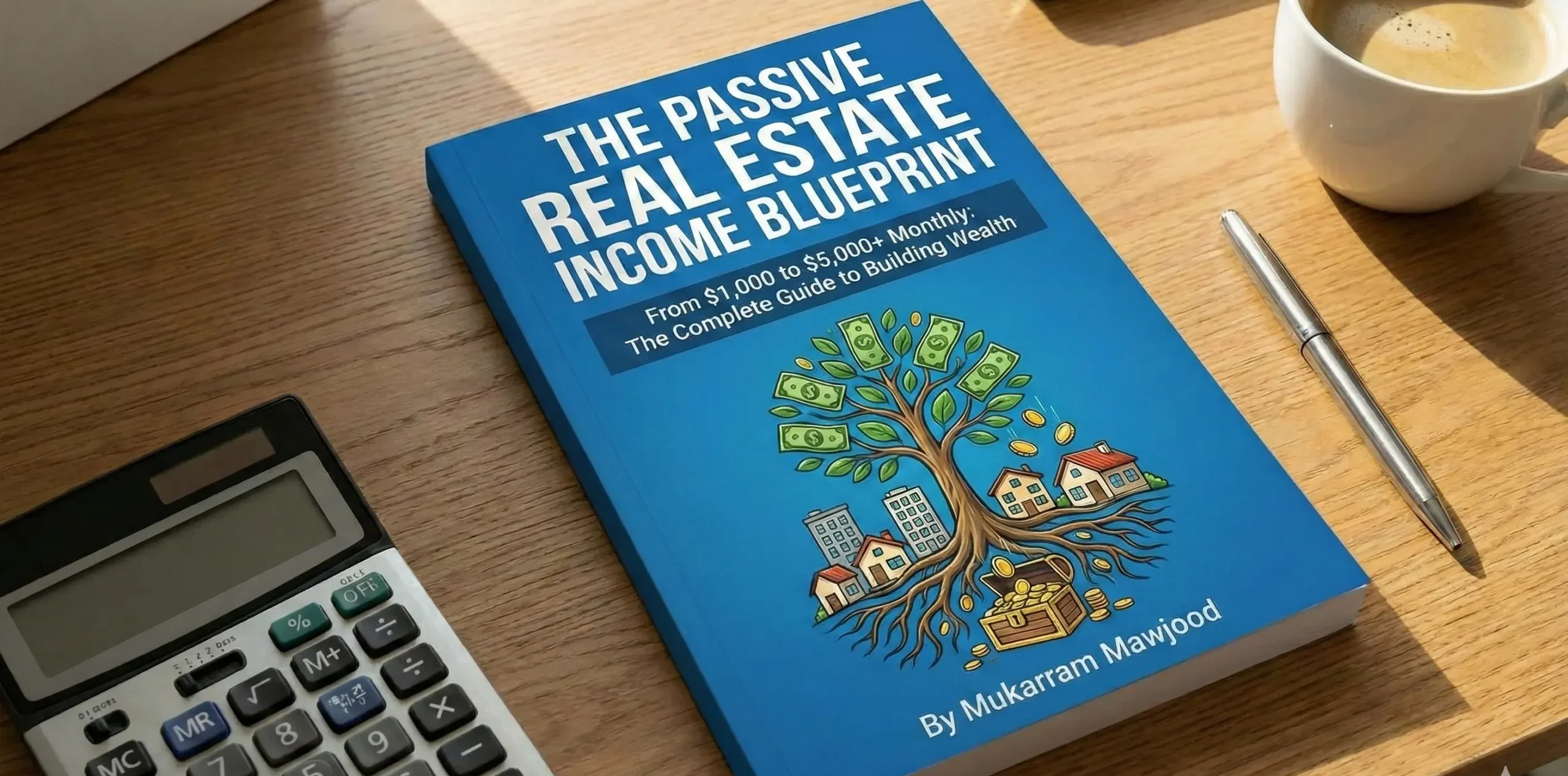
How Much Money Do You Need to Start Building Passive Real Estate Income?
TLDR: You can start with as little as $1,000 through REITs, but meaningful passive real estate income requires $240,000-$400,000 to generate $2,000 monthly. Begin with $5,000-$10,000 to learn the mechanics before scaling up.
You can start building passive income with real estate with as little as $1,000 through publicly traded REITs available on any brokerage platform. But let’s be honest about what “meaningful” income actually means and what different capital levels unlock.
The relationship between capital and passive income is straightforward but often misunderstood. Most beginners either think they need hundreds of thousands to start (wrong) or believe $5,000 will generate substantial monthly income (also wrong). The reality sits somewhere in the middle, and understanding the math helps you set realistic expectations.
What Different Capital Levels Get You
The $1,000-$5,000 Range: Education Phase
With $1,000, you can buy shares of publicly traded REITs through any standard brokerage account. According to Nareit (National Association of Real Estate Investment Trusts), equity REITs have historically delivered average annual total returns of 9-11% over long periods, which translates to roughly $60-$100 annually in dividend income on a $1,000 investment.
Think of this level as your education fund. You’re learning how quarterly distributions arrive, how property types perform differently, and how real estate income feels compared to stock dividends. The financial impact is minimal. The knowledge gained is valuable.
The $5,000-$10,000 Range: Platform Access
This amount opens access to real estate crowdfunding platforms. These platforms pool investor capital to acquire properties you couldn’t afford individually—$10 million apartment complexes, commercial buildings, or diversified portfolios across multiple markets.
At this level, you’re generating $400-$1,000 annually in passive income. Still not replacing your job, but you’re now invested in actual properties with professional management, not just publicly traded securities.
This is where most people should start. The capital requirement is achievable through focused saving over 6-12 months. The platforms handle all complexity. And you’re learning due diligence skills by reviewing platform offerings, property locations, and sponsor track records.
The $10,000-$25,000 Range: Diversification Begins
With $10,000-$25,000, you can diversify across multiple crowdfunding platforms or combine platform investments with individual REIT positions. You’re now generating $800-$2,500 annually, and the income starts feeling real.
More importantly, you’re learning which property types (multifamily, industrial, retail) and which markets (Sunbelt growth, Midwest cash flow, coastal appreciation) align with your goals. This hands-on experience proves invaluable when you scale to larger amounts.
The $25,000-$50,000 Range: Syndication Access
Real estate syndications—where sponsors acquire and operate single large properties with pooled investor capital—typically require $25,000-$50,000 minimum investments. These deals target 15-20% IRR with hold periods of 5-7 years.
At $50,000 deployed, you’re generating $3,000-$5,000 in annual distributions during the hold period, plus equity appreciation returned upon property sale. The income becomes meaningful enough to cover a car payment, fund additional investments, or supplement retirement savings.
The $100,000-$250,000 Range: Portfolio Construction
With six figures, you’re building a diversified real estate portfolio: 30-40% in liquid REITs for stability, 40-50% in syndications for higher returns, 10-20% in real estate notes for consistent income, and 10% cash reserves for opportunities.
This level generates $8,000-$25,000 annually in passive income—enough to notice, but not enough to replace most incomes.
The $250,000-$500,000+ Range: Income Replacement Territory
This is where passive real estate income becomes substantial. A well-constructed $400,000 portfolio targeting blended 10% returns generates $40,000 annually, or $3,333 monthly.
That covers housing costs for many people. Or replaces part-time work income. Or funds annual retirement contributions. The money becomes meaningful to your lifestyle.
The Math That Actually Matters
Here’s the rule of thumb that’s held true across different strategies and market cycles: expect $500-$1,000 annual passive income per $10,000 invested.
That’s a 5-10% annual return range, depending on your strategy mix. Conservative portfolios heavy on REITs and stable notes land around 6-8%. Aggressive portfolios concentrated in syndications and crowdfunding target 10-14%.
So if your goal is $2,000 monthly passive income ($24,000 annually), you need $240,000-$400,000 deployed, depending on your risk tolerance and strategy selection.
Want $5,000 monthly ($60,000 annually)? You’re looking at $600,000-$1,000,000 in deployed capital.
These numbers seem daunting. They are. Building substantial passive income takes time and consistent capital deployment.
The Biggest Mistake Beginners Make
Most people see these numbers and conclude they should wait until they save $100,000 or $250,000 before starting. This is wrong for two reasons.
First, you need experience before deploying large amounts. Starting with $5,000 and spending two years learning platforms, evaluating deals, and understanding risk tolerance makes better decisions possible when you have $100,000 to deploy.
Second, the time cost of waiting is massive. Contributing $1,000 monthly to real estate investments for five years beats sitting on cash waiting to save $60,000 upfront. You’re earning 8-12% returns on early contributions while still accumulating capital. Over five years, monthly contributions compound to roughly $77,000 versus $60,000 for the lump-sum approach—a $17,000 difference from identical contribution amounts.
How to Start With What You Have Now
If you have $1,000-$5,000: Open a brokerage account and buy shares of diversified REIT index funds or individual REITs across different property types. The SEC’s investor education resources provide helpful background on how REITs work and what to look for. Learn how distributions work. Track performance through different market conditions. Spend six months understanding real estate income mechanics.
If you have $5,000-$25,000: Research crowdfunding platforms. Read through their offerings. Understand fee structures. Make your first investment in a diversified fund rather than individual properties. Review quarterly reports religiously. Join investor forums to learn from others’ experiences.
If you have $25,000-$100,000: Start evaluating individual syndications. Join platforms that vet deals. Attend sponsor webinars. Read operating agreements thoroughly. Make your first syndication investment, then review performance for 12-18 months before committing to additional deals. Diversify across 3-5 sponsors rather than concentrating with one.
If you have $100,000+: Build a written investment strategy. Define allocation targets across different property types and geographies. Establish criteria for evaluating deals. Create a deployment schedule spreading investments over 12-24 months to avoid timing risk. Consider using a self-directed IRA for tax advantages on highest-return strategies.
The Power of Consistent Deployment
The relationship between capital invested and passive income is linear: double your investment, double your income (assuming similar return rates).
A $50,000 investment generating 8% returns produces $4,000 annually. Scale to $100,000, and you’re at $8,000. Hit $250,000, and you’re generating $20,000 annually.
This linearity makes planning straightforward. Know your monthly income goal, divide by 0.008-0.012 (the expected return range), and you have your capital target.
Want $3,000 monthly ($36,000 annually)? Divide $36,000 by 0.10 (10% target return) = $360,000 needed.
The path from $0 to $360,000 seems impossible. But break it down:
- Year 1-2: Save aggressively, invest $1,000 monthly, learn platforms ($24,000 + $2,000 returns = $26,000)
- Year 3-5: Increase monthly investment to $2,000, returns compound ($98,000 + $12,000 returns = $110,000 total)
- Year 6-8: Deploy windfalls (bonuses, inheritance, business sale), maintain $2,000 monthly ($182,000 + $28,000 returns = $210,000 total)
- Year 9-12: Final push to goal with increased contributions and compounding returns
It takes a decade. Most worthwhile financial goals do.
When Alternative Assets Make Sense
Real estate represents one category within alternative assets investment opportunities. Other options include precious metals investing, private equity, or venture capital.
For most investors building passive income, real estate offers the best combination of accessibility (lower minimums than other alternatives), cash flow (quarterly distributions versus illiquid equity), and comprehensibility (you understand apartment buildings better than private equity structures).
However, some investors allocate 5-15% to precious metals IRAs or other alternative assets for portfolio diversification. This makes sense once you’ve established core real estate positions and have capital exceeding $100,000-$250,000.
Reality Check: The Timeline
Here’s what realistic timelines look like for different goals:
Goal: $500 monthly passive income
- Capital needed: $50,000-$75,000
- Timeline from $0: 3-5 years with $1,000-$1,500 monthly contributions
- Realistic for: Most households with focused effort
Goal: $2,000 monthly passive income
- Capital needed: $200,000-$300,000
- Timeline from $0: 7-10 years with $2,000-$3,000 monthly contributions
- Realistic for: High-income households or those with windfalls
Goal: $5,000 monthly passive income
- Capital needed: $500,000-$750,000
- Timeline from $0: 12-18 years with aggressive saving or business success
- Realistic for: Long-term accumulators or entrepreneurs
These timelines assume 8-10% blended returns and consistent monthly investing. Markets don’t cooperate perfectly, so build in 20-30% buffer time.
Key Takeaways:
- Minimum entry: $1,000 (REITs), $5,000-$10,000 (crowdfunding), $25,000+ (syndications)
- Income formula: $500-$1,000 per year per $10,000 invested (5-10% returns)
- For $2,000 monthly income: need $240,000-$400,000 deployed capital
- For $5,000 monthly income: need $600,000-$1,000,000 deployed capital
- Start with $5,000-$10,000 to learn before committing larger amounts
- Consistent monthly investing beats waiting for lump sums
- Timeline to meaningful income: 7-12 years with disciplined approach
- Don’t wait to save large amounts—start learning with available capital now

As the Founder and Chief Investment Officer of Bullionite and Bullionite Asset Group, I’ve built my career on a simple premise understanding the intersection of macroeconomics, commodities, and digital assets to stay ahead of the curve, not under it. My focus is on navigating the complexities of the world’s largest markets spanning the US, the Middle East, and Asia to identify high-value opportunities for alternative investment.
With a specialized focus on Self-Directed IRAs (SDIRAs), I help investors move beyond traditional 401ks by integrating assets like precious metals and cryptocurrency into their retirement strategies. Based in Newport Beach, California, I am dedicated to bridging the gap between traditional finance and the evolving landscape of new age digital assets, ensuring that every strategic move is backed by deep market insight and a commitment to long-term growth.