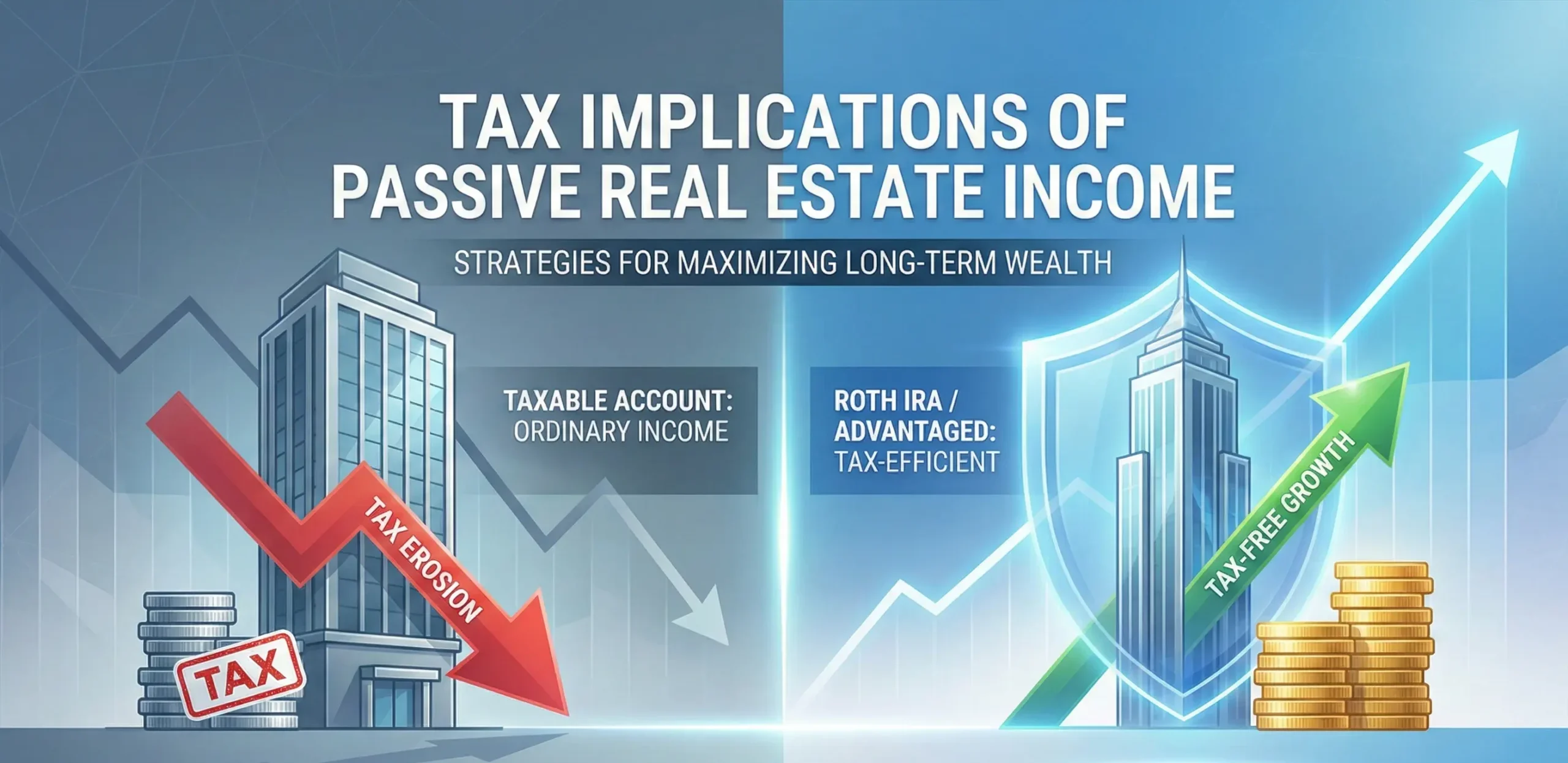
What Are the Tax Implications of Passive Real Estate Income?
TLDR: Tax treatment depends on investment structure and account type. REITs are taxed as ordinary income (up to 37%), syndications offer depreciation benefits deferring taxes until sale, and self-directed Roth IRAs eliminate all taxes forever. The difference in tax efficiency can add $200,000-$500,000 to lifetime wealth on identical investments.
Passive real estate income taxation depends entirely on investment structure and account type, with tax efficiency varying dramatically between strategies. Understanding these differences helps you keep significantly more of what you earn and compound wealth faster over decades.
The wrong account placement costs you tens or hundreds of thousands in unnecessary taxes. The right structure can eliminate taxation entirely on real estate returns.
Taxation in Taxable Brokerage Accounts
REIT Dividends: Ordinary Income Treatment
Publicly traded REIT dividends receive the least favorable tax treatment. Unlike qualified dividends from regular stocks (taxed at 15-20% long-term capital gains rates), REIT dividends are taxed as ordinary income at your marginal rate.
If you’re in the 35% federal tax bracket, a $10,000 REIT dividend costs you $3,500 in federal tax plus state income tax (0-13% depending on location). Total tax bite: $3,500-$4,800.
Compare this to $10,000 in qualified stock dividends taxed at 20% federal long-term capital gains rate plus 3.8% Net Investment Income Tax (NIIT): $2,380 total. REITs cost an extra $1,120-$2,420 in tax on the same $10,000 income.
However, a portion of REIT dividends (typically 20-40%) are classified as “return of capital” which reduces your cost basis and isn’t immediately taxable. And some portion may qualify as long-term capital gains. Check the 1099-DIV form annually to see the breakdown.
Real Estate Syndication Distributions: Depreciation Shelters Current Income
Syndication investments provide significant tax advantages through depreciation offsetting current income. This creates “phantom losses” that shelter cash distributions from immediate taxation.
Here’s how it works: You invest $50,000 in a multifamily syndication. The property generates $3,500 annual cash distributions to you (7% cash-on-cash return). But the property also generates $8,000 in depreciation allocated to your K-1.
On your tax return:
- Cash received: $3,500
- Depreciation loss: -$8,000
- Net taxable income: -$4,500 (loss)
You receive $3,500 cash but report a $4,500 loss for tax purposes. That loss can offset other passive income or carry forward to future years.
The tax is deferred, not eliminated. When the property sells in year 5-7, you’ll pay:
- Capital gains tax on appreciation (15-20% federal + 3.8% NIIT)
- Depreciation recapture tax (25% federal rate on cumulative depreciation taken)
But deferring tax for 5-7 years while compounding money in your investment creates substantial value. And strategic use of 1031 exchanges allows indefinite tax deferral by rolling proceeds into new properties.
Cost Segregation: Accelerating Depreciation Benefits
Sophisticated syndication sponsors use cost segregation studies to accelerate depreciation into early years. This creates massive year-one deductions.
Normal depreciation on real estate spreads deductions over 27.5 years (residential) or 39 years (commercial). Cost segregation reclassifies portions of the property (carpet, appliances, landscaping, parking lots) as shorter-lived assets depreciable over 5, 7, or 15 years.
Result: A $1 million property might generate $30,000-$40,000 in normal first-year depreciation, but $150,000-$250,000 with cost segregation. For high-income investors, this creates six-figure tax deductions in year one.
The IRS allows cost segregation as a legitimate tax strategy when properly documented by qualified engineers.
Real Estate Crowdfunding Returns: Ordinary Income + Capital Gains
Crowdfunding platforms typically distribute returns as a combination of ordinary income (from rental cash flow) and capital gains (from property sales).
Quarterly distributions from cash flow are taxed as ordinary income in the year received. When the platform sells properties, gains are reported as long-term capital gains (15-20% federal rate if held over 1 year) on your K-1.
Unlike syndications with significant depreciation pass-through, many crowdfunding structures don’t pass depreciation to investors (the platform entity absorbs it). This makes crowdfunding less tax-efficient than direct syndication investments in taxable accounts.
Real Estate Note Interest: Ordinary Income
Interest income from private real estate notes is taxed as ordinary income at your marginal rate. A note paying 10% on $100,000 generates $10,000 annual interest, taxed at up to 37% federal plus state income tax.
No depreciation benefits. No preferential capital gains treatment. Pure ordinary income taxation.
This makes notes most suitable for tax-advantaged retirement accounts where the income grows tax-deferred or tax-free.
Taxation in Retirement Accounts
Traditional IRA Real Estate: Tax-Deferred Compounding
Real estate investments in Traditional self directed IRAs grow completely tax-deferred until withdrawal in retirement.
Property generates $15,000 annual rental income? Zero current tax. Sell property for $100,000 gain? Zero capital gains tax. All growth compounds tax-deferred inside the IRA.
The tax comes when you take distributions in retirement. At that point, everything is taxed as ordinary income regardless of whether it came from rent, interest, dividends, or capital gains inside the IRA.
This matters because capital gains that would have been taxed at 15-20% are now taxed at ordinary income rates (potentially 22-35% in retirement). You lose the preferential capital gains treatment.
However, many retirees are in lower tax brackets than during their working years, partially offsetting this disadvantage. And decades of tax-deferred compounding typically outweigh the tax rate differences.
Roth IRA Real Estate: Tax-Free Forever
Real estate in self directed Roth IRAs grows completely tax-free forever. No taxes on income. No taxes on gains. No taxes on distributions in retirement.
This is the most powerful tax structure available for long-term wealth building. Every dollar of appreciation, every distribution, every gain compounds without any tax drag.
The math is extraordinary: A $50,000 Roth IRA investment in a syndication earning 16% annually grows to $430,000 over 30 years. In a taxable account, that same investment nets roughly $280,000 after taxes. The Roth IRA generates $150,000 more wealth from identical investment performance.
The IRS Roth IRA rules require account to be open 5+ years and you must be 59½ or older for completely tax-free withdrawals. But the 5-year clock starts when you first open any Roth IRA, not when you make each investment.
UBIT: The Hidden Tax on Leveraged IRA Real Estate
When you use non-recourse loans to purchase real estate in an IRA, you may trigger Unrelated Business Income Tax (UBIT) on the debt-financed portion.
UBIT tax IRA applies to the percentage of property purchased with borrowed money. Buy a $200,000 property with $100,000 from your IRA and $100,000 non-recourse financing (50% debt)? Then 50% of the net income is subject to UBIT.
The property generates $20,000 net operating income. $10,000 (50%) is subject to UBIT at trust tax rates (10-37%, same brackets as individuals but compressed into lower income ranges). After $1,000 exemption, you’d pay approximately $1,800-$3,300 in UBIT on that $10,000.
The remaining 50% ($10,000) grows tax-free in your Roth IRA or tax-deferred in your Traditional IRA as usual.
UBIT also applies to capital gains upon sale. If you sell the property for $100,000 gain, $50,000 (the debt-financed portion) is subject to UBIT.
Many investors avoid UBIT by purchasing IRA properties all-cash (no leverage). Others accept UBIT as a worthwhile cost for using leverage to amplify returns—even after UBIT, leveraged returns often exceed unleveraged returns.
Form 990-T must be filed annually for any IRA generating over $1,000 in unrelated business income. Your self directed IRA custodian doesn’t handle this—you must file it yourself or hire a tax preparer familiar with UBIT calculations.
State Tax Considerations
State taxation of real estate income varies significantly:
No Income Tax States: Alaska, Florida, Nevada, South Dakota, Tennessee, Texas, Washington, Wyoming have no state income tax on any real estate income. New Hampshire only taxes dividends and interest (not capital gains).
High Tax States: California (13.3% top rate), New York (10.9%), New Jersey (10.75%), Oregon (9.9%), and Minnesota (9.85%) take substantial portions of real estate income.
REIT-Specific Rules: Some states tax REIT dividends differently than regular dividends. Check state-specific rules.
IRA Distribution Taxation: All states without income tax also don’t tax IRA distributions in retirement. High-tax states do tax Traditional IRA distributions (but not Roth IRA distributions, which are federally tax-free).
This creates massive differences in after-tax wealth. A California resident in the 13.3% bracket pays nearly 50% combined federal and state tax on ordinary income. A Texas or Florida resident pays only 37% federal tax.
Tax Efficiency Strategies
Strategy 1: Asset Location Optimization
Place investments strategically across account types to minimize total tax burden:
Roth IRA (tax-free forever):
- Highest-return investments (syndications targeting 15-20% IRR)
- Longest time horizon investments (maximize compounding time)
- Investments with significant appreciation potential
Traditional IRA (tax-deferred):
- Moderate-return investments (notes paying 8-12%)
- Investments generating mostly ordinary income
- Shorter time horizon investments (if retiring soon)
Taxable brokerage accounts:
- Publicly traded REITs (if held in tax-advantaged accounts unavailable or maxed out)
- Investments with return of capital components
- Holdings you may need to access before 59½ (no early withdrawal penalty)
Strategy 2: Tax-Loss Harvesting with REITs
REITs in taxable accounts can be sold at losses to offset capital gains from other investments. You can immediately repurchase a different REIT to maintain real estate exposure without violating wash-sale rules (as long as it’s not “substantially identical”).
Strategy 3: Qualified Opportunity Zones
Investing capital gains into Qualified Opportunity Zone funds provides:
- Deferral of capital gains tax until 2026 or when you sell the QOZ investment
- 10% reduction in deferred gain if held 5+ years
- Complete elimination of capital gains tax on QOZ investment appreciation if held 10+ years
This pairs well with selling appreciated real estate syndications in taxable accounts and rolling gains into QOZ funds. The IRS Opportunity Zone guidelines provide full details.
Strategy 4: Charitable Donations of Appreciated Real Estate Investments
If you’re charitably inclined, donating appreciated REIT shares or syndication interests to donor-advised funds or directly to charities eliminates capital gains tax while providing income tax deduction for fair market value.
Strategy 5: Intentionally Defective Grantor Trusts (IDGTs)
High-net-worth investors can use IDGTs to sell real estate investments to trusts at fair market value in exchange for promissory notes. Income and appreciation occur inside the trust (benefiting heirs) while you remove assets from taxable estate. The “defect” means you pay income tax on trust earnings, effectively making tax-free gifts to heirs.
This requires sophisticated estate planning with experienced attorneys but can save millions in estate taxes for large portfolios.
Tax Reporting Requirements
K-1 Forms from Syndications and Crowdfunding
Most private real estate investments issue K-1 forms (Form 1065 Schedule K-1) rather than 1099s. K-1s report your share of:
- Rental income
- Interest income
- Dividends
- Capital gains and losses
- Depreciation and other deductions
K-1s typically arrive in March or April, well after the early filing season. If you like filing taxes in February, real estate syndications will frustrate you—you’ll need extensions.
Each investment issues a separate K-1. A portfolio of 10 syndications means 10 K-1s to track and report.
FBAR and Foreign Real Estate
If you invest in real estate outside the United States through crowdfunding platforms or syndications, you may need to file FBAR (Foreign Bank Account Report) if your foreign financial accounts exceed $10,000 at any point during the year.
International real estate investments add complexity. Understand reporting requirements before investing.
State Nexus Issues
Owning real estate investments in other states may create filing obligations in those states. Some states require non-resident tax returns if you have any income sourced from property in that state.
For example, own part of a Texas syndication as a California resident? Texas has no income tax so you’re fine. Own part of a New York syndication as a California resident? You may need to file both California and New York tax returns, with credits for taxes paid to other states preventing double taxation.
The Tax Value of Self-Directed Roth IRAs: Real Numbers
Let’s quantify the tax advantage of optimal account placement over a career:
Scenario: $100,000 invested in real estate syndications over 30 years
Taxable Brokerage Account:
- Annual return: 16% gross, 12.5% after-tax (assuming 35% tax drag from current income taxes and deferred capital gains)
- Ending value: $3,340,000
- Taxes paid over 30 years: ~$2,100,000
- Net after-tax: $3,340,000
Traditional Self-Directed IRA:
- Annual return: 16% tax-deferred
- Ending value: $8,480,000
- Taxes owed on distributions (assume 30% effective rate in retirement): $2,544,000
- Net after-tax: $5,936,000
Self-Directed Roth IRA:
- Annual return: 16% tax-free
- Ending value: $8,480,000
- Taxes owed: $0
- Net after-tax: $8,480,000
The Differences:
- Roth IRA vs. Taxable: $5,140,000 more wealth (154% increase)
- Roth IRA vs. Traditional IRA: $2,544,000 more wealth (43% increase)
- Traditional IRA vs. Taxable: $2,596,000 more wealth (78% increase)
This isn’t hypothetical. This is basic math that plays out over decades for investors who understand tax-advantaged account structures.
Common Tax Mistakes to Avoid
Mistake 1: Not Filing Form 990-T for UBIT
Failing to file Form 990-T when your IRA has leveraged real estate generating over $1,000 in debt-financed income triggers penalties and potential IRS audit. File even if no tax is owed.
Mistake 2: Commingling Personal and IRA Expenses
Paying IRA property expenses from personal accounts creates prohibited transactions, disqualifying the entire IRA. Every dollar in and out must flow through the IRA.
Mistake 3: Ignoring State Tax Nexus
Not filing required state non-resident returns for out-of-state real estate income can trigger penalties, interest, and complications years later when states eventually discover the income.
Mistake 4: Overconcentrating in Tax-Inefficient Structures
Holding all real estate in taxable accounts when you have unused IRA contribution room or holding everything in Traditional IRAs when Roth conversions would save more long-term tax are both inefficient.
Mistake 5: Not Tracking Cost Basis Properly
REIT dividends classified as “return of capital” reduce your cost basis. Failing to track this means overpaying capital gains tax when you eventually sell. Keep detailed records of all 1099-DIV forms.
Work With Qualified Tax Professionals
Real estate taxation is complex. The intersection of real estate tax rules, passive activity loss rules, self-directed IRA rules, UBIT calculations, and state tax complications creates a minefield.
Work with CPAs or tax attorneys experienced in real estate investing and self directed retirement accounts. The money saved through proper tax planning dramatically exceeds professional fees.
If investing in syndications generating K-1s or using self-directed IRAs, don’t use consumer tax software alone. These situations require professional review.
Key Takeaways:
- REIT dividends taxed as ordinary income (up to 37% + state), least tax-efficient
- Syndication distributions mostly tax-deferred via depreciation until property sale
- Cost segregation accelerates depreciation, creating massive early-year deductions
- Real estate notes generate ordinary income with zero preferential tax treatment
- Traditional IRA real estate: tax-deferred until retirement distributions
- Roth IRA real estate: completely tax-free forever (most powerful structure)
- UBIT applies to debt-financed portion when using non-recourse loans in IRAs
- Optimal placement: highest-return investments in Roth IRAs, moderate returns in Traditional IRAs, remainder in taxable accounts
- Over 30 years, Roth IRA can generate $2-5 million more wealth than taxable accounts on identical investments
- Work with CPAs experienced in real estate and self-directed IRAs for complex situations
- K-1 forms arrive late (March/April), plan for tax filing extensions
- State tax rates vary 0-13.3%, creating huge differences in after-tax returns

As the Founder and Chief Investment Officer of Bullionite and Bullionite Asset Group, I’ve built my career on a simple premise understanding the intersection of macroeconomics, commodities, and digital assets to stay ahead of the curve, not under it. My focus is on navigating the complexities of the world’s largest markets spanning the US, the Middle East, and Asia to identify high-value opportunities for alternative investment.
With a specialized focus on Self-Directed IRAs (SDIRAs), I help investors move beyond traditional 401ks by integrating assets like precious metals and cryptocurrency into their retirement strategies. Based in Newport Beach, California, I am dedicated to bridging the gap between traditional finance and the evolving landscape of new age digital assets, ensuring that every strategic move is backed by deep market insight and a commitment to long-term growth.