TL;DR
A palladium IRA rollover transfers existing retirement savings from a 401k, traditional IRA, Roth IRA, SEP IRA, 403b, TSP, 457b, or pension into a self-directed IRA that holds physical palladium. What is a palladium IRA, exactly? It is a self-directed precious metals IRA where the underlying asset is physical palladium bullion meeting IRS purity standards, rather than stocks or bonds. Palladium in retirement account vehicles has been IRS-permitted since 1997. This palladium IRA rollover guide covers the complete 2026 palladium IRA rollover process: eligible account types, step-by-step transfer mechanics, IRS purity rules, custodian selection, fees, tax advantages, and risks. Done correctly, a precious metals IRA rollover is completely penalty-free and tax-free. Palladium retirement investment inside an IRA shields your gains from the 28% collectibles capital gains tax that applies to physical palladium held outside a retirement account. Palladium IRA liquidity is lower than gold — factor this into your allocation decisions. How liquid is a palladium IRA? Selling $50,000 of palladium takes 5 to 10 business days to settle as cash in your SDIRA account, compared to 1 to 3 days for gold.
Yes, you can convert your existing retirement funds into physical palladium inside a tax-advantaged account. The IRS permits precious metals including palladium in self-directed IRAs under IRC Section 408(m)(3), as long as the metal meets the required purity standard and is held by a qualified custodian at an approved depository.
This palladium IRA rollover 2026 guide fills a gap that most gold-focused content ignores. Palladium is the rarest and most misunderstood of the four IRS-permitted precious metals. Its industrial demand profile, supply concentration in Russia and South Africa, and tax treatment inside an IRA are all distinct from gold and silver. If you are evaluating whether to roll 401k into palladium IRA or move an existing precious metals IRA to include palladium, this is the most complete resource available.
What Is a Palladium IRA Account and How Does It Work?
A palladium IRA account is a self-directed individual retirement account (SDIRA) that holds physical IRS-approved palladium bullion as its primary asset. Unlike standard IRAs, a palladium self-directed IRA cannot be opened at Fidelity, Vanguard, or Schwab — those custodians only support paper-based assets. How to open a palladium IRA: you need a specialist self-directed IRA custodian that handles physical precious metals. Opening a palladium IRA requires palladium IRA account setup with one of these specialist custodians — a process that takes 3 to 5 business days.
Self directed ira palladium accounts, also called a palladium SDIRA, work like any other IRA for tax purposes: contributions and gains in a palladium traditional IRA grow tax-deferred, while gains in a palladium Roth IRA grow completely tax-free for qualified distributions. The key structural difference is that the IRA’s assets are physical palladium bars and coins stored at an IRS-approved depository, not ETF shares or paper contracts.
You can open several account types as a palladium-backed IRA: a palladium traditional IRA funded with pre-tax dollars, a palladium Roth IRA funded with after-tax dollars for tax-free growth, a palladium Roth IRA rollover converting pre-tax funds into Roth treatment, a palladium SEP IRA for self-employed individuals or small business owners, and a palladium SIMPLE IRA for qualifying small business employees. Palladium IRA account setup typically takes 3 to 5 business days once you have chosen a custodian. A palladium self directed IRA is sometimes called a palladium-backed IRA in industry shorthand. Opening a palladium SEP IRA is especially valuable for self-employed investors: palladium SEP IRA contribution limits allow up to 25% of net self-employment income annually, far above standard IRA limits.
If you are comparing the best palladium IRA accounts, the key variables are annual custody fees, depository options, product selection (bars vs. coins), and whether the custodian has dedicated palladium dealer relationships. Not all SDIRA custodians offer palladium — confirm this before submitting any application.
Which Retirement Accounts Can You Roll Over Into a Palladium IRA?
Almost every qualified retirement plan can be used to convert retirement account to palladium or fund an SDIRA. Here is a complete list of account types that qualify for a palladium IRA rollover, allowing you to rollover retirement account to precious metals without triggering taxes:
- 401k to palladium rollover: Former employer 401k plans are the most common source. A 401k rollover to palladium IRA from a past employer is straightforward via direct transfer. Current employer plans typically require separation from service or in-service distribution provisions. 401k palladium investment is how most investors first access this asset class.
- 403b to palladium IRA: Available to teachers, nonprofit employees, and healthcare workers. Rollover mechanics are identical to 401k plans.
- TSP rollover to palladium IRA: Federal employees and military personnel can move Thrift Savings Plan funds into a palladium SDIRA upon separation or retirement.
- 457b rollover palladium IRA: State and local government employees can roll 457b plan balances into a palladium IRA after leaving employment.
- Pension rollover to palladium IRA: Lump-sum pension distributions can be rolled directly into a palladium SDIRA within 60 days.
- Traditional and Roth IRA transfers: Existing IRA balances transfer without limits or deadlines via direct custodian-to-custodian transfer.
- SEP and SIMPLE IRA rollovers: SEP IRAs can be moved at any time. SIMPLE IRA funds require a 2-year holding period before rolling to a different plan type.
Roll 401k into palladium IRA remains the most popular entry point, typically involving palladium retirement savings accumulated over decades in an employer plan. Palladium IRA for seniors near or in retirement: you can still roll over existing retirement funds at any age, though RMD rules from a traditional palladium IRA begin at age 73. Palladium retirement fund and palladium retirement savings in a Roth SDIRA have no RMDs during the account holder’s lifetime, making the Roth route attractive for estate planning.
A palladium SDIRA also qualifies as an alternative assets IRA palladium vehicle, allowing you to hold palladium alongside other permitted alternative assets in a single self-directed account if your custodian supports multi-asset SDIRAs.
IRS Rules for a Palladium IRA: What Is IRA-Eligible Palladium?
Can you hold palladium in an IRA? Yes — but only specific products. Is palladium allowed in an IRA? Under IRC Section 408(m)(3) (IRC 408 palladium IRA rules), the IRS permits palladium in self-directed IRAs subject to three mandatory requirements: minimum purity fineness, custodian holding, and approved depository storage. IRA-eligible palladium (also called IRA-approved palladium) must meet these rules in full. Palladium IRA rules leave no room for exceptions.
Palladium IRA Purity Requirements: The .9995 Fineness Standard
Palladium IRA purity requirements mandate a minimum fineness of .9995 (99.95% pure) — the palladium IRA fineness requirement is stricter than gold (which requires .9950) and silver (.9990). The palladium .9995 fineness IRA rule is non-negotiable. Any palladium coin or bar below this threshold is classified as a collectible under IRC 408(m)(2)(E) — the palladium IRA collectibles rule — and holding it inside an IRA triggers immediate taxation as a distribution equal to the purchase price.
IRA eligible palladium coins and IRA eligible palladium bars are the two categories of ira approved palladium and ira eligible palladium products. IRA eligible palladium falls into two product types: coins struck by authorized government mints meeting .9995 purity, and bars produced by NYMEX/COMEX-approved refineries at .9995 fineness or higher. Everything else is ineligible by definition.
IRA-Eligible Palladium Coins
IRA-approved palladium (also called IRA-eligible palladium) coins that meet .9995 fineness include:
- Palladium Maple Leaf IRA eligible: Canadian Palladium Maple Leaf (Royal Canadian Mint, 1 oz, .9999 fineness — exceeds the minimum)
- Palladium American Eagle IRA eligible: Palladium American Eagle coin (U.S. Mint, 1 oz, .9995 fineness, authorized by Public Law 115-123 effective 2018)
- Russian Palladium Ballerina coins produced by an approved refinery meeting .9995 purity
IRA-Eligible Palladium Bars
Palladium IRA eligible bars must meet .9995 fineness and be produced by a NYMEX or COMEX-approved refinery and assayer. IRA-approved palladium bars that qualify include:
- PAMP Suisse palladium bars (.9995 fineness, COMEX-approved)
- Credit Suisse palladium bars (.9995 fineness, NYMEX-approved)
- Baird & Co. palladium bars (.9995 fineness)
- Johnson Matthey palladium bars (.9995 fineness, from approved refineries)
- Any palladium bars IRA from a NYMEX/COMEX-approved refinery meeting .9995 purity
Palladium rounds IRA eligible status: rounds may qualify if they meet .9995 fineness and are produced by an approved refinery — but rounds are less standardized than bars and coins, so confirm eligibility with your custodian before purchasing.
What Palladium Is NOT IRA-Eligible
Palladium IRA numismatic coins — collector, commemorative, or proof coins valued above their melt value — are never IRA-eligible. Common examples of non-eligible palladium: France 100 Franc Lafayette palladium proofs, Portugal palladium proof coins, China Palladium Panda 50/100 Yuan coins, Tonga King Taufa Ahau Tupou IV palladium coins, Australian Emu palladium coins. The palladium IRA collectibles rule treats these as collectibles, triggering a deemed distribution if purchased inside an IRA.
Palladium IRA Prohibited Transactions
Palladium IRA compliance also requires avoiding prohibited transactions under IRC Section 4975. Common violations that will disqualify your physical palladium IRA and make the entire account balance taxable:
- Taking personal possession of the palladium bullion IRA assets at any point while in the IRA
- Using IRA-owned palladium as collateral for a personal loan
- Selling personally-owned palladium to your own IRA at any price
- Purchasing palladium IRA bars or palladium coins IRA assets from a disqualified person (you, your spouse, parents, children, or their spouses)
- Home storage or personal vault: any palladium IRA home storage arrangement where you control access is a prohibited transaction
How to Rollover IRA to Palladium: The Complete 5-Step Process
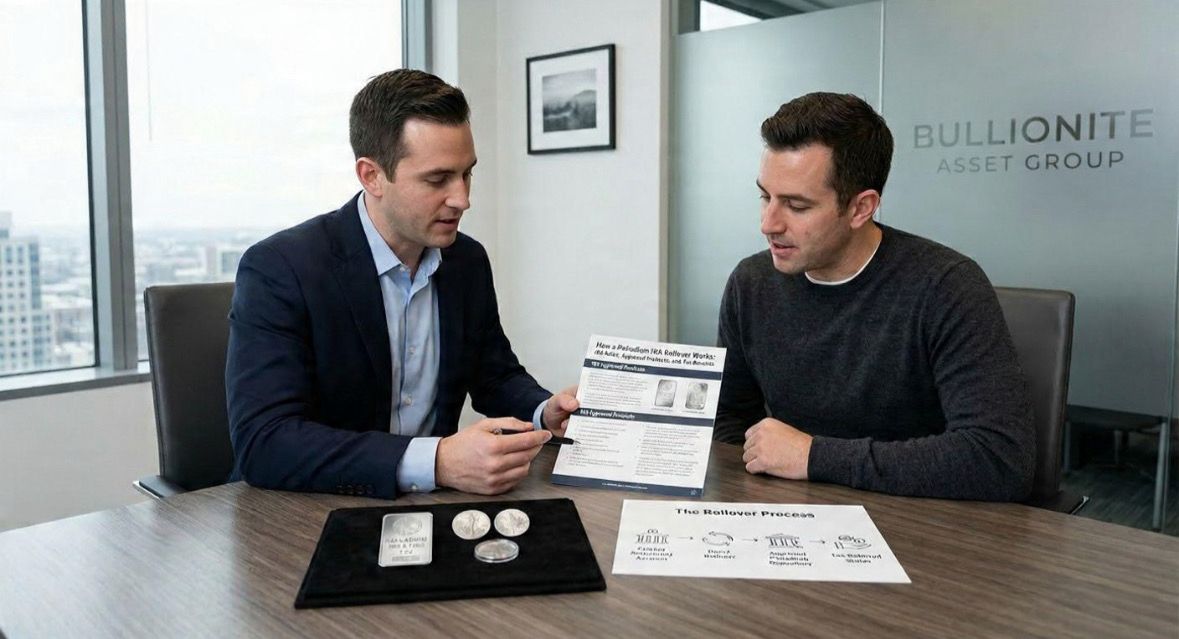
Here are the complete palladium IRA rollover steps from start to first purchase. How long does a palladium IRA rollover take? Typically 3 to 6 weeks from opening the account to palladium sitting in your depository. Understanding the palladium IRA direct transfer vs rollover distinction is the most important decision in this process.
Step 1: Choose Your Palladium IRA Custodian
Before doing anything else, select the custodian for your new self-directed IRA. This is where most investors spend too little time. Not every SDIRA custodian supports palladium. Confirm explicitly that they custody physical palladium bullion and have established dealer relationships for palladium purchases.
Step 2: Open Your Self-Directed Palladium IRA Account
Complete the palladium IRA rollover paperwork — specifically the new account application and the palladium IRA rollover form authorizing the fund transfer from your existing account. Most custodians now offer a palladium IRA online account application that takes 10 to 20 minutes. Account approval typically takes 1 to 3 business days.
Step 3: Initiate the Fund Transfer (Direct vs. Indirect)
This is the most important step. There are two types of palladium IRA rollover:
Palladium IRA direct rollover (recommended): Your existing custodian wires funds directly to your new SDIRA custodian. You never receive a check. No 60-day deadline. No withholding. No annual limit on direct transfers. This is the penalty free palladium rollover route and how you achieve a palladium IRA rollover no penalty outcome. A palladium IRA direct rollover is technically called a trustee-to-trustee transfer.
Palladium IRA indirect rollover (risky): Your old custodian issues a check made payable to you. You then have 60 days — the palladium IRA 60 day rollover rule — to redeposit 100% into the new SDIRA. If your old account is a 401k, the custodian is required to withhold 20% for taxes. You must still deposit the full original amount from other funds or that 20% becomes a taxable distribution. The palladium IRA rollover deadline is 60 days from check issue date, not receipt date. Miss it and you owe income tax plus a 10% early withdrawal penalty if under age 59.5.
“The palladium IRA rollover penalty free path is nearly always the direct transfer. We have seen investors miss the 60-day window because they thought the clock started when they received the check, not when it was issued. On a $300,000 rollover at a 35% combined tax rate, that mistake costs $105,000 plus penalties. Always use a direct palladium IRA transfer unless you have a specific reason not to. According to Marcus Reid, CFP, BullioniteAssetGroup.”
Step 4: Direct Your Custodian to Purchase Palladium
Once the IRA rollover into palladium account is funded, submit a Buy Direction Letter (this is the core palladium IRA rollover form for purchases) specifying the product type, quantity, dealer, agreed price, and depository. Your custodian wires funds to the dealer. The dealer ships directly to the depository. You do not take possession. IRA rollover into palladium is complete when the metal clears the depository intake.
Step 5: Confirm Depository Storage
Rollover existing ira to palladium is complete only once the metal is confirmed in storage at an IRS-approved depository. Your custodian will provide a confirmation statement showing the account holds physical palladium. A palladium IRA rollover timeline from account opening to confirmed storage confirmation is typically 3 to 6 weeks, with the slowest step usually being the fund transfer from your old 401k plan administrator (which can take 10 to 15 business days for large plans).
Palladium IRA Direct Transfer vs Rollover: At a Glance
| Factor | Direct Transfer (Recommended) | Indirect Rollover (Risky) |
| Funds touch your hands? | Never | Yes — check made to you |
| 60-day deadline? | No | Yes — starts at check issue date |
| 20% withholding (401k)? | None | Mandatory — you cover the gap |
| Annual frequency limit? | Unlimited | One per IRA per 12 months |
| Penalty risk? | Essentially zero if done correctly | High if deadline missed |
| Palladium IRA rollover fees? | Custodian transfer fee ($0–$50 typically) | Same, plus risk of distribution tax |
Best Palladium IRA Custodians and Storage Options (2026 Company Comparison)
Choosing the right palladium IRA custodian is the single most impactful decision in this process. The best palladium IRA custodian for your situation depends on fee structure, palladium dealer relationships, storage options, and account minimums. Here is a palladium IRA company comparison of the top palladium IRA companies and reputable palladium IRA custodians.
| Custodian | Annual Fee | Setup Fee | Palladium? | Min. Investment | Notes |
| Equity Trust | $225–$595 | $50 | Yes | $5,000 | Equity Trust palladium IRA — largest SDIRA custodian, broad palladium selection |
| Madison Trust | $175–$375 | $50 | Yes | $2,000 | Madison Trust palladium IRA — flat fee palladium IRA custodian option, good for larger accounts |
| GoldStar Trust | $175–$300 | $0–$75 | Yes | $1,000 | GoldStar Trust palladium IRA — palladium IRA no minimum option available on some tiers |
| Kingdom Trust | $225–$450 | $0 | Limited | $5,000 | Kingdom Trust palladium IRA — confirm palladium availability before opening |
Note: This top palladium IRA companies table reflects publicly available fee schedules as of Q1 2026. Always request a full fee schedule from your chosen palladium IRA provider before opening an account. Fee structures change. A palladium IRA specialist or palladium IRA advisor at each custodian can provide current numbers.
A note on each entry in this palladium IRA company comparison: Equity Trust palladium IRA accounts are the most widely used for first-time SDIRA investors due to their extensive educational resources. Madison Trust palladium IRA offers a flat fee palladium IRA custodian model ideal for accounts above $100,000. GoldStar Trust palladium IRA is notable for low minimums including a palladium IRA no minimum option on some account tiers. Kingdom Trust palladium IRA has limited palladium availability — confirm before applying. Equity Trust palladium IRA and Madison Trust palladium IRA are consistently cited reputable palladium IRA custodians across industry sources. Highest rated palladium IRA company rankings typically place these four based on BBB scores and verified reviews. Note that palladium IRA storage fees charged by the depository ($100 to $450 per year) are separate from the custodian annual fee.
Can I Store Palladium IRA at Home?
No. Can I store palladium IRA at home is one of the most common questions — and the answer is an unqualified no. Palladium IRA home storage of any kind is a prohibited transaction. Storing IRA-owned palladium in your home safe, private safe deposit box, or any facility you personally control counts as a distribution under IRS Publication 590-B. The full market value of the palladium becomes taxable income in the year you take possession, plus a 10% early withdrawal penalty if you are under 59.5. Every ounce must remain at an approved depository palladium IRA facility.
Palladium IRA Storage Options: Segregated vs. Commingled vs. Allocated
Most palladium IRA depository facilities offer three palladium IRA storage types:
- Palladium IRA segregated storage: Your specific bars or coins are kept in a separately marked vault space identified by serial number. You receive the exact pieces you deposited when you take a distribution. Most expensive storage type. Palladium IRA segregated storage fees typically run $200 to $450 per year.
- Palladium IRA allocated storage: Similar to segregated — your palladium is specifically assigned to your account in an allocated pool. Palladium IRA allocated storage is slightly less expensive than fully segregated but still provides ownership of specific bars.
- Palladium IRA commingled storage: Your palladium is pooled with other investors’ holdings of the same product type. You are entitled to equivalent quantity and quality on distribution, not the same physical bars. Most economical option. Palladium IRA commingled storage fees typically run $100 to $150 per year. Adequate for most investors with holdings under $200,000.
The two primary approved depository palladium IRA facilities are Delaware Depository (Wilmington, DE) and Brinks Global Services (multiple U.S. locations). Both offer full insurance, regular third-party audits, and 24/7 security. Your palladium IRA advisor or custodian will coordinate all logistics — you never arrange shipping yourself.
When evaluating the best place to open palladium IRA accounts, look for custodians offering a palladium IRA online account portal for 24/7 balance checking. Most top palladium IRA companies now provide this. A palladium IRA broker or palladium IRA dealer relationship established by the custodian ensures you receive competitive palladium spot price execution.
Palladium IRA Fees and Costs: What You Actually Pay in 2026
Understanding the full palladium IRA cost picture before you commit is non-negotiable. Palladium IRA fees are not just the custody fee — they include setup, annual maintenance, storage, transaction fees, and the often-ignored palladium IRA spread costs. Here is the palladium IRA fees breakdown:
| Fee Type | 2026 Range | What It Covers |
| Palladium IRA setup fees | $0–$150 | One-time account opening charge. Many custodians waive this for accounts over $25k. |
| Palladium IRA annual fees | $175–$595/yr | Annual custody fee charged by your SDIRA custodian. Flat fee palladium IRA custodians are better for larger accounts. |
| Palladium IRA transaction fees | $40–$100 per order | Per buy or sell order submitted to the custodian. Some custodians bundle this into annual fees. |
| Palladium IRA storage fees (commingled) | $100–$150/yr | Charged by depository. Low fee palladium IRA option. Adequate for most investors. |
| Palladium IRA storage fees (segregated) | $200–$450/yr | Higher but your specific bars are held separately. Worth it above $200k. |
| Palladium IRA rollover fees | $0–$50 | Transfer processing. Many custodians offer palladium IRA no fee rollover on incoming transfers. |
| Dealer spread over palladium IRA spot price | 3%–8% over spot | The largest hidden palladium IRA cost. On $15,000 of palladium, this is $450–$1,200 in markup. |
| Palladium IRA bid ask spread (on liquidation) | 2%–5% below spot | You receive below spot when selling. Combined with the buy spread, round-trip cost is 6%–13%. |
How much to start palladium IRA: The palladium IRA minimum investment varies by custodian. GoldStar Trust has options with palladium IRA no minimum or very low floors. Equity Trust and Madison Trust generally require $2,000 to $5,000 palladium IRA minimum account size. No IRS minimum exists — the palladium IRA minimum investment is set by individual custodians, not the IRS.
To be specific on palladium IRA setup fees: expect $0 to $150 one-time. Palladium IRA annual fees range from $175 to $595 per year depending on custodian and account size. Palladium IRA transaction fees are $40 to $100 per buy or sell order. Palladium IRA rollover fees for incoming transfers are often waived — many custodians offer a palladium IRA no fee rollover (zero transfer fees) on incoming rollovers. A flat fee palladium IRA custodian like Madison Trust charges a fixed annual rate regardless of account size, making it a low fee palladium IRA option for larger balances. Palladium IRA storage fees add $100 to $450 depending on storage type.
Palladium IRA contribution limits: Standard IRA contribution limits apply. For 2026, the palladium IRA 2026 limits are $7,000/year if under age 50 and $8,000/year if age 50 or older. However, these limits only apply to new contributions. Rollover amounts from existing retirement accounts have no cap — you can roll over $1,000,000 from a 401k into a palladium IRA with no limit. Only direct annual contributions face the $7,000/$8,000 ceiling.
“The palladium IRA spread costs are the fee nobody talks about. An investor who focuses only on custody fees is ignoring the $450 to $1,200 dealer markup on a $15,000 palladium purchase. Always ask your palladium IRA dealer for the current premium over spot price before executing any purchase. According to Dr. Thomas Kaur, CPA, BullioniteAssetGroup Tax Advisory.”
Palladium IRA Tax Benefits: Why the IRA Wrapper Changes Everything
Palladium IRA tax advantages are the core reason to use this structure rather than buying physical palladium directly. Outside an IRA, palladium is classified as a collectible under IRS rules — subject to the palladium IRA collectibles tax rule — which means the collectibles capital gains tax rate of up to 28% applies on any gains. That is 8 percentage points higher than the standard 20% long-term capital gains rate for stocks.
| Traditional Palladium IRA | Roth Palladium IRA | |
| Tax on contributions | Pre-tax (deductible, subject to income limits) | After-tax (no current deduction) |
| Palladium IRA tax deferred growth | Yes — zero capital gains tax while in account | N/A (even better — tax free) |
| Palladium Roth IRA tax free growth | No | Yes — all growth is tax-free on qualified distributions |
| Palladium IRA capital gains tax | No capital gains tax while in IRA | No capital gains tax ever (qualified distributions) |
| Palladium IRA distribution tax | Taxed as ordinary income on withdrawal | Tax free palladium retirement withdrawals (qualified) |
| Palladium IRA RMD rules | RMDs required starting at age 73 (palladium IRA required minimum distributions) | No RMDs during account holder lifetime |
| Palladium IRA early withdrawal penalty | 10% penalty + income tax if under age 59.5 | 10% penalty on earnings if under 59.5 and account < 5 yrs |
Is palladium IRA rollover taxable? No, if done as a direct trustee-to-trustee transfer. Palladium IRA rollover tax free treatment applies when funds move directly between custodians without passing through your hands. Palladium IRA rollover tax consequences arise only from indirect rollovers (missed 60-day deadline) or Roth conversions (the converted amount is taxable income in the conversion year).
Palladium IRA vs taxable account: The difference compounds dramatically over time. Palladium held in a taxable brokerage account is subject to the 28% collectibles rate on every gain — this is the palladium IRA collectibles tax rule. Palladium IRA tax deferred growth inside a traditional IRA means zero capital gains tax while in the account. Palladium IRA capital gains tax does not apply inside the IRA — gains accumulate without annual tax drag. Tax free palladium retirement income from a Roth SDIRA means qualified distributions are completely tax-free, including all appreciation. Palladium IRA required minimum distributions (palladium IRA RMD rules) require annual withdrawals starting at age 73 from traditional accounts; palladium IRA distribution tax applies to each traditional IRA withdrawal at ordinary income rates. For long-term holders, palladium IRA tax advantages and palladium IRA tax benefits make the IRA wrapper superior to direct physical ownership for most retirement-focused investors. Palladium Roth IRA tax free growth makes the Roth route especially compelling for investors with decades of compounding ahead.
Why Invest in Palladium IRA: The Investment Case for 2026
Why invest in palladium IRA rather than simply staying in stocks or gold? Palladium IRA investment thesis rests on three structural factors that create a fundamentally different return and risk profile from other precious metals self directed IRA holdings.
The Palladium Supply Deficit IRA Argument
Palladium has been in a structural palladium supply deficit IRA investors call a “chronic shortage” for most of the past decade. Global palladium mine production is highly concentrated — according to USGS Mineral Commodity Summaries, Russia and South Africa together account for roughly 80% of world mine supply. Any disruption to either country’s output creates immediate price pressure.
For the industrial metals IRA investment case, palladium’s primary use is as a rare metal in catalytic converters for gasoline internal combustion engines — the palladium catalytic converter demand retirement thesis argues that gasoline engines will continue to require palladium through the 2030s and beyond in emerging markets where EV adoption is slow. Palladium industrial demand IRA exposure gives your retirement portfolio a driver completely uncorrelated to S&P 500 earnings or Federal Reserve interest rate decisions.
Palladium Price History IRA: What the Numbers Show
Palladium price history IRA investors watch closely shows extraordinary volatility and extraordinary upside. Palladium traded under $500/oz in 2016. It surpassed gold’s price in 2019 — becoming the most expensive of the four precious metals for the first time in recorded market history. It reached over $3,200/oz in early 2022. It has since corrected to the $1,400–$1,500 range in 2026 as EV transition concerns weighed on catalytic converter demand. Palladium IRA performance across this cycle illustrates both the extraordinary growth potential and the significant palladium IRA volatility.
Is palladium a good IRA investment? That depends entirely on your time horizon and portfolio context. For palladium IRA diversification within a broader palladium IRA portfolio that already holds stocks, bonds, and gold, palladium provides genuinely non-correlated exposure. Its price drivers — Russian supply geopolitics, gasoline engine production volumes, recycled palladium supply from scrapped vehicles — have nothing to do with stock market earnings multiples or bond yields.
Palladium IRA as Inflation Hedge and Currency Hedge
Like all real assets, investing in palladium through IRA provides protection against inflation proof ira assets erosion. Palladium IRA as inflation hedge and palladium IRA currency hedge benefits arise from its dollar-denominated pricing combined with genuine scarcity. When the dollar weakens, palladium prices rise in dollar terms. Palladium IRA inflation hedge characteristics also include its role as recession proof retirement palladium exposure — in severe supply disruption scenarios, palladium can spike regardless of economic conditions because industrial demand is relatively inelastic.
Palladium IRA growth is most compelling when viewed as a palladium IRA portfolio allocation rather than a total replacement for conventional assets. Palladium IRA 2026 outlook: supply dynamics remain favorable (mine production from Russia and South Africa has not meaningfully increased), but EV headwinds create medium-term demand uncertainty. For long-term palladium IRA outlook analysis, the key question is whether hybrid vehicle growth (which uses palladium) offsets full EV growth (which does not). Most industry forecasts suggest palladium demand from vehicles remains elevated through 2030 at minimum. Palladium IRA returns from 2016 to 2022 were extraordinary — palladium IRA performance over that six-year span included a 6x increase in palladium spot price. No one is forecasting that again, but the supply fundamentals that drove those palladium ira returns remain structurally intact.
Beyond catalytic converters, investing in palladium through IRA provides exposure to a rare metals IRA asset class — palladium is genuinely rarer than gold, classified alongside platinum as a platinum group metal. Non traditional IRA investments like palladium give retirement investors exposure to recession proof retirement palladium dynamics: supply disruptions from Russia or South Africa create price spikes regardless of economic conditions, making it a true alternative metals IRA and commodities IRA rollover option within a self-directed structure.
Palladium IRA vs Gold IRA vs Silver vs Platinum: Which Metal Belongs in Your Retirement?
Should you diversify IRA with palladium instead of gold, or alongside it? When comparing palladium IRA vs gold IRA for retirement purposes, no single answer is right for every investor. A complete gold silver platinum palladium IRA understanding requires knowing how each metal’s demand drivers and IRA characteristics differ:
| Palladium IRA | Gold IRA | Silver IRA | Platinum IRA | |
| IRA purity req. | .9995 | .9950 | .9990 | .9950 |
| Primary demand | Catalytic converters | Investment/jewelry/central banks | Industrial + investment | Catalytic converters (diesel) |
| Price volatility | Highest | Lower | High | High |
| Liquidity | Lowest | Highest | High | Lower |
| Supply concentration | Russia + S. Africa ~80% | More diversified | More diversified | S. Africa ~70% |
| EV headwind? | Yes (gasoline catalyst) | No | Partial (EV batteries use silver) | Yes (diesel catalyst) |
Is palladium better than gold for IRA allocation? Not categorically — they serve different purposes. Palladium vs gold IRA investment analysis shows gold has lower volatility and higher liquidity, making it a more stable precious metals IRA palladium anchor. Palladium vs gold retirement account comparison: gold works better as a store-of-value anchor; palladium works better as a supply-deficit industrial exposure. Palladium IRA vs silver IRA: silver has broader industrial demand and higher liquidity but lower individual unit value. Palladium IRA vs platinum IRA (palladium ira vs platinum ira): both are catalytic converter metals, but palladium serves gasoline engines and platinum serves diesel — the gold silver platinum palladium IRA allocation question is really about which industrial demand profile you want exposure to. The most sophisticated precious metals self directed IRA strategies we see at BullioniteAssetGroup hold gold as the core 60–70% of precious metals allocation and add palladium for 20–30% of that slice.
For palladium vs platinum IRA comparison (palladium IRA vs platinum IRA): both are industrial catalytic converter metals, but palladium dominates gasoline engines while platinum dominates diesel. A platinum palladium IRA allocation with both metals provides exposure to both catalytic markets. Palladium and platinum IRA rollover into the same SDIRA is possible if your custodian supports both metals.
Palladium IRA vs stock market: Palladium’s correlation to equity markets is historically low. During the 2008–2009 equity crash, palladium fell along with everything else. But during 2019–2022 when stock valuations stretched and inflation emerged, palladium dramatically outperformed the S&P 500. Add palladium to retirement portfolio as a diversifier rather than a replacement for equities.
Palladium IRA vs physical palladium (held outside an IRA): Physical palladium you own directly is subject to the 28% collectibles capital gains rate. Inside an IRA, that same appreciation is either deferred or tax-free. For large positions held long-term, the palladium IRA wrapper provides compounding advantages that make it superior to direct ownership for most retirement-focused investors.
Palladium IRA Risks: Pros and Cons Every Investor Must Know
Is palladium IRA safe? As a hard assets IRA or real assets IRA vehicle, a palladium SDIRA is structurally safe when operated correctly — it is FDIC and SIPC-equivalent in that the physical metal is legally your IRA’s asset, stored at insured facilities. But safe structure does not mean safe investment. Here is the honest pros and cons of palladium IRA assessment:
| PROS of a Palladium IRA | CONS of Palladium IRA |
| Tax-deferred or tax-free growth. Avoids 28% collectibles capital gains rate | Palladium IRA volatility: price can swing 40-50% in a year — far more than gold |
| Supply-deficit fundamentals with geopolitical price catalysts | Palladium IRA liquidity: thinner market than gold, liquidation takes longer |
| Non-correlated to stock market — genuine diversification | Palladium IRA downside: EV transition is a structural demand headwind |
| Physical, tangible asset — palladium IRA inflation hedge | Ongoing fees (custody + storage) reduce net return vs. paper assets |
| Alternative metals IRA / rare metals IRA / non traditional IRA investments exposure | Fewer IRA-eligible products vs. gold — limited coins and bars |
| Tangible assets IRA rollover preserves wealth outside financial system | Cons of palladium IRA: no dividend, interest, or yield during holding |
| Commodities IRA rollover exposure to supply-demand driven price discovery | Palladium price volatility IRA: Russian supply disruption can create both spikes and crashes |
Palladium IRA Red Flags, Scams and Fraud: How to Protect Yourself
Palladium IRA scams and palladium IRA fraud are real concerns in this space. The CFTC warns investors about precious metals fraud regularly. Palladium IRA red flags to watch for:
- Guaranteed returns: No reputable palladium IRA provider guarantees price appreciation. Any guarantee of a specific return is a scam.
- Pressure to buy collector coins: High-pressure sales tactics pushing numismatic or rare coins as IRA assets are a classic fraud vector. These coins are not IRA-eligible and are overpriced.
- Custodian “approval” claims: A dealer claiming to be “IRS approved” or “government approved” is misleading — the IRS does not endorse specific dealers.
- Home delivery arrangements: Any company offering to deliver palladium to your home “for your IRA” is offering an illegal structure that will trigger immediate taxation.
- Non-existent storage: Always verify your palladium is held at a named, verifiable depository. Demand confirmation from the depository directly, not just through the dealer.
“The palladium IRA scams we see most often involve investors being sold numismatic coins at 200-400% premiums under the promise they are IRA-eligible. They are not. They are collectibles. Any palladium IRA dealer pushing collector coins with exotic names and “limited edition” framing should be a dealbreaker. According to Jennifer Calloway, JD, SDIRA Compliance Attorney, BullioniteAssetGroup.”
How to Buy and Sell Physical Palladium in an IRA
Understanding how to buy palladium in an IRA is straightforward once your account is funded. Buy palladium with IRA funds by submitting a Buy Direction Letter to your custodian specifying the product, quantity, dealer, and depository. Your custodian wires payment. The dealer ships to the approved depository. You never handle the metal. To purchase palladium in IRA or to convert retirement account to palladium, the entire process from direction letter to confirmed receipt typically takes 5 to 10 business days. Use our palladium IRA rollover checklist (available at bullioniteassetgroup.com) to ensure every step of your palladium IRA 60 day rollover rule compliance is tracked. How long does a palladium IRA rollover take from start to finish? How long does palladium IRA rollover take vs a standard IRA transfer? Both take 3 to 6 weeks — the palladium IRA rollover timeline from opening your SDIRA through the fund transfer to first purchase completion.
Sell palladium from IRA: To liquidate palladium IRA holdings, submit a sell order to your custodian. They coordinate with an approved dealer who purchases from the depository. Proceeds land in your IRA as cash, which you can reinvest or take as a distribution. Liquidate palladium IRA positions during retirement or for a rollover are both handled this way.
Palladium IRA in kind distribution: Instead of selling first, you can take a palladium IRA take physical possession distribution — the actual bars or coins are shipped from the depository to your home. This is taxable income at the palladium IRA spot price on the distribution date (for traditional IRAs). From a Roth palladium IRA, qualified in-kind distributions are tax-free. In-kind distributions require detailed custodian paperwork and typically take 2 to 4 weeks to process and deliver.
Ready to Start a Palladium IRA Rollover? Here Is Your Next Step
If you are ready to start palladium IRA rollover conversations, BullioniteAssetGroup offers a free palladium IRA consultation with no obligation. We help you evaluate whether a palladium SDIRA fits your retirement timeline, walk through the complete palladium IRA rollover checklist, and connect you with the right custodian for your account size and goals.
To open palladium IRA today or get started palladium IRA rollover planning, the first step is a 20-minute call with one of our SDIRA specialists. We have guided investors through hundreds of start palladium IRA accounts across traditional, Roth, SEP, and SIMPLE IRA structures. Call us, email us, or fill out our consultation request form at bullioniteassetgroup.com/palladium-ira-rollover.
Key Takeaways
- A palladium IRA rollover moves existing 401k, traditional IRA, Roth IRA, 403b, TSP, 457b, or pension funds into a self-directed IRA holding physical palladium. Done as a direct transfer, it is completely tax-free and penalty-free.
- Always use a direct palladium IRA transfer (trustee-to-trustee) to achieve a palladium IRA rollover no penalty outcome. Avoid indirect rollovers and the 60-day deadline unless absolutely necessary.
- IRA-eligible palladium must meet .9995 fineness. The Canadian Palladium Maple Leaf IRA eligible and Palladium American Eagle IRA eligible coins, plus bars from NYMEX/COMEX-approved refineries, are the primary IRA-approved palladium products.
- Palladium IRA costs include setup fees, annual custody fees, storage fees, transaction fees, and — most importantly — the dealer spread over palladium IRA spot price and palladium IRA bid ask spread on liquidation. Budget 8-15% total first-year cost.
- Inside an IRA, palladium IRA tax advantages shield you from the 28% collectibles capital gains rate. Traditional IRA provides tax-deferred growth; Roth IRA provides palladium Roth IRA tax free growth permanently.
- Never attempt palladium IRA home storage — it triggers an immediate taxable distribution plus early withdrawal penalty if under age 59.5.
- Palladium IRA diversification works best alongside gold, not as a replacement. The palladium ira inflation hedge, currency hedge, and supply-deficit fundamentals are different from gold’s investment demand drivers.
- Palladium IRA red flags include guaranteed return promises, pressure to buy numismatic coins, and any arrangement involving home delivery of IRA metals.
Disclosure: This article is for educational purposes only and does not constitute tax, legal, or investment advice. BullioniteAssetGroup is a self-directed IRA consulting firm. Readers should consult a qualified CPA, tax attorney, or financial advisor before making retirement investment decisions. Non-compliance with IRS rules can result in full IRA disqualification and significant penalties.
Published: March 2026 | Next Review: August 2026
FAQ's
Can I roll over my current employer 401k into a palladium IRA?
It depends on your plan and employment status. Most employer-sponsored 401k plans don’t allow in-service rollovers while you are still actively employed, unless you are over age 59½. If you have separated from that employer, the funds are generally eligible for rollover into a self-directed IRA at any time. Some plans do offer in-service rollover provisions even for active employees, particularly for money that has already vested beyond the employee’s own contributions. Check your plan document or call your HR benefits administrator to confirm whether your specific plan allows it. If it doesn’t, the funds remain in the 401k until you leave the employer or reach 59½.
What happens if I miss the 60-day indirect rollover deadline?
Missing the 60-day deadline converts the entire distribution into a taxable event. You owe ordinary income tax on the full amount at your marginal rate for that year. If you are under age 59½, you also owe a 10% early withdrawal penalty on top of the income tax. The IRS does grant hardship waivers in very limited circumstances, such as a natural disaster, hospitalization, or a financial institution error, but the bar is high and approval is not guaranteed. The practical answer is to use a direct rollover every time to eliminate the 60-day risk entirely. There is no situation where an indirect rollover provides enough benefit to justify the deadline exposure.
How do I verify a palladium product is IRS-approved before buying?
Start with the purity standard: .9995 fine. Any product below that does not qualify, regardless of who produced it. For coins, only the American Palladium Eagle and Canadian Palladium Maple Leaf are currently IRS-approved. For bars, the manufacturer must be a NYMEX or COMEX-approved assayer or refiner. Your SDIRA custodian should maintain an approved product list and confirm eligibility before placing any purchase order. If you are ever unsure, request written confirmation from the custodian. Do not buy a product and assume it qualifies after the fact. The consequence of holding a non-approved product in your IRA, disqualification of the entire account, is too severe to manage reactively.
Are palladium IRA fees tax-deductible?
Fees paid directly to an IRA custodian or storage facility can sometimes be deducted if they are paid from outside the IRA with personal funds, not from the IRA account itself. However, the 2017 Tax Cuts and Jobs Act suspended the deduction for investment advisory fees and most investment expenses as itemized deductions through 2025. This is an evolving area of tax law, and the deductibility rules may change after 2025 depending on Congressional action. The cleaner approach is to factor fees into your overall cost-benefit analysis of the palladium IRA rather than relying on a deduction. Consult a CPA who specializes in self-directed retirement accounts for guidance specific to your situation.
Can I take physical delivery of my palladium when I retire?
Yes. Once you reach age 59½ and are ready to take distributions, you can choose an in-kind distribution, meaning your custodian ships the physical palladium to you rather than selling it first. The distribution is taxed at the fair market value of the metal on the distribution date, which is treated as ordinary income in a traditional IRA. For a Roth IRA, qualified distributions are tax-free. You can also choose a cash distribution, where the custodian sells the palladium and transfers the proceeds to you. Either way, once the palladium leaves the IRA, the tax-deferred or tax-free treatment ends. Required Minimum Distributions starting at age 73 may also force partial distributions if you hold a traditional palladium IRA and the account balance is large enough to generate a material RMD.
What happens to my palladium IRA if the custodian shuts down?
Your palladium is held in a depository, not at the custodian’s own facilities. The custodian manages the paperwork, IRS reporting, and account administration. The physical metal is stored independently by the depository. If your custodian closes, you have the right to transfer the account to another qualified SDIRA custodian. The palladium stays in the depository during the transition. This is one reason to choose a custodian with a long track record and one that uses a well-established, independently insured depository. Before opening an account, confirm that the custodian is separate from the storage provider and that the depository carries full insurance coverage on holdings.
How much of my retirement portfolio should I allocate to palladium?
There is no universal answer, but most financial planners who work with alternative assets suggest keeping speculative industrial metals like palladium to 5% to 10% of total retirement assets at most, and usually as part of a broader precious metals allocation that includes gold and possibly silver. Palladium’s price history, which includes a 70%+ drawdown from a three-year high, makes it unsuitable as a core retirement holding. It functions better as a tactical allocation for investors with a specific thesis on automotive supply constraints or geopolitical risk premiums on Russian-origin metals. If you are primarily seeking inflation protection or capital preservation, gold is typically the more appropriate anchor. Palladium is the highest-risk, highest-potential-reward precious metal in the IRA-eligible universe.
Is a home storage palladium IRA legal?
No. The IRS requires that physical metals held in an IRA be stored by a qualified custodian in an IRS-approved depository. You cannot store IRA-owned palladium in a home safe, a bank safe deposit box, or any storage facility you personally control. Some companies market so-called home storage IRAs or checkbook IRAs that supposedly allow home custody of metals. The IRS has consistently challenged these structures, and the Tax Court has ruled against home storage arrangements in multiple cases. If you take personal possession of IRA-owned palladium before a qualifying distribution, the IRS treats it as a distribution in the year it occurred, triggering full income tax plus the 10% early withdrawal penalty if you are under 59½. The home storage IRA concept is not a legitimate planning strategy; it is a liability.
Can I hold palladium alongside gold and silver in the same self-directed IRA?
Yes. A single self-directed IRA can hold all four IRS-approved precious metals (gold, silver, platinum, and palladium) simultaneously, provided each metal meets its specific purity requirement. Gold must be .995 fine, silver .999 fine, platinum .9995 fine, and palladium .9995 fine. You can allocate across all four within the same account, which allows you to build a diversified precious metals position inside a single tax-advantaged structure. Many investors start with a larger gold or silver position and add palladium or platinum as a smaller supplemental allocation once they are comfortable with the SDIRA mechanics.

As the Founder and Chief Investment Officer of Bullionite and Bullionite Asset Group, I’ve built my career on a simple premise understanding the intersection of macroeconomics, commodities, and digital assets to stay ahead of the curve, not under it. My focus is on navigating the complexities of the world’s largest markets spanning the US, the Middle East, and Asia to identify high-value opportunities for alternative investment.
With a specialized focus on Self-Directed IRAs (SDIRAs), I help investors move beyond traditional 401ks by integrating assets like precious metals and cryptocurrency into their retirement strategies. Based in Newport Beach, California, I am dedicated to bridging the gap between traditional finance and the evolving landscape of new age digital assets, ensuring that every strategic move is backed by deep market insight and a commitment to long-term growth.