What Does IRA Eligible Silver Mean? (2026)
TL;DR
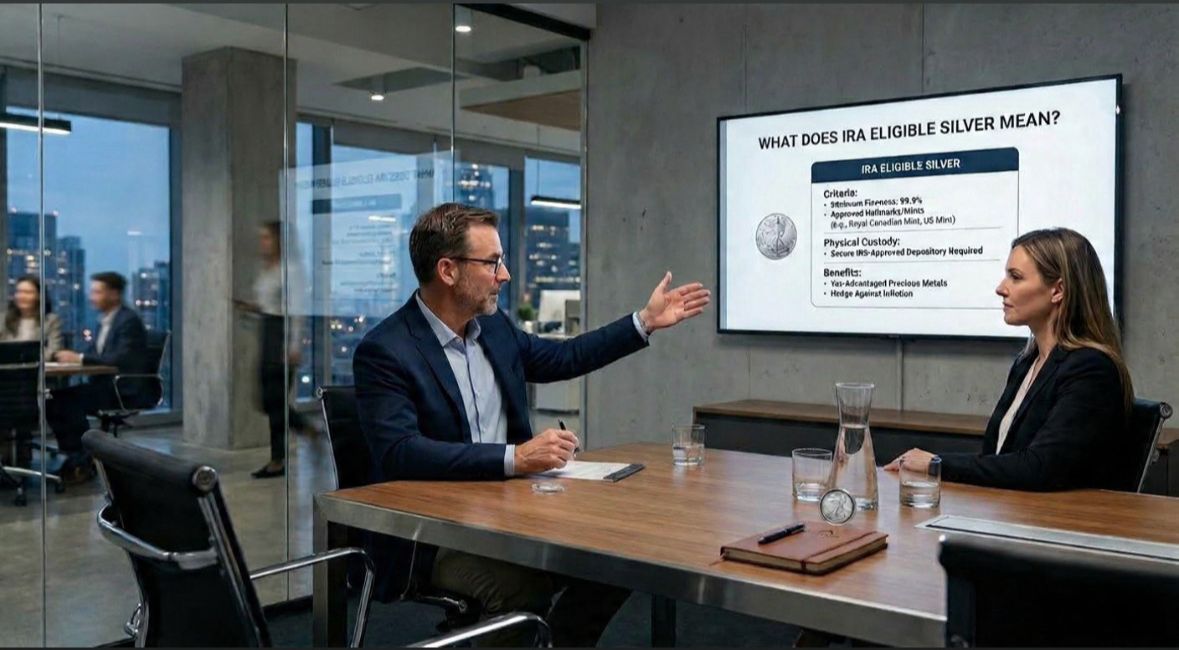
IRA eligible silver means silver your IRA is legally allowed to hold, and it must pass a two-part test under IRC Section 408(m): a minimum fineness of .999 (99.9% pure) and production by an approved government mint or accredited refiner. Coins like the American Silver Eagle and Canadian Silver Maple Leaf qualify, along with accredited silver bars and rounds. What does not qualify catches people out: pre-1965 “junk silver” (only .900 fine), sterling silver, collectible or numismatic coins, and any silver you already own personally. IRA eligible silver must also be purchased by the IRA and stored with a custodian in an IRS-approved depository, never at home. This guide explains exactly what counts, what does not, and why.
What Does IRA Eligible Silver Mean?
IRA eligible silver is investment-grade silver that meets the IRS standards for being held inside a self-directed IRA. The term is also written as “IRA approved silver,” and the two mean the same thing: the metal qualifies to be a retirement asset rather than a collectible.
The important point is that “IRA eligible” is not a marketing label and not the same as “silver you own.” A dealer can call a product anything, but only silver that meets the IRS fineness and manufacturer rules, and that is bought by the IRA and stored properly, is actually eligible. The next section breaks down the exact test.
What Makes Silver Qualify for an IRA?
Silver qualifies for an IRA when it passes a two-part test. Purity alone is not enough, which is the mistake that trips up most buyers.
- Test 1, fineness: the silver must be at least .999 fine (99.9% pure). This is stricter than gold’s .995 standard, because lower-grade silver alloys are common in the coin market.
- Test 2, approved manufacturer: the silver must be produced by a national government mint or by a refiner, assayer, or manufacturer accredited by a recognized body such as NYMEX, COMEX, the LBMA, or ISO 9000. A .999 round from a non-accredited private mint can still be rejected.
Two more conditions complete the picture. The silver must be purchased by the IRA itself (you cannot contribute silver you already own, known as an in-kind contribution), and it must be held by a custodian in an IRS-approved depository, not at home. The American Silver Eagle has a specific statutory place under IRC Section 408(m), and in practice it is .999 fine, so it qualifies on both counts. See IRC Section 408 for the underlying rule.
Which Silver Coins and Bars Are IRA Eligible?
The most common IRA eligible silver products are government bullion coins and bars from accredited refiners, all at .999 fineness or higher. Here are the staples that qualify.
| Silver product | Fineness | IRA eligible? |
|---|---|---|
| American Silver Eagle (bullion or proof) | .999 | Yes |
| Canadian Silver Maple Leaf | .9999 | Yes |
| Austrian Silver Philharmonic | .999 | Yes |
| Australian Silver Kangaroo / Kookaburra | .9999 | Yes |
| British Silver Britannia (2013 and later) | .999 | Yes |
| Accredited silver bars and rounds (PAMP, Valcambi, RCM, Sunshine, Asahi) | .999+ | Yes |
When buying bars and rounds, the refiner matters as much as the purity. Stick to recognized names from LBMA or COMEX-approved refiners so the product clears the approved-manufacturer test. For the buying process, see our guides on how a silver IRA works and buying silver in an IRA.
What Silver Is Not Allowed in an IRA?
Plenty of silver people already own is not IRA eligible, and buying the wrong product for your IRA can be treated as a taxable distribution. These are the common disqualifiers.
| Silver | Why it fails |
|---|---|
| Pre-1965 US “junk silver” (dimes, quarters, half-dollars) | Only .900 fine, below the .999 minimum |
| Sterling silver, flatware, and jewelry | .925 fine and not investment bullion |
| Numismatic, rare, or graded collectible coins | Collectibles are excluded under IRC Section 408(m)(1) |
| British Silver Britannia minted before 2013 | .958 fine, below .999 |
| Rounds from non-accredited private mints | Fail the approved-manufacturer test even at .999 |
| Silver you already own personally | Must be purchased by the IRA; no in-kind contribution |
The proof-coin gray area is worth a note: a proof American Silver Eagle is eligible because it is .999 from the US Mint, but coins priced mostly for their collectible value rather than their metal content are risky, so get written confirmation from your custodian before buying. If non-eligible silver does end up in the account, the IRS can treat it as a distribution, with income tax and a 10% penalty if you are under 59.5.
Key Takeaways
- IRA eligible silver is silver your IRA can legally hold, and it must pass a two-part test: .999 fineness and production by an approved government mint or accredited refiner.
- Purity alone is not enough. A .999 round from a non-accredited mint can be rejected on the manufacturer test.
- Eligible staples include the American Silver Eagle, Canadian Silver Maple Leaf, Austrian Philharmonic, and accredited bars and rounds.
- Not eligible: pre-1965 junk silver (.900), sterling silver (.925), collectible or numismatic coins, and pre-2013 Britannias.
- You cannot contribute silver you already own. The IRA must buy it, and it must be stored with a custodian in an IRS-approved depository, not at home.
- Buying non-eligible silver for an IRA can be treated as a taxable distribution, so confirm eligibility in writing before you purchase.
FAQs
Is junk silver IRA eligible?
No. Pre-1965 U.S. silver coins, including Roosevelt dimes, Washington quarters, Franklin half-dollars, and Morgan dollars, contain 90% silver. The IRS fineness threshold for silver IRAs is .999 (99.9% pure). Junk silver falls 9.9 percentage points short and fails the purity test regardless of who minted it. Even though these coins were produced by the U.S. Mint, an approved manufacturer, they cannot be included in a self-directed IRA. If you already own junk silver and want to add silver exposure to your IRA, you would need to sell the junk silver separately and roll cash from an existing retirement account into a self-directed IRA, then use those funds to purchase IRA-eligible products like American Silver Eagles.
Are silver rounds IRA eligible?
It depends entirely on the manufacturer. Silver rounds at .999 purity meet the fineness requirement, but they also need to come from a NYMEX/COMEX-accredited refiner, LME-approved manufacturer, or ISO 9000 certified facility. Rounds produced by large, recognized refiners like Sunshine Mint, Johnson Matthey, or similar institutions typically qualify. Rounds poured by small private artisans, individual silver smiths, or small unlisted mints do not, even if the silver content is genuinely .999 fine. Before purchasing any silver round for an IRA, confirm that it appears on your specific custodian’s approved product list. Get that confirmation in writing.
Is sterling silver IRA eligible?
No. Sterling silver is .925 fine and is treated as a manufactured good, not investment bullion, so it fails the fineness test.
Are proof silver coins IRA eligible?
Standard bullion proof coins from government mints are generally IRA eligible. The proof American Silver Eagle, for example, is .999 fine and produced by the U.S. Mint, meaning it passes both eligibility tests. Most custodians accept it. The gray area arises with limited edition colorized proofs, special commemorative issues, and privately minted proof sets. These can fall into the IRS’s broad definition of a collectible under IRC §408(m)(1), making them ineligible regardless of their silver content. If you want to include a proof coin in your silver IRA, get written confirmation from your custodian that the specific product is on their approved list before any purchase is made.
Does silver I already own qualify for my IRA?
No. You cannot contribute silver you personally own. The IRA must purchase the silver, and a custodian must hold it in an approved depository.
What happens if I buy non-eligible silver for my IRA?
The IRS can treat it as a distribution of that amount, triggering income tax plus a 10% early withdrawal penalty if you are under 59.5.
Have Questions About Your Self-Directed IRA?
Schedule a free 30-minute consultation with Bullionite Asset Group. No pitch, no pressure, no referral commissions.

As the Founder and Chief Investment Officer of Bullionite and Bullionite Asset Group, I’ve built my career on a simple premise understanding the intersection of macroeconomics, commodities, and digital assets to stay ahead of the curve, not under it. My focus is on navigating the complexities of the world’s largest markets spanning the US, the Middle East, and Asia to identify high-value opportunities for alternative investment.
With a specialized focus on Self-Directed IRAs (SDIRAs), I help investors move beyond traditional 401ks by integrating assets like precious metals and cryptocurrency into their retirement strategies. Based in Newport Beach, California, I am dedicated to bridging the gap between traditional finance and the evolving landscape of new age digital assets, ensuring that every strategic move is backed by deep market insight and a commitment to long-term growth.