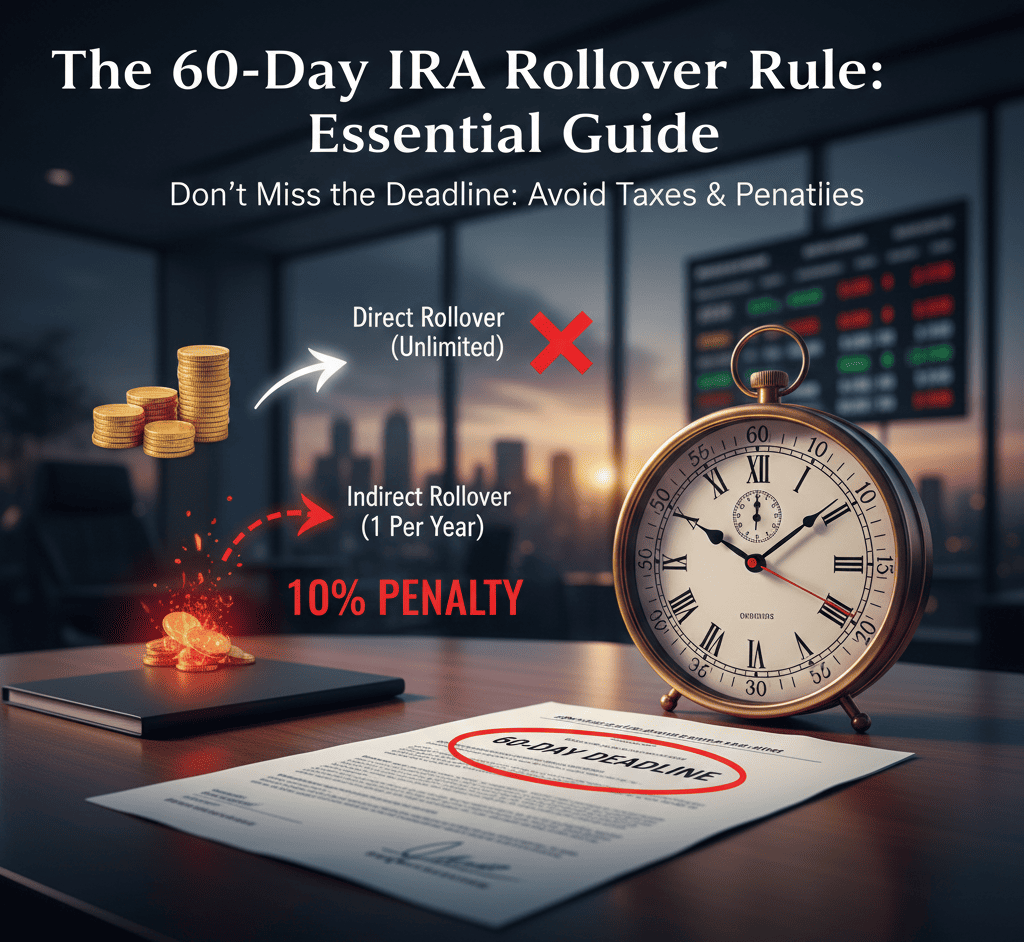
60 Day Self Directed IRA Rollover Rule: How to Avoid IRS Penalties and Withholding
TL;DR
The 60 day rule is the IRS deadline that gives you 60 calendar days from the date you receive an indirect retirement-account distribution to redeposit the full amount into another qualified retirement account, or the entire distribution becomes taxable as ordinary income plus a 10% early withdrawal penalty if you are under 59½. The rule applies to Traditional IRAs, Roth IRAs, SEP IRAs, SIMPLE IRAs, and 401(k) / 403(b) / TSP plans. Two structural traps make the rule expensive in practice: (1) 401(k)-sourced indirect rollovers carry mandatory 20% federal withholding, which you must replace out of pocket within 60 days to complete a full rollover, and (2) the IRS allows only one indirect IRA-to-IRA rollover per 12-month rolling period across all your IRAs combined, a limit clarified in Bobrow v. Commissioner (T.C. 2014-21) and codified in IRS Announcement 2014-15. The clean alternative is a trustee-to-trustee transfer (also called a direct rollover), which is exempt from the 60-day clock, exempt from withholding, and exempt from the once-per-year limit. Use direct transfers. The 60 day rule is what you fall back on when you have no choice.
60 Day Rule: The IRS 60-Day IRA Rollover Rule Explained for 2026
The 60 day rule is the deadline that catches more retirement investors off-guard than any other IRS regulation, because it converts a perfectly legal account transfer into a fully taxable distribution if you miss the 60th day by even one business day. This guide covers what the rule is, how the 60-day clock starts and ends, the 12-month aggregate limit that Bobrow v. Commissioner established, the 20% mandatory withholding trap on 401(k) sources, how the rule applies to Roth, SEP, SIMPLE, and inherited IRAs, the 11 self-certification waiver conditions under Rev. Proc. 2016-47, and how serious investors avoid the rule entirely through trustee-to-trustee transfers. For the broader explainer on how a self-directed account actually works, see our complete guide to self-directed IRAs.
What the 60 Day Rule Actually Is
The 60 day rule is the deadline imposed by IRC §408(d)(3) for completing an indirect rollover of retirement-account funds. An indirect rollover is any rollover in which the original custodian sends the distribution to you personally rather than directly to the receiving custodian. Once funds enter your personal possession, you have 60 calendar days to deposit the full amount into another qualified retirement account, or the IRS treats the distribution as a taxable withdrawal.
The 60 days are calendar days, including weekends and federal holidays. No extensions for banking closures, mail delivery, or processing delays. The clock starts on the date you receive the funds, not the date you requested them. If the custodian dated the check on March 12 but the check reaches you on March 17, the clock starts on March 17.
The rule does not apply to trustee-to-trustee transfers (also called direct rollovers), where the funds move from custodian to custodian without your personal possession. Those transfers have no 60-day clock, no withholding, and no annual frequency limit.
How the 60-Day Rollover Rule Works (Step-by-Step)
The mechanics in eight clean steps:
- You request an indirect distribution from your IRA, 401(k), 403(b), or TSP.
- The custodian or plan administrator processes the distribution.
- For 401(k) / 403(b) / TSP / governmental 457 distributions, the administrator withholds 20% for federal income tax under IRC §3405(c). For traditional IRAs, withholding defaults to 10% but you can elect 0%. For Roth IRA distributions, no mandatory withholding applies.
- The custodian sends the net (post-withholding) amount to you by check, ACH, or wire.
- The 60-day clock starts the day you receive the funds.
- You open or identify the receiving retirement account.
- You deposit the full pre-withholding amount into the receiving account within 60 days. If you only deposit the net amount, the withheld portion remains a taxable distribution.
- You report the rollover on Form 1040 and the receiving custodian reports the contribution on Form 5498.
Worked example. You request a $100,000 indirect rollover from a 401(k). The plan administrator withholds $20,000 federal tax and sends you a $80,000 check on April 1. To complete a full tax-free rollover, you must deposit $100,000 (the $80,000 check plus $20,000 from your own pocket) into the receiving IRA by May 31. The $20,000 withheld will be credited against your federal tax liability when you file your 1040 the following spring, returning as part of any refund. If you only deposit the $80,000 net check and skip replacing the $20,000, you have completed a partial rollover. The $20,000 not redeposited is a taxable distribution. At a 24% federal marginal rate, that produces $4,800 in income tax. If you are under 59½, add a 10% early withdrawal penalty of $2,000, for $6,800 in total tax on the $20,000 shortfall.
The 12-Month Limit: Bobrow v. Commissioner Changed the Rule
Until 2014, the IRS interpreted the once-per-year limit as applying per IRA. An investor with five IRAs could complete five indirect rollovers a year. The Tax Court rejected that reading in Bobrow v. Commissioner (T.C. Memo 2014-21), holding that the once-per-12-months limit applies in aggregate across all IRAs the taxpayer owns, not per account.
The IRS adopted the Bobrow interpretation in Announcement 2014-15, effective for indirect rollovers received on or after January 1, 2015. The rule today:
- One indirect IRA-to-IRA rollover per 12-month rolling period, counted across all your Traditional, Roth, SEP, and SIMPLE IRAs combined.
- The 12 months run from the date of receipt of the prior distribution, not the calendar year.
- Trustee-to-trustee transfers (direct rollovers) are exempt from this limit and from the 60-day clock. You can do unlimited direct transfers in any 12-month period.
- Rollovers between IRAs and 401(k) / 403(b) / TSP plans are also exempt. The once-per-year limit applies only to IRA-to-IRA indirect rollovers. A 401(k)-to-IRA indirect rollover does not consume your annual allotment.
- Roth conversions are exempt. A traditional-IRA-to-Roth-IRA conversion is not counted as a rollover for this rule.
A second indirect IRA-to-IRA rollover inside the 12-month window does not just produce a tax. It is treated as a regular distribution from the source IRA (taxable, plus 10% penalty if under 59½) and an excess contribution to the destination IRA, subject to an additional 6% annual penalty until removed.
Mandatory 20% Withholding on 401(k) and 403(b) Sources
The 20% withholding rule is what most investors do not see coming until the check arrives short.
Under IRC §3405(c), any eligible rollover distribution from a qualified plan (401(k), 403(b), governmental 457, or TSP) paid directly to a participant is subject to mandatory 20% federal income tax withholding. The withholding is not optional. The plan administrator cannot waive it. State income tax withholding may also apply depending on state law.
The asymmetry that traps people:
| Source Account | Mandatory Withholding on Indirect Rollover |
|---|---|
| Traditional IRA | 10% default (electable down to 0%) |
| Roth IRA | 0% default (no mandatory withholding on Roth distributions) |
| 401(k), 403(b), TSP, governmental 457 | 20% mandatory (not waivable) |
| SEP IRA, SIMPLE IRA | 10% default (electable) |
To complete a clean 60-day rollover from a 401(k), you must front the withheld 20% from personal funds, deposit the full gross amount into the IRA, and recover the withholding via your annual tax return. If your personal cash position cannot absorb the front-money, the 401(k) indirect rollover is not viable. Use a direct rollover instead.
This is why our 401(k) rollover guide and 403(b) rollover guide recommend trustee-to-trustee transfers as the default path for 401(k) and 403(b) moves.
Direct Rollover vs Indirect Rollover: The 60 Day Rule Comparison
| Factor | Direct Rollover (Trustee-to-Trustee) | Indirect Rollover (Subject to 60 Day Rule) |
|---|---|---|
| Funds touch the account holder | No | Yes |
| 60-day deadline | Not applicable | Hard deadline; missed = taxable |
| Mandatory withholding (401(k) source) | None | 20% federal |
| Mandatory withholding (IRA source) | None | 10% default, electable to 0% |
| Once-per-12-months limit | Not applicable | Applies to IRA-to-IRA only |
| Reporting on Form 1099-R | Code G (direct rollover) | Code 7 or 1 (normal / early distribution) |
| Reporting on Form 5498 | Box 2 (rollover contribution) | Box 2 |
| Risk profile | Negligible | High; one administrative slip causes full taxation |
| Recommended for | Every move you can plan in advance | Edge cases where direct transfer is not available |
Direct rollovers are the default sophisticated-investor path. Use indirect rollovers only when you have a specific reason and a documented plan to redeposit within 60 days.
Does the 60 Day Rollover Rule Apply to Roth IRAs, 401(k)s, SEP, and SIMPLE IRAs?
Roth IRAs: Yes. The 60-day rule applies to indirect Roth-to-Roth rollovers identically to Traditional IRAs, and Roth-to-Roth indirect rollovers count toward the same once-per-12-months aggregate limit as Traditional IRAs. The IRS does not provide separate aggregate buckets for Roth and Traditional accounts; Bobrow aggregation is across all IRAs you own, regardless of tax structure. Roth distributions have no mandatory withholding because Roth distributions are not generally taxable, but the 60-day deposit deadline still applies. For Roth-specific structural detail, see self-directed IRA vs Roth IRA comparison.
401(k) and 403(b): Yes, with two differences. A 401(k)-to-IRA indirect rollover triggers the 60-day deposit deadline and the 20% mandatory withholding, but it does not count toward the once-per-12-months IRA aggregate. Plan-to-plan and plan-to-IRA indirect rollovers are exempt from the Bobrow aggregate limit. The 60-day clock still runs.
SEP IRA and SIMPLE IRA: Yes. SEPs and SIMPLEs are IRAs and follow the same once-per-12-months aggregate limit. Note: SIMPLE IRAs have an additional 2-year rule under IRC §72(t)(6) — distributions within the first 2 years of participation that are not rolled to another SIMPLE IRA face a 25% (not 10%) early withdrawal penalty.
Inherited IRAs: Effectively no, with one narrow exception. A non-spouse beneficiary cannot do a 60-day rollover of an inherited IRA. The only rollover path for an inherited IRA is a trustee-to-trustee transfer to another inherited IRA in the same beneficiary’s name. A spouse beneficiary who elects to treat the inherited IRA as their own can use a 60-day indirect rollover, treating it as a regular IRA from that point.
Roth conversions: Exempt from the once-per-year limit. A Traditional-to-Roth conversion is not a “rollover” for Bobrow purposes. You can do unlimited conversions in any 12-month period. The conversion is taxable in the year executed.
Tax Consequences of Missing the 60-Day Deadline
Missing the 60th day converts the entire distribution into a taxable event with three layers of cost:
- Ordinary income tax on the full distribution at your marginal federal rate.
- 10% early withdrawal penalty under IRC §72(t) if you are under 59½, unless an exception applies.
- State income tax at your state’s marginal rate, if applicable.
Worked example for a missed $100,000 rollover. Investor age 45 in the 24% federal marginal bracket and a 5% state bracket misses the 60-day redeposit:
- Federal income tax: $100,000 × 24% = $24,000
- 10% early withdrawal penalty: $100,000 × 10% = $10,000
- State income tax: $100,000 × 5% = $5,000
- Total immediate tax cost: $39,000
Beyond the immediate hit, the $100,000 no longer compounds inside the IRA. At a conservative 7% annual return over 25 years to age 70, that lost compounding is approximately $443,000 in foregone retirement balance. The 60th day is expensive.
Section 72(t) exceptions that can wipe out the 10% penalty (but not the income tax):
- Substantially equal periodic payments (SEPP) under §72(t)(2)(A)(iv)
- First-time home purchase up to $10,000
- Qualified higher education expenses for you, your spouse, children, or grandchildren
- Unreimbursed medical expenses exceeding 7.5% of AGI
- Health insurance premiums while unemployed
- Disability or death of the IRA owner
- IRS levy on the IRA
- Qualified reservist distributions
- Qualified birth or adoption distributions up to $5,000 per child
- Domestic abuse victim distributions up to $10,000 (SECURE 2.0)
- Emergency personal expenses up to $1,000/year (SECURE 2.0)
These exceptions reduce the penalty but not the income tax owed. The rollover failure is still a taxable distribution.
The 11 Self-Certification Waiver Conditions Under Rev. Proc. 2016-47
If you miss the 60-day deadline for a reason on the IRS’s qualifying list, you can self-certify a late rollover under Rev. Proc. 2016-47 without paying for a private letter ruling. The 11 qualifying conditions:
- An error was committed by the financial institution receiving or distributing the funds.
- The distribution check was misplaced and never cashed.
- The distribution was deposited into an account that the taxpayer mistakenly thought was an eligible retirement plan.
- The taxpayer’s principal residence was severely damaged.
- A member of the taxpayer’s family died.
- The taxpayer or a member of the taxpayer’s family was seriously ill.
- The taxpayer was incarcerated.
- Restrictions were imposed by a foreign country.
- A postal error occurred.
- The distribution was made on account of a levy under §6331 and the proceeds were returned to the taxpayer.
- The party making the distribution delayed providing information that the receiving plan required to complete the rollover despite the taxpayer’s reasonable efforts.
To self-certify: complete the rollover as soon as practicable after the impediment resolves (typically within 30 days), and provide a written self-certification statement to the receiving custodian using the model language in Appendix A of Rev. Proc. 2016-47. Keep documentation supporting the qualifying reason in case of IRS audit.
If your reason for missing the deadline is not on the 11-condition list, your only path is a private letter ruling request, which costs $10,000 in user fees (per 2024 Rev. Proc. 2024-1, subject to annual updates) and takes 6–9 months. The IRS approves these case-by-case based on reasonable cause and good faith.
Special Considerations for Self-Directed IRA Investors
Self-directed IRAs holding alternative assets face two specific 60-day-rule pressure points.
Illiquid assets cannot be moved in 60 days. Liquidating a rental property, a private equity stake, or a tax lien position to complete an indirect rollover in 60 days is usually impossible. For self-directed accounts holding alternative assets, the only realistic path is an in-kind trustee-to-trustee transfer where the asset itself moves from custodian to custodian without liquidation. The 60-day rule does not apply because there is no distribution.
Custodian processing times are longer. Standard brokerage rollovers settle in 5–15 business days. Self-directed custodian transfers of alternative assets can take 30–60 days because of title work, asset appraisal, custodian-to-custodian documentation, and the receiving custodian’s onboarding compliance review. Always initiate self-directed transfers well before any 60-day clock could run. If you accidentally end up holding distributed funds, the alternative-asset complexity is no excuse for missing the deadline.
Practical sequence for self-directed transitions:
- Open the receiving self-directed IRA at the new custodian. See how to open a self-directed IRA and our best self-directed IRA custodian comparison.
- Request a trustee-to-trustee transfer (in-kind for alternative assets, cash for liquid balances) from the old custodian to the new.
- Avoid taking personal possession of any funds or assets. Once you possess them, the 60-day clock has started.
- If a 60-day rollover is the only option (rare), execute it as the very first transaction after the distribution lands, not the last task on your to-do list.
For asset-class-specific rollover paths, see our 401(k) to gold IRA rollover guide and 401(k) to crypto IRA rollover.
Best Practices to Avoid the 60 Day Rule Entirely
- Default to trustee-to-trustee transfers. Direct transfers have no 60-day clock, no mandatory withholding, no aggregate limit, and no risk of administrative slippage. Use them every time you can.
- If an indirect rollover is unavoidable, initiate the redeposit on day one, not day fifty-nine. Banking errors, ACH returns, and weekend timing are real. Build margin.
- Track the 12-month rolling window. If you completed an indirect IRA-to-IRA rollover within the last 12 months, do not start another. Use a direct transfer or wait.
- Replace the 20% withholding out of pocket for any 401(k) / 403(b) / TSP indirect rollover, or accept the partial-rollover tax cost.
- Document everything. Distribution date, deposit date, check numbers, wire confirmations, receiving custodian acknowledgment. Keep these for 7 years.
- For self-directed accounts, always transfer in-kind when the asset is alternative (real estate, metals, crypto, private placements). Liquidating to meet a 60-day deadline is rarely possible and almost never advisable.
- Get a Letter of Acceptance from the receiving custodian before requesting the distribution. Most 401(k) plan administrators require it.
For the broader rollover walkthrough, see how to roll a 401(k) into a self-directed IRA and how to roll a 403(b) into a self-directed IRA.
Frequently Asked Questions
What is the 60 day rule for IRA rollovers?
The 60 day rule for IRA rollovers requires that any indirect distribution from an IRA must be redeposited into another qualified retirement account within 60 calendar days from the date you receive the funds. Miss the deadline and the entire distribution becomes taxable as ordinary income, plus a 10% early withdrawal penalty under IRC §72(t) if you are under 59½.
How does the 60-day rollover rule work?
You receive a distribution from an IRA or 401(k). The 60-day clock starts the day you receive the funds. You deposit the full pre-withholding amount into the receiving retirement account within 60 calendar days. The receiving custodian reports the deposit on Form 5498. You report the rollover on Form 1040.
Does the 60 day rollover rule apply to 401(k)s?
Yes. A 401(k)-to-IRA indirect rollover is subject to the 60-day deadline and to 20% mandatory federal withholding. It is not subject to the once-per-12-months aggregate limit (that limit applies only to IRA-to-IRA indirect rollovers per Bobrow v. Commissioner).
Does the 60 day rule apply to Roth IRAs?
Yes. Roth-to-Roth indirect rollovers must complete within 60 days and count toward the same once-per-12-months aggregate limit as Traditional IRAs. Roth distributions have no mandatory withholding because Roth distributions are not generally taxable.
How many 60-day rollovers can I do in a year?
One indirect IRA-to-IRA rollover per 12-month rolling period, counted in aggregate across all your Traditional, Roth, SEP, and SIMPLE IRAs. Trustee-to-trustee transfers are unlimited. 401(k)-to-IRA and IRA-to-401(k) indirect rollovers do not count against the IRA aggregate limit.
What is the 20% mandatory withholding on a 60-day rollover?
Federal law under IRC §3405(c) requires 401(k), 403(b), TSP, and governmental 457 plan administrators to withhold 20% federal income tax on any eligible rollover distribution paid directly to the participant. To complete a full tax-free rollover, you must front the 20% from personal funds and recover it on your annual tax return.
What happens if I miss the 60-day deadline?
The distribution becomes taxable ordinary income for the year you received it, plus a 10% early withdrawal penalty if you are under 59½. You may also owe state income tax. The funds permanently lose their retirement-account tax status.
Can the 60-day deadline be waived?
Yes, in two ways. Self-certification under Rev. Proc. 2016-47 is available for 11 specific qualifying conditions (financial institution error, postal failure, death or serious illness, incarceration, residence damage, etc.). For reasons not on that list, you can request a private letter ruling for approximately $10,000 in user fees and 6–9 months of processing.
Does the 60-day rule apply to inherited IRAs?
Non-spouse beneficiaries cannot do a 60-day rollover of an inherited IRA. The only allowed transfer is a trustee-to-trustee transfer to another inherited IRA in the beneficiary’s name. Spouse beneficiaries who elect to treat the inherited IRA as their own can use a 60-day rollover.
Can I use a 60-day rollover as a short-term loan from my IRA?
Technically yes, but it is one of the most dangerous moves in retirement planning. You have exactly 60 days to redeposit the full amount, you use up your annual indirect-rollover allotment, and a single banking delay or unexpected expense turns the “loan” into a full taxable distribution. Solo 401(k) and 401(k) plan loans are the appropriate tools for short-term retirement-account borrowing. IRAs do not allow loans.
Does Bullionite Asset Group help with 60-day rollover scenarios?
Yes. Bullionite Asset Group offers a free, no-obligation consultation for investors evaluating an indirect-rollover scenario, a missed-deadline self-certification, or a complex multi-account consolidation. Visit bullioniteassetgroup.com to schedule.
Key Takeaways
- The 60 day rule is the deadline under IRC §408(d)(3) requiring that any indirect retirement-account distribution be redeposited within 60 calendar days, or the full amount becomes taxable.
- The clock starts on the date you receive the funds, not the date of the distribution request. Calendar days, including weekends and holidays. No extensions.
- One indirect IRA-to-IRA rollover per 12-month rolling period, aggregated across all your IRAs per Bobrow v. Commissioner and IRS Announcement 2014-15. Trustee-to-trustee transfers and Roth conversions are exempt from this limit.
- 20% mandatory federal withholding applies to any 401(k), 403(b), TSP, or governmental 457 distribution paid to you. You must front the withholding from personal funds and recover it on your tax return to complete a full rollover.
- Missing the deadline costs ordinary income tax + 10% penalty if under 59½ + state tax + decades of lost compounding. For a $100,000 missed rollover at 24% federal / 5% state at age 45: roughly $39,000 immediate tax and ~$443,000 in foregone 25-year retirement compounding.
- Rev. Proc. 2016-47 allows self-certification waiver for 11 specific qualifying conditions without a private letter ruling. Document the qualifying reason and complete the rollover as soon as the impediment resolves.
- For self-directed IRAs holding alternative assets, in-kind trustee-to-trustee transfers are the only realistic path. The 60-day clock and illiquid real estate, metals, or private equity are incompatible.
- The clean rule: never trigger the 60 day rule unless you have no choice. Direct rollovers exist precisely so you do not have to.
What is the 60 day rollover rule?
The 60 day rollover rule requires account holders receiving indirect retirement account distributions to deposit the full amount into another qualified retirement account within 60 calendar days from the distribution date. This IRS regulation prevents indefinite personal access to retirement funds without taxation while providing reasonable time to complete rollovers. Missing the 60 day deadline triggers ordinary income taxation on the entire distribution plus 10 percent early withdrawal penalties if under age 59½, creating substantial tax liability and permanently removing funds from tax advantaged retirement status.
Does the 60 day rollover rule apply to 401k plans?
Yes, the 60 day rollover rule applies to 401k plan distributions when you receive funds directly rather than through direct rollover to another qualified plan or IRA. However, 401k rollovers face additional mandatory 20 percent federal tax withholding not applicable to IRA to IRA indirect rollovers. Direct rollovers from 401k plans to IRAs or other employer plans avoid the 60 day deadline, eliminate mandatory withholding, and represent the strongly preferred method for moving retirement funds between accounts preventing costly taxation and penalty risks.
What happens if I miss the 60 day rollover deadline?
Missing the 60 day deadline converts your distribution into taxable income subject to ordinary income taxation at your marginal tax rate for the year you received funds. Account holders under age 59½ face additional 10 percent early withdrawal penalties unless qualifying exceptions apply. The distribution permanently loses tax advantaged status with no opportunity to restore funds to retirement accounts after the deadline passes. For substantial distributions, combined taxation and penalties create severe financial consequences potentially consuming 30 to 40 percent of distributed amounts. You may request IRS waiver consideration for legitimate circumstances preventing timely completion, though approval requires demonstrating reasonable cause and remains uncertain.
FAQ Schema Markup Loaded
Have Questions About Your Self-Directed IRA?
Schedule a free 30-minute consultation with Bullionite Asset Group. No pitch, no pressure, no referral commissions.

As the Founder and Chief Investment Officer of Bullionite and Bullionite Asset Group, I’ve built my career on a simple premise understanding the intersection of macroeconomics, commodities, and digital assets to stay ahead of the curve, not under it. My focus is on navigating the complexities of the world’s largest markets spanning the US, the Middle East, and Asia to identify high-value opportunities for alternative investment.
With a specialized focus on Self-Directed IRAs (SDIRAs), I help investors move beyond traditional 401ks by integrating assets like precious metals and cryptocurrency into their retirement strategies. Based in Newport Beach, California, I am dedicated to bridging the gap between traditional finance and the evolving landscape of new age digital assets, ensuring that every strategic move is backed by deep market insight and a commitment to long-term growth.