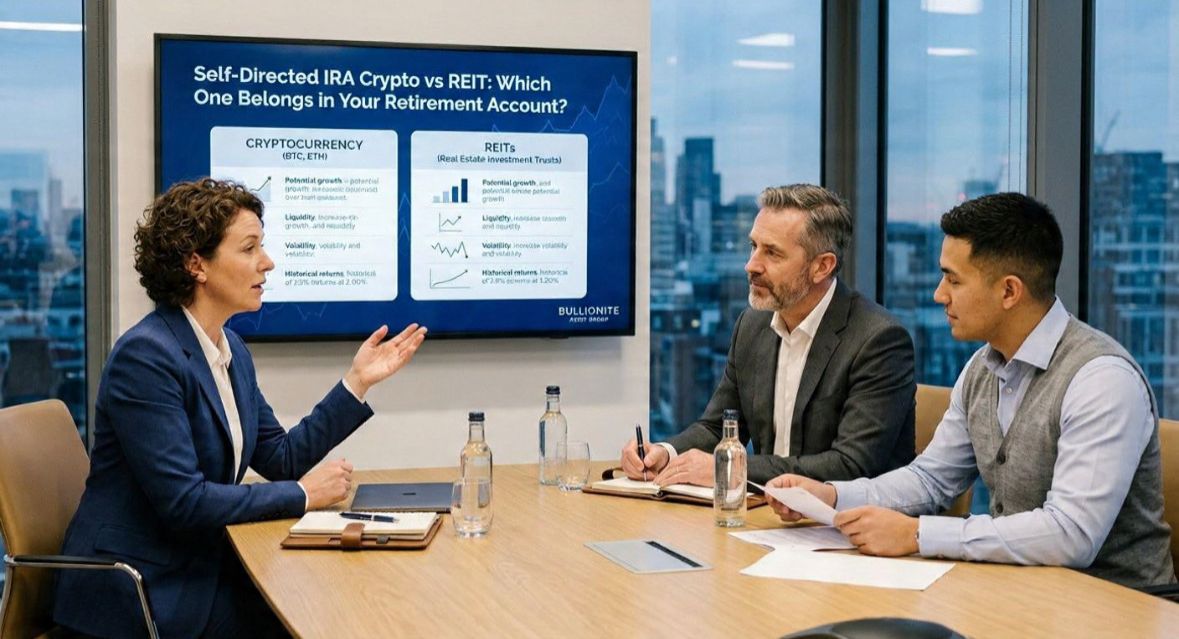
Self-Directed IRA Crypto vs REIT: Which One Belongs in Your Retirement Account?
TL;DR
A self-directed IRA crypto investment offers asymmetric upside with high volatility, no income while held, and requires a dedicated custodial account. A REIT inside a self-directed IRA provides predictable dividend income, lower volatility, and works in either a standard or self-directed IRA depending on whether it’s public or private. Neither is universally better, as your time horizon, income needs, and risk tolerance determine which fits your retirement account. Many sophisticated investors hold both, using crypto for growth and REITs for income stability.
Self-directed IRA crypto vs REIT is one of the most searched, and least clearly answered, questions in alternative retirement investing today. Both asset classes are permitted in a self-directed IRA (SDIRA), yet they operate under entirely different rules, require different account structures, carry different tax implications, and serve different portfolio functions. Getting this wrong does not just mean suboptimal returns; it can mean UBIT tax surprises, liquidity crises at RMD time, or a prohibited-transaction disqualification that collapses your entire account.
In this guide, BullioniteAssetGroup’s advisory team breaks down every material difference between holding crypto and REITs inside a self-directed IRA, from account structure to tax treatment, risk profile, and long-term wealth-building potential. We will also show you when it makes sense to hold both, and how to structure each position correctly from day one.
What Is a Crypto Self-Directed IRA and How Does It Work?
A crypto self-directed IRA lets you buy, hold, and trade digital assets, including Bitcoin, Ethereum, Solana, and others, inside a tax-advantaged retirement account. The IRS treats cryptocurrency as property under IRS Notice 2014-21 (IRS.gov), meaning it is a permissible IRA investment. However, you cannot hold crypto through Fidelity, Vanguard, or any standard brokerage IRA. You need a custodian specifically approved to administer digital assets.
The mechanics work like this: you open a self-directed IRA with a digital-asset custodian, fund the account via rollover, transfer, or annual contribution as detailed in IRS Publication 560 (IRS.gov/publications/p560), and instruct the custodian to purchase the cryptocurrency on your behalf through an approved exchange. The assets are held in custody, not in your personal wallet, until you take a distribution. This is a critical compliance point: you cannot transfer existing crypto you personally own into your IRA. All purchases must originate with IRA cash.
Key structural rules for a crypto self-directed IRA:
- Separate account required: Most custodians require a dedicated IRA specifically for crypto. It cannot be commingled with your SDIRA holding real estate or private equity.
- No personal wallet control: The custodian holds the private keys, not you. Some custodians (e.g., IRA Financial) offer optional self-custody paths, but this adds compliance complexity.
- No existing crypto transfers: You cannot fund the IRA with Bitcoin you already own. Only cash contributions or rollovers are permitted.
- Staking and rewards: Staking income generated inside the IRA stays inside the IRA, growing tax-deferred. There is no immediate taxable event.
- Trading is tax-free inside the account: You can sell Bitcoin at a 300% gain and reinvest into Ethereum with zero capital gains tax triggered, because all activity stays within the IRA wrapper.
“Cryptocurrency inside a self-directed IRA is one of the most powerful tax shields available to investors who understand the rules. The compounding effect of eliminating annual capital gains tax on high-volatility assets over a 20-year period is extraordinary.”
Adam Bergman, J.D., Founder of IRA Financial and author of nine books on self-directed IRAs, as stated in IRA Financial’s published educational content on crypto IRAs.
What Is a REIT in a Self-Directed IRA, and Do You Even Need an SDIRA?
This is where most investors get confused, as detailed in widely-cited investor education resources including FINRA’s Investor Alert on Self-Directed IRAs and the Risk of Fraud (FINRA.org) and NerdWallet’s guide to Self-Directed IRAs (NerdWallet.com). You do NOT need a self-directed IRA to hold a REIT, but the type of REIT you want determines which account you need.
Public REITs vs. Private REITs: A Critical Distinction
Publicly traded REITs, such as Realty Income, Prologis, or VICI Properties, are listed on stock exchanges and can be purchased directly inside any standard IRA at Fidelity, Schwab, or Vanguard. No SDIRA is required. Dividends and appreciation grow tax-deferred inside a Traditional IRA or tax-free inside a Roth IRA.
Private REITs, which are non-publicly traded entities that invest in real estate portfolios, cannot be purchased through standard brokerage IRAs. These require a self-directed IRA custodian. Private REITs typically offer higher yield potential, reduced correlation to public markets, and access to commercial real estate deals unavailable to retail investors. However, they also carry illiquidity risk and limited SEC disclosure requirements. As Equity Trust Company notes in their published guide “Five Misconceptions About Self-Directed IRAs” (TrustETC.com/blog), many investors open expensive SDIRAs unnecessarily when their target investment could be held in a standard account.
| REIT Type | Account Required | Liquidity | Yield Range | Market Correlation |
| Public REIT (e.g., Realty Income) | Standard or SDIRA | High (daily trading) | 3 to 6% | Moderate to High |
| Public Non-Traded REIT | SDIRA recommended | Low (redemption windows) | 5 to 8% | Low |
| Private REIT | SDIRA required | Very Low (lock-up periods) | 6 to 12%+ | Very Low |
Source: BullioniteAssetGroup internal classification framework; REIT.com NAREIT data 2025.
When your self-directed IRA invests in a private REIT, all income, including dividends, rental income distributions, and capital appreciation, flows in and out of your retirement plan. The normal tax drag of REIT dividends being taxed as ordinary income is completely eliminated inside the IRA wrapper. For high-income investors in the 37% bracket, this can represent a 37-cent savings on every dollar of REIT dividend income.
“A self-directed IRA is the ideal vehicle for private REIT investing because it eliminates the one structural disadvantage REITs have always carried in taxable accounts: their dividend income being taxed at ordinary rates. Inside a Roth SDIRA, private REIT income becomes completely tax-free.”
Mat Sorensen, J.D., Attorney, CEO of Directed IRA, and author of The Self-Directed IRA Handbook (60,000+ copies sold; DirectedIRA), sourced from Directed IRA educational webinar on private REIT investing, 2024.
Crypto IRA vs REIT: Tax Treatment Compared Side-by-Side
Both assets generate compelling tax advantages inside an IRA, but the specific mechanisms differ and the breakeven calculations favor each option under different circumstances.
| Tax Scenario | Crypto in SDIRA | Public REIT in Any IRA | Private REIT in SDIRA | |
| Capital Gains on Sale | 0% (deferred/tax-free) | 0% (deferred/tax-free) | 0% (deferred/tax-free) | |
| Dividend/Interest Income | N/A (no income yield) | 0% while held in IRA | 0% while held in IRA | |
| Staking/Mining Rewards | Tax-deferred/free inside IRA | N/A | N/A | |
| UBIT Exposure | No (cash-only purchase) | Possible if leveraged | Possible if fund uses leverage | |
| Distribution Tax (Trad. IRA) | Ordinary income rate | Ordinary income rate | Ordinary income rate | |
| Distribution Tax (Roth IRA) | 0% (qualified) | 0% (qualified) | 0% (qualified) | |
| In-Kind Distribution? | Yes (take as crypto) | Yes (take as shares) | Limited (fund terms) |
Note: Tax treatment subject to change. Consult a qualified CPA before making investment decisions.
The Roth SDIRA Advantage for Both Assets
For investors who can fund a Roth SDIRA, either through direct contribution or a Roth conversion, both crypto and private REITs become extraordinarily powerful. Bitcoin purchased at $50,000 inside a Roth SDIRA that appreciates to $500,000 generates zero federal tax on the $450,000 gain. Similarly, a private REIT generating $8,000 per year in distributions inside a Roth SDIRA creates a permanent stream of tax-free retirement income. The Roth SDIRA is the single highest-leverage tax structure available to alternative investors.
How Does UBIT Apply to Crypto IRA vs REIT Investments?
Unrelated Business Income Tax (UBIT), governed by IRC Sections 511 to 514 (IRS.gov), is one of the most misunderstood and most costly compliance pitfalls for SDIRA investors. Understanding exactly when it applies to each asset class is non-negotiable.
UBIT and Crypto in a Self-Directed IRA
When you purchase cryptocurrency with cash inside your SDIRA, there is no UBIT exposure. The IRS does not classify straightforward buy-and-hold crypto investment as an unrelated trade or business. Capital appreciation, sales, and even staking rewards generated inside the IRA are sheltered from UBIT. However, if your self-directed IRA uses leverage (margin trading) to purchase crypto, the debt-financed portion of any gain could trigger Unrelated Debt-Financed Income (UDFI), a subcategory of UBIT. Most crypto custodians do not offer margin inside IRAs, but investors should verify this.
UBIT and REITs in a Self-Directed IRA
Public REITs held in an SDIRA do not generate UBIT as long as the IRA does not use leverage to acquire shares. Private REITs are more complex: if the underlying REIT fund uses leveraged financing (which most commercial real estate funds do), a portion of the fund’s income may flow through to the IRA as UDFI. The IRA’s proportional share of that debt-financed income is subject to tax at trust tax rates, which reach 37% starting at just $15,200 of income as of 2026.
Practical Implications:
- Always request the private REIT’s K-1 and ask the fund manager specifically whether the fund uses leverage and whether it generates UBTI for IRA investors.
- Some private REITs are specifically structured to be UBTI-free. This is a premium feature worth seeking.
- File IRS Form 990-T if your SDIRA’s UBTI exceeds $1,000 in a tax year. Failure to file is a compliance violation.
- Crypto positions (held without leverage) carry no UBIT obligation, which is a structural advantage over leveraged real estate.
“The distinction investors must understand is this: UBIT is not an IRA fee. It is a real tax owed at trust rates that can reach 37%. A $100,000 private REIT investment generating $8,000 in UBTI annually costs the IRA $2,960 in taxes that cannot be recaptured. Structuring matters as much as asset selection.”
John Hyre, CPA and Self-Directed IRA Tax Attorney, from his published SDIRA tax planning guides and UBIT compliance materials.
Which Has Better Returns: Crypto IRA or REIT in a Self-Directed IRA?
Return comparisons between crypto and REITs inside an SDIRA depend entirely on the time horizon, asset selection, and risk tolerance. Here is what the data shows, without glossing over the volatility.
| Asset / Index | 5-Year Annualised Return | 10-Year Annualised Return | Volatility (Std Dev) | Max Drawdown | |
| Bitcoin (BTC) | ~52% (2020 to 2025) | ~93% CAGR (2015 to 2025) | Very High (~80%) | -83% (2022) | |
| Ethereum (ETH) | ~38% (2020 to 2025) | ~70% CAGR (est.) | Very High (~85%) | -77% (2022) | |
| FTSE NAREIT All Equity REITs | ~8.4% (2020 to 2025) | ~10.9% (long-run avg.) | Moderate (~15%) | -35% (2020) | |
| Private REIT (Commercial) | 8 to 14% (fund dependent) | 8 to 14% (fund dependent) | Low (illiquid) | Varies (less marked-to-mkt) | |
| S&P 500 (benchmark) | ~17% (2020 to 2025) | ~13.5% (2015 to 2025) | Moderate (~16%) | -34% (2020) |
Sources: NAREIT Annual Index Values & Returns 2025 (REIT.com/data-research/reit-indexes); ARK Investment Management, Measuring Bitcoin’s Risk and Reward (ARK-Invest.com, 2025; Glassnode data); Visual Capitalist asset class comparison 2025. Past performance does not guarantee future results.
Bitcoin’s raw 10-year CAGR is unmatched by any traditional asset class. However, its standard deviation of roughly 80% means an investor who retired at the wrong time, say, December 2021, would have seen their SDIRA crypto position fall 83% within 12 months. REITs, by contrast, have delivered a 10.9% average annual net return over 24-year studies (Ernst & Young data) with a fraction of crypto’s volatility.
The IRA Advantage That Changes the Math
Outside an IRA, crypto’s high returns are significantly eroded by the capital gains tax triggered every time you sell a position. Active crypto traders in the 37% bracket can lose nearly 40% of each gain to taxes. Inside a Roth SDIRA, that entire 40% stays in your account and continues compounding. A $50,000 Bitcoin position that returns 500% over 15 years produces $250,000 in a taxable account after a 37% CGT hit; inside a Roth SDIRA, the same position produces the full $300,000 gain, a 20% absolute difference attributable entirely to the IRA structure.
What Are the Liquidity and RMD Risks for Each Asset?
Required Minimum Distributions (RMDs) beginning at age 73 force Traditional IRA holders to take annual withdrawals based on account value. If the bulk of your SDIRA sits in illiquid assets, RMDs can become a compliance crisis. Both crypto and private REITs carry liquidity risks that must be planned for in advance.
Crypto Liquidity in an SDIRA
Publicly traded cryptocurrencies like Bitcoin and Ethereum are highly liquid. They can be sold 24/7 through custodian-connected exchanges. For RMD purposes, the custodian can liquidate a portion of the crypto position and distribute cash, or you may be able to take an in-kind distribution of actual cryptocurrency. The in-kind option is powerful: you take Bitcoin as your RMD, move it to your personal wallet, and retain upside exposure on that position, though you owe ordinary income tax on the fair market value at distribution for a Traditional IRA.
REIT Liquidity in an SDIRA
Public REITs are liquid and simple to manage for RMDs. Private REITs introduce significant risk: most have lock-up periods of 3 to 7 years and limited redemption windows (quarterly, annually, or none). If your entire SDIRA is in an illiquid private REIT and your RMD exceeds the redemption limit, you face a forced non-compliant distribution or must satisfy the RMD from another IRA you own. Planning for this is not optional.
| Scenario | Crypto SDIRA | Private REIT SDIRA |
| RMD Flexibility | High (liquid 24/7) | Low (lock-up periods) |
| In-Kind Distribution Available? | Yes (Bitcoin, ETH, etc.) | Limited (fund-dependent) |
| RMD Planning Complexity | Moderate (price volatility) | High (illiquidity risk) |
| Recommended Backup Liquid IRA | Advisable (for bear markets) | Essential |
Which Account Structure Do You Need for Each Asset?
Account structure is where many investors make expensive setup mistakes. Here is the complete picture:
| Investment | Account Needed | Custodian Type | Typical Setup Cost | Typical Annual Fee |
| Bitcoin / Major Crypto | Dedicated Crypto SDIRA | Digital-asset custodian | $0 to $360 | $495/yr + 1% trade fee |
| Altcoins / DeFi tokens | SDIRA + LLC (Checkbook) | SDIRA custodian + LLC | $1,200 to $2,500 | $395 to $595/yr + LLC costs |
| Public REIT shares | Any Standard IRA | Standard brokerage | $0 | $0 (most brokerages) |
| Private REIT | SDIRA | SDIRA custodian | $50 to $360 | $395 to $595/yr |
| REIT + Crypto (combined) | Two separate SDIRAs | Two custodians (or one with separate accts) | $400 to $800 combined | $800 to $1,200/yr combined |
Fee ranges based on published schedules of major SDIRA custodians as of March 2026. Verify directly with providers before opening accounts.
The Checkbook IRA LLC for Crypto
Investors wanting to hold less common cryptocurrencies, those not available on the primary exchange tied to their custodian, can use a Checkbook IRA LLC structure. The SDIRA owns the LLC, and the LLC holds a separate exchange account or even a hardware wallet. This grants maximum flexibility and access to the full crypto market, including DeFi protocols. However, it adds compliance complexity: every transaction must be documented, personal use of LLC funds is a prohibited transaction, and annual operating agreement maintenance is required. This structure is best suited for investors with prior IRA compliance experience or those working with an experienced SDIRA attorney.
Should You Hold Both Crypto and REITs in Your Self-Directed IRA?
The framing of ‘crypto vs. REIT’ creates a false choice. The real question is: does each asset serve a defined function in your SDIRA portfolio? When the answer is yes, holding both is not just acceptable. It is a sophisticated diversification strategy.
Why REITs Anchor the Portfolio While Crypto Provides Asymmetric Upside
The REIT portion of an SDIRA functions as a yield engine, generating consistent quarterly distributions that compound inside the account. A private REIT generating 8% annually on a $150,000 SDIRA position produces $12,000 per year in tax-sheltered income that reinvests automatically. Over 20 years at 8% annualised, that $150,000 grows to approximately $699,000 with no annual tax drag.
The crypto portion provides an asymmetric growth layer. A 10 to 15% allocation to Bitcoin inside a Roth SDIRA has historically either underperformed in bear years (costing the portfolio 10 to 15% of its growth) or dramatically outperformed in bull cycles (potentially doubling or tripling the overall account value). This asymmetry, limited downside weighting against unlimited upside, is the strategic argument for holding both.
KEY TAKEAWAYS
- Crypto needs a dedicated self-directed IRA with a digital-asset custodian; public REITs can be held in any standard IRA.
- Private REITs inside an SDIRA keep all dividends and appreciation tax-deferred or tax-free (Roth), eliminating the ordinary income tax drag REITs normally carry.
- Crypto staking rewards inside an SDIRA are NOT immediately taxable, as they compound tax-sheltered until distribution.
- Leveraged REIT investments in an SDIRA may trigger UBIT; crypto held without leverage does not.
- Bitcoin’s 10-year CAGR has exceeded all major asset classes, including REITs; however, its standard deviation is 4 to 6 times higher.
- For investors within 10 years of retirement, REITs offer more predictable income; for those with a 15+ year horizon, crypto’s compounding potential inside a Roth SDIRA is unmatched.
Disclosure: This article is for educational purposes only and does not constitute tax, legal, or investment advice. BullioniteAssetGroup is a self-directed IRA consulting firm. Readers should consult a qualified CPA, tax attorney, or financial advisor before making retirement investment decisions. Non-compliance with IRS rules can result in full IRA disqualification and significant penalties.
Published: March 2026 | Next Review: August 2026
FAQ's
Can I hold both crypto and a REIT in the same self-directed IRA account?
No, in most cases you cannot. Dedicated crypto IRA accounts are typically required to be separate from other SDIRA positions. Some custodians allow you to hold multiple asset types under one umbrella account, but verify this explicitly before opening. The practical solution is to maintain two separate SDIRAs: one for crypto and one for private REIT or real estate investments. Both can be Roth accounts if eligible.
Do I pay tax on crypto staking rewards inside my self-directed IRA?
No. Staking rewards earned inside any IRA, Traditional or Roth, are not taxable in the year they are received. They remain inside the IRA, compound tax-deferred (or tax-free in a Roth), and are only subject to taxation (if applicable) upon distribution. This is a significant advantage over holding staking positions in a taxable account, where rewards are taxed as ordinary income in the year received.
Is a REIT self-directed IRA the same thing as a standard IRA with REIT shares?
Not necessarily. A standard brokerage IRA (Fidelity, Vanguard, Schwab) can hold publicly traded REIT shares with no SDIRA required. A self-directed IRA becomes necessary when you want to invest in private REITs, which are non-publicly traded entities with higher yield potential and less liquidity. Many investors mistakenly open an expensive SDIRA just to buy public REIT shares, paying unnecessary annual fees they could avoid by using a standard IRA.
Will my crypto IRA be subject to UBIT?
Generally no. If you purchase cryptocurrency with cash (no leverage) inside your SDIRA, there is no UBIT exposure. The IRS has not classified standard crypto investment as an unrelated trade or business. UBIT could theoretically apply if you are mining cryptocurrency at scale inside the IRA (potentially treated as a business), or if you use margin/leverage to purchase crypto. For the vast majority of investors making straightforward purchases, UBIT is not a concern for crypto SDIRAs.
Does a private REIT inside an SDIRA always trigger UBIT?
No, not automatically. UBIT is triggered only by the unrelated business taxable income (UBTI) that flows through to your IRA, which typically arises when the REIT uses leverage. Many private REITs are specifically structured to be UBTI-free for IRA investors. Always request a written confirmation from the REIT sponsor about UBTI treatment, and have your CPA review the fund’s operating agreement. If the fund routinely generates UBTI, weigh this cost against the yield premium before investing.
Have Questions About Your Self-Directed IRA?
Schedule a free 30-minute consultation with Bullionite Asset Group. No pitch, no pressure, no referral commissions.

As the Founder and Chief Investment Officer of Bullionite and Bullionite Asset Group, I’ve built my career on a simple premise understanding the intersection of macroeconomics, commodities, and digital assets to stay ahead of the curve, not under it. My focus is on navigating the complexities of the world’s largest markets spanning the US, the Middle East, and Asia to identify high-value opportunities for alternative investment.
With a specialized focus on Self-Directed IRAs (SDIRAs), I help investors move beyond traditional 401ks by integrating assets like precious metals and cryptocurrency into their retirement strategies. Based in Newport Beach, California, I am dedicated to bridging the gap between traditional finance and the evolving landscape of new age digital assets, ensuring that every strategic move is backed by deep market insight and a commitment to long-term growth.