Palladium IRA Rollover: How to Transfer Your 401k or Existing IRA to Palladium Tax-Free
TL;DR
A palladium IRA rollover moves funds from an existing retirement account, such as a 401(k) or another IRA, into a self-directed IRA that holds physical palladium, without triggering taxes when it is done correctly. The key is a direct rollover, where the money moves custodian to custodian and never reaches your hands. You open a self-directed IRA with a precious metal custodian, initiate the rollover, and once the cash lands you direct the purchase of IRS-approved palladium that ships to an approved depository. A direct rollover has no annual dollar cap and no tax. An indirect rollover, where the money is paid to you first, starts a 60-day clock and is limited to one per 12 months. This guide covers the process step by step, which accounts qualify, how to avoid penalties, and the timeline.
New to palladium? See what a palladium IRA is, including the rules, risks, and returns before you move any money.
What is a palladium IRA rollover and how does it work?
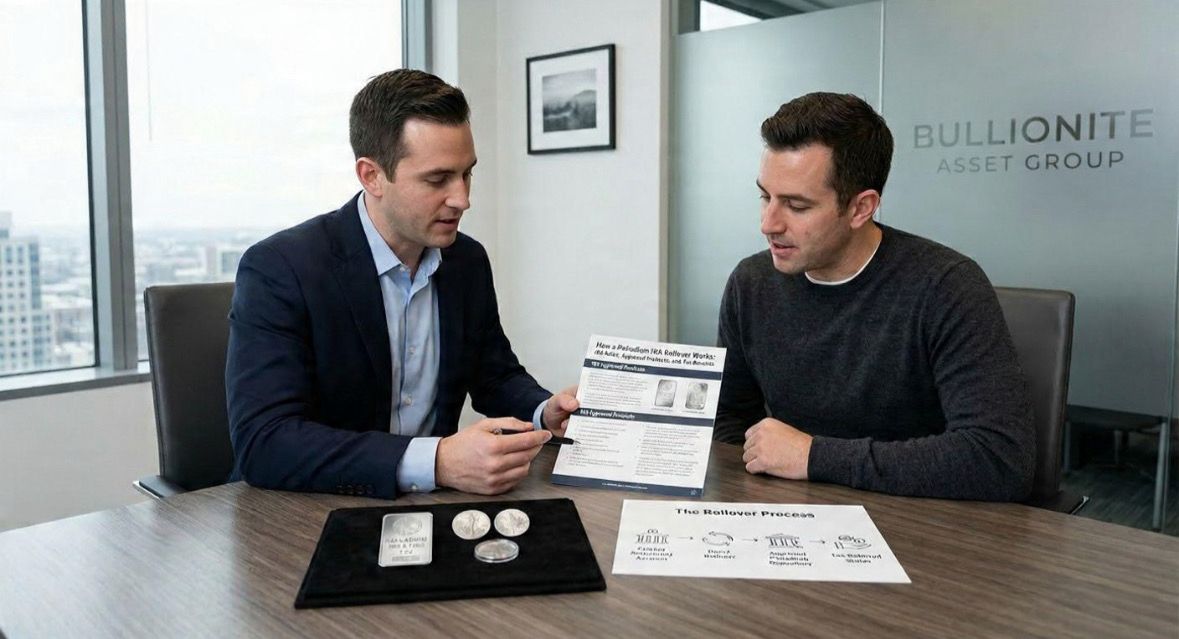
A palladium IRA rollover is the process of moving retirement money you already have into a self-directed IRA that holds physical palladium. The funds keep their tax-advantaged status the whole way, so a correctly executed rollover is not a taxable event. A palladium IRA itself is simply a self-directed IRA that holds IRS-approved palladium at an approved depository under the normal IRA tax rules.
The mechanic is straightforward. Your current provider sends the money directly to your new self-directed IRA custodian, the cash sits in the palladium IRA until you act, and then you direct the custodian to buy eligible palladium. Because the money goes custodian to custodian, nothing is withheld and no taxes are due. You never take possession of either the cash or the metal.
If you are still weighing whether palladium belongs in your retirement plan, the risks and returns are worth reading first on our palladium IRA guide. This page assumes you have decided and want to execute the move cleanly.
Why roll over a 401(k) or IRA into palladium?
People roll retirement funds into a palladium IRA for a few practical reasons that have more to do with the rollover than with palladium itself. An old 401(k) sitting with a former employer is easy to forget and often stuck in a limited menu of funds, and rolling it into a self-directed IRA puts you back in control of where it is invested. A rollover also lets you add a tangible, physical asset to a retirement plan that is otherwise all paper, and it does so without creating a taxable event when handled as a direct transfer.
What it does not do is change palladium’s risk profile. Palladium is the most volatile and most auto-dependent of the IRA metals, so the rollover decision should follow a clear-eyed look at whether the metal fits your plan in the first place. The risks and returns section of our palladium guide lays that out before you commit funds.
Palladium IRA rollover vs transfer: which applies to you?
People use “rollover” loosely, but the IRS distinguishes two moves, and which one applies depends on where your money sits today. Both can be done tax-free.
|
Move |
When it applies |
Key feature |
|
Rollover |
Money is in a workplace plan like a 401(k), 403(b), 457(b), or TSP |
Moves plan funds into an IRA; direct rollover is tax-free |
|
Transfer |
Money is already in an IRA (Traditional, SEP, or SIMPLE) |
Trustee-to-trustee move between IRAs; unlimited and tax-free |
Within a rollover, you then choose direct or indirect, and that single choice is where most of the tax risk lives. A direct rollover or transfer is almost always the right call, for reasons the penalties section explains.
One more option applies if you already hold metal in another precious metals IRA: an in-kind transfer moves the physical palladium itself between custodians without selling it. That avoids a sell-and-rebuy cycle and the dealer spread that comes with it, which matters for a less liquid metal like palladium. If your funds are in cash or paper assets, a standard cash rollover or transfer is the path, and you buy the palladium once the money lands.
How to roll over into a palladium IRA, step by step
A palladium IRA rollover takes six steps and usually one to three weeks, with most of the wait sitting on the funding transfer.
- Choose a self-directed IRA custodian that handles precious metals. Look for metals experience, a written all-in fee schedule, a choice of depository, and fast transfer handling.
- Open the self-directed IRA with a short application and your ID. This is the account that will legally own the palladium.
- Initiate a direct rollover or transfer from your current provider. Your new custodian usually coordinates the request so the funds move institution to institution.
- Wait for the funds to land. They arrive as cash in your palladium IRA, still tax-advantaged but not yet allocated to metal.
- Select IRS-approved palladium. The eligible options are the American Palladium Eagle, the Canadian Palladium Maple Leaf, and accredited .9995 bars. The full eligibility detail is in the palladium IRA rules section of our main guide.
- Authorize the purchase. The custodian pays the dealer from your IRA funds and the metal ships directly to an approved depository, where it is insured and reported. You receive statements.
How to vet the custodian before you commit
Step one carries the most weight, because the custodian sets your fees and your transfer speed. A few questions separate a good one from the rest:
- How many precious metals IRAs do you administer, and how long have you offered them?
- Can you send a complete written fee schedule, including setup, annual custodian, storage, and any transaction fees?
- Is the annual fee flat or charged as a percentage of assets? A flat fee is usually cheaper as the account grows.
- Which depositories do you work with, and how fast do your direct rollovers typically complete?
Which accounts can you roll over into a palladium IRA?
Most tax-advantaged retirement accounts can fund a palladium IRA through a rollover or transfer. The common sources are:
- Traditional, SEP, and SIMPLE IRAs (SIMPLE IRAs after the initial two-year holding period).
- 401(k), 403(b), and 457(b) plans, typically from a former employer.
- Thrift Savings Plan (TSP) accounts for federal employees and service members.
- Roth IRAs and Roth 401(k)s, which roll into a Roth palladium IRA to keep their tax-free status.
One practical limit applies to workplace plans: you usually cannot roll over a 401(k) with your current employer while you still work there, unless the plan allows in-service rollovers or you are 59 and a half or older. Plans from previous employers are almost always eligible. When in doubt, your plan administrator can confirm whether your balance is eligible to move.
What do you need to start a palladium IRA rollover?
Have these ready before you begin, and the rollover moves quickly without back-and-forth.
- A government-issued photo ID and your Social Security number.
- A recent statement from the account you are rolling over, showing the balance and account number.
- Your current plan administrator’s or custodian’s contact details, so the transfer request can be submitted.
- Your funding decision: a full or partial rollover, and the dollar amount.
- Beneficiary information, including names and dates of birth, since beneficiary designations override your will for the account.
How to do a palladium IRA rollover with no taxes or penalties
The difference between a tax-free rollover and an expensive mistake comes down to direct versus indirect. Choose direct, and the rest takes care of itself.
Direct rollover, the safe default
In a direct rollover, your old custodian sends the funds straight to your new palladium IRA custodian. The money never touches your hands, nothing is withheld, there is no deadline, and there is no limit on how often you can do it. This is the recommended route for essentially every palladium IRA rollover.
Indirect rollover, the route to avoid
In an indirect rollover, the funds are paid to you first, and you have 60 days to redeposit them into the new IRA. A 401(k) distribution paid to you also has 20% withheld up front, which you then have to make up from other money to roll over the full amount. On top of that, you are limited to one indirect IRA-to-IRA rollover in any 12-month period. There is no upside to this route, only risk.
The 60-day trap: if you take an indirect rollover and miss the 60-day redeposit deadline, the IRS treats the entire amount as a taxable distribution, plus a 10% penalty if you are under 59 and a half. This is the most expensive and most avoidable mistake in the whole process. A direct rollover removes the deadline entirely.
You also do not have to move everything. A partial rollover lets you fund the palladium IRA with only the portion you want allocated to metal, leaving the rest of your account invested where it is. That is how most people keep palladium as a measured slice of the portfolio rather than betting the whole balance on one volatile metal.
How long does a palladium IRA rollover take?
Most palladium IRA rollovers complete within one to three weeks. Opening the account takes a day or two, and the variable is how quickly your current provider releases the funds. Here is a realistic timeline.
|
Stage |
Typical time |
What is happening |
|
Account application |
1 to 2 days |
You submit the form and ID; custodian opens the account |
|
Direct rollover or transfer |
5 to 10 business days |
Funds move from your old provider to the palladium IRA |
|
Indirect rollover |
Up to 60 days |
You receive funds and must redeposit before the deadline |
|
Purchase and shipment |
A few days after funds clear |
You authorize the buy; palladium ships to the depository |
If you are trying to buy at a particular price, a direct rollover with a responsive custodian is the fastest reliable path. Indirect rollovers add weeks and risk for no benefit.
Common palladium IRA rollover mistakes
The same process snags come up again and again. All of them are avoidable.
- Choosing an indirect rollover when a direct one was available, which triggers withholding and the 60-day clock for no reason.
- Missing the 60-day redeposit deadline on an indirect rollover, which turns the whole amount into a taxable distribution.
- Trying to buy palladium before the funds have actually cleared into the account.
- Submitting paperwork where the name or account number does not match the source account, which stalls the transfer.
- Rolling over more than you intended, when a partial rollover would have kept the rest of your portfolio in place.
Key takeaways
- A palladium IRA rollover moves a 401(k) or IRA into a self-directed IRA holding physical palladium, tax-free when done as a direct rollover.
- Use a direct rollover or trustee-to-trustee transfer to avoid the 60-day deadline, the 20% withholding, and the once-per-year limit on indirect rollovers.
- Most workplace and IRA accounts qualify; current-employer 401(k)s may need an in-service rollover or age 59 and a half.
- After funds clear, you buy IRS-approved palladium (American Palladium Eagle, Canadian Palladium Maple Leaf, or accredited bars) that ships to an approved depository.
- The whole process usually takes one to three weeks, and partial rollovers let you move only what you want in metal.
Sources
- IRS, Rollovers of retirement plan and IRA distributions
- IRS, 401(k) and IRA limits for 2026 (Notice 2025-67)
- IRS, IRA one-rollover-per-year rule
- IRS, Individual Retirement Arrangements (IRAs)
Disclosures
This article is for educational purposes only and is not investment, tax, or legal advice. Bullionite Asset Group is a self-directed IRA consulting firm, not a licensed investment adviser, broker-dealer, or law firm. Palladium is a volatile commodity that can lose value. IRS rollover rules, contribution limits, and tax treatment change and depend on your individual circumstances. Confirm current procedures with IRS.gov and consult a qualified tax or financial professional before moving retirement funds.
FAQ's
Can I roll over my current employer 401k into a palladium IRA?
It depends on your plan and employment status. Most employer-sponsored 401k plans don’t allow in-service rollovers while you are still actively employed, unless you are over age 59½. If you have separated from that employer, the funds are generally eligible for rollover into a self-directed IRA at any time. Some plans do offer in-service rollover provisions even for active employees, particularly for money that has already vested beyond the employee’s own contributions. Check your plan document or call your HR benefits administrator to confirm whether your specific plan allows it. If it doesn’t, the funds remain in the 401k until you leave the employer or reach 59½.
What happens if I miss the 60-day indirect rollover deadline?
Missing the 60-day deadline converts the entire distribution into a taxable event. You owe ordinary income tax on the full amount at your marginal rate for that year. If you are under age 59½, you also owe a 10% early withdrawal penalty on top of the income tax. The IRS does grant hardship waivers in very limited circumstances, such as a natural disaster, hospitalization, or a financial institution error, but the bar is high and approval is not guaranteed. The practical answer is to use a direct rollover every time to eliminate the 60-day risk entirely. There is no situation where an indirect rollover provides enough benefit to justify the deadline exposure.
How do I verify a palladium product is IRS-approved before buying?
Start with the purity standard: .9995 fine. Any product below that does not qualify, regardless of who produced it. For coins, only the American Palladium Eagle and Canadian Palladium Maple Leaf are currently IRS-approved. For bars, the manufacturer must be a NYMEX or COMEX-approved assayer or refiner. Your SDIRA custodian should maintain an approved product list and confirm eligibility before placing any purchase order. If you are ever unsure, request written confirmation from the custodian. Do not buy a product and assume it qualifies after the fact. The consequence of holding a non-approved product in your IRA, disqualification of the entire account, is too severe to manage reactively.
Are palladium IRA fees tax-deductible?
Fees paid directly to an IRA custodian or storage facility can sometimes be deducted if they are paid from outside the IRA with personal funds, not from the IRA account itself. However, the 2017 Tax Cuts and Jobs Act suspended the deduction for investment advisory fees and most investment expenses as itemized deductions through 2025. This is an evolving area of tax law, and the deductibility rules may change after 2025 depending on Congressional action. The cleaner approach is to factor fees into your overall cost-benefit analysis of the palladium IRA rather than relying on a deduction. Consult a CPA who specializes in self-directed retirement accounts for guidance specific to your situation.
Can I take physical delivery of my palladium when I retire?
Yes. Once you reach age 59½ and are ready to take distributions, you can choose an in-kind distribution, meaning your custodian ships the physical palladium to you rather than selling it first. The distribution is taxed at the fair market value of the metal on the distribution date, which is treated as ordinary income in a traditional IRA. For a Roth IRA, qualified distributions are tax-free. You can also choose a cash distribution, where the custodian sells the palladium and transfers the proceeds to you. Either way, once the palladium leaves the IRA, the tax-deferred or tax-free treatment ends. Required Minimum Distributions starting at age 73 may also force partial distributions if you hold a traditional palladium IRA and the account balance is large enough to generate a material RMD.
What happens to my palladium IRA if the custodian shuts down?
Your palladium is held in a depository, not at the custodian’s own facilities. The custodian manages the paperwork, IRS reporting, and account administration. The physical metal is stored independently by the depository. If your custodian closes, you have the right to transfer the account to another qualified SDIRA custodian. The palladium stays in the depository during the transition. This is one reason to choose a custodian with a long track record and one that uses a well-established, independently insured depository. Before opening an account, confirm that the custodian is separate from the storage provider and that the depository carries full insurance coverage on holdings.
How much of my retirement portfolio should I allocate to palladium?
There is no universal answer, but most financial planners who work with alternative assets suggest keeping speculative industrial metals like palladium to 5% to 10% of total retirement assets at most, and usually as part of a broader precious metals allocation that includes gold and possibly silver. Palladium’s price history, which includes a 70%+ drawdown from a three-year high, makes it unsuitable as a core retirement holding. It functions better as a tactical allocation for investors with a specific thesis on automotive supply constraints or geopolitical risk premiums on Russian-origin metals. If you are primarily seeking inflation protection or capital preservation, gold is typically the more appropriate anchor. Palladium is the highest-risk, highest-potential-reward precious metal in the IRA-eligible universe.
Is a home storage palladium IRA legal?
No. The IRS requires that physical metals held in an IRA be stored by a qualified custodian in an IRS-approved depository. You cannot store IRA-owned palladium in a home safe, a bank safe deposit box, or any storage facility you personally control. Some companies market so-called home storage IRAs or checkbook IRAs that supposedly allow home custody of metals. The IRS has consistently challenged these structures, and the Tax Court has ruled against home storage arrangements in multiple cases. If you take personal possession of IRA-owned palladium before a qualifying distribution, the IRS treats it as a distribution in the year it occurred, triggering full income tax plus the 10% early withdrawal penalty if you are under 59½. The home storage IRA concept is not a legitimate planning strategy; it is a liability.
Can I hold palladium alongside gold and silver in the same self-directed IRA?
Yes. A single self-directed IRA can hold all four IRS-approved precious metals (gold, silver, platinum, and palladium) simultaneously, provided each metal meets its specific purity requirement. Gold must be .995 fine, silver .999 fine, platinum .9995 fine, and palladium .9995 fine. You can allocate across all four within the same account, which allows you to build a diversified precious metals position inside a single tax-advantaged structure. Many investors start with a larger gold or silver position and add palladium or platinum as a smaller supplemental allocation once they are comfortable with the SDIRA mechanics.

As the Founder and Chief Investment Officer of Bullionite and Bullionite Asset Group, I’ve built my career on a simple premise understanding the intersection of macroeconomics, commodities, and digital assets to stay ahead of the curve, not under it. My focus is on navigating the complexities of the world’s largest markets spanning the US, the Middle East, and Asia to identify high-value opportunities for alternative investment.
With a specialized focus on Self-Directed IRAs (SDIRAs), I help investors move beyond traditional 401ks by integrating assets like precious metals and cryptocurrency into their retirement strategies. Based in Newport Beach, California, I am dedicated to bridging the gap between traditional finance and the evolving landscape of new age digital assets, ensuring that every strategic move is backed by deep market insight and a commitment to long-term growth.