Free 30-min consultation · No pitch, no pressure 📞 CALL: (949) 536-9733


Non-Recourse Loan IRA: How to Buy Rental Property With Leverage
How a non-recourse loan IRA purchase works: the IRS rules, what three lenders publish for 2026, and the tax on the borrowed share, with a worked example.
A non-recourse loan IRA purchase lets your self-directed IRA buy rental property with borrowed money. The loan is secured only by that property, and you never sign for it personally. It's the only kind of bank mortgage that fits inside the IRS rules, because a normal mortgage needs your personal guarantee.
You pay for that protection. Lenders want a bigger down payment and a higher rate, and the IRA owes tax on the part of the profit the loan paid for. IRA loans for real estate also come from a short list of lenders, so the terms below are taken straight from three banks' own sites, and the tax example follows a $400,000 rental from purchase to sale.
What is a non-recourse IRA loan?
A non-recourse IRA loan is a mortgage where your IRA is the borrower and the property is the only collateral. If the loan goes bad, the lender takes the property back. It can't come after you, your home or the rest of your IRA.
First National Bank of America says it plainly in its non-recourse IRA lending FAQ: the bank "only has a security interest in the property being mortgaged," and on default its only remedy "is to take the property back and try to resell it."
A standard investment-property mortgage works the other way: the bank wants you personally on the hook. You can't do that for your IRA without breaking the rules (the next section explains why), so a non-recourse loan for self-directed IRA real estate is the only bank financing that fits.
Can a self-directed IRA take out a mortgage?
Yes. A self-directed IRA mortgage is allowed, but only on non-recourse terms and only on investment property the IRA owns.
The limit comes from the prohibited transaction rules in section 4975 of the tax code. Section 4975(c)(1)(B) bans any "lending of money or other extension of credit" between your IRA and a disqualified person. You're the first disqualified person on that list. A personal guarantee of your IRA's loan is an extension of credit.
The Tax Court enforced this in Peek v. Commissioner (2013). Two investors used their IRAs to buy a company, then personally guaranteed a note the company owed. The court held the guarantees were prohibited even though they ran through the company, and it disqualified both IRAs. The Journal of Accountancy's summary of the case walks through the facts.
The penalty doesn't stop at the one deal. Under section 408(e)(2), an IRA whose owner engages in a prohibited transaction stops being an IRA as of January 1 of that year. The whole account is treated as distributed.
What are the self-directed IRA loan rules?
Most of the self-directed IRA loan rules exist to keep your personal money and credit out of the deal:
- The title and the loan go in the IRA's name, usually written as "[Custodian] FBO [your name] IRA," or in an LLC the IRA owns.
- Nobody guarantees the loan: not you, your spouse, your parents or your children, because they're all disqualified persons.
- The lender can't be a disqualified person either, so you can't lend your IRA the money and neither can your family. Our post on what the IRS allows for IRA loans to family covers the reverse case.
- The IRA pays every bill (down payment, closing costs, mortgage, taxes, insurance and repairs), and the rent goes back into it.
- You can't pledge the IRA as security for anything else. Under section 408(e)(4), the part you pledge counts as distributed to you.
- You, your family and your business can't live in, rent or use the property.
The full list of disqualified persons and traps is in our guide to self-directed IRA rules and prohibited transactions.
How big is the IRA mortgage down payment?
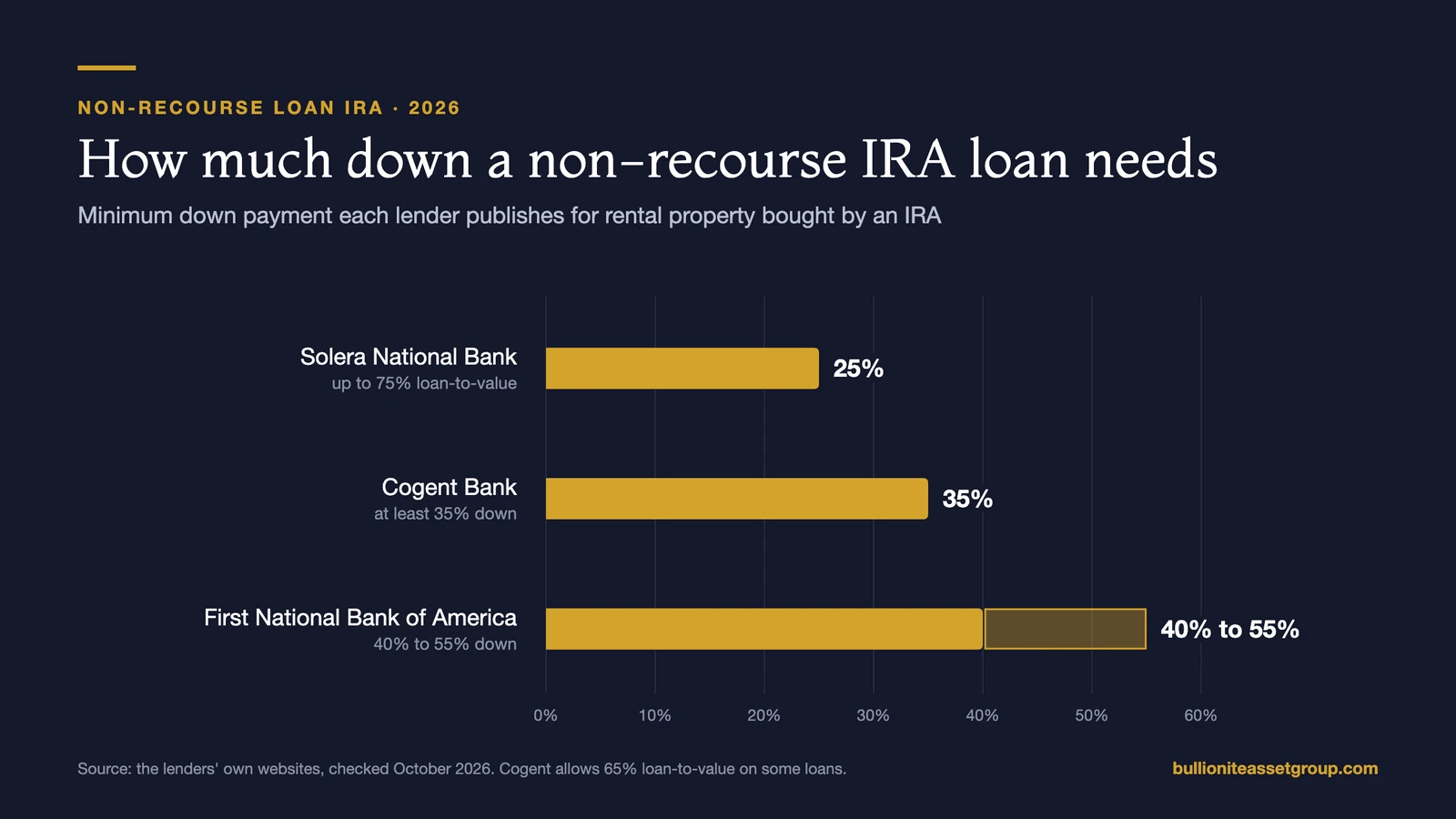
Plan on 25% to 55% down. The IRA mortgage down payment is the biggest difference from a regular investor loan, and lenders set it high because the property is their only protection. Our view: if a deal only works at a lender's maximum loan-to-value, it's too tight for an IRA, which can't take extra cash from you when the roof goes.
These are the terms three banks publish on their own sites, checked in October 2026:
| Lender | Down payment or loan-to-value | Rate | Loan terms | Rent test | Reserves in the IRA | Minimum loan |
|---|---|---|---|---|---|---|
| First National Bank of America | 40% to 55% down | Not published | 5, 10 or 15-year ARM, or 20-year fixed, all on 20-year amortization | Net operating income beats the payment by 20% to 25% | 6 months of payments if leased at closing, 12 if vacant or a short-term rental | Not published |
| Solera National Bank | Up to 75% loan-to-value | From 7.25% to 8.0% APR | 7 or 10-year ARM on 30-year amortization, or 25-year fixed | Net operating income beats the payment by at least 25% | A minimum is required | $125,000 |
| Cogent Bank | At least 35% down, up to 65% on some loans | Not published | Not published | Rental income analysis | Several months of payments and HOA dues | $100,000 |
"Payments" here means principal, interest, property taxes and insurance (PITI).
Self-directed IRA real estate mortgage rates run above standard investor loans because the lender gives up recourse. Solera's published starting range of 7.25% to 8.0% APR is a fair yardstick, and fees add up on top. First National Bank of America charges 1.50% to 2.75% in origination plus a $250 processing fee and a $500 documentation fee.
Lenders care most about whether the rent covers the loan. They divide the property's net operating income by a year of loan payments: First National Bank of America wants 1.20 to 1.25, and Solera wants at least 1.25.
Who are the IRA non-recourse loan lenders?
IRA non-recourse loan lenders are a short list of banks and private lenders, because most banks won't lend without a personal guarantee. The three in the table publish their terms. North American Savings Bank also advertises IRA non-recourse loans, and many custodians keep lender lists for their clients.
Get quotes from at least two. Compare the whole cost: rate, origination, the reserves you'll have to leave idle in the IRA, and any prepayment terms. Ask your real estate SDIRA custodian which lenders it has closed with, since the custodian signs the loan documents for the IRA.
A private loan works too, as long as the lender isn't a disqualified person and the note is non-recourse. That can be the seller carrying back part of the price or an unrelated private lender. Keep the rate and terms at market levels and put everything in writing.
How to buy a rental with a non-recourse loan IRA, step by step
- Open and fund a self-directed IRA with a custodian that holds real estate. If you're new to the structure, start with how a self-directed IRA holds real estate, and compare self-directed IRA fees too, since some custodians charge more for leveraged purchases. Roll over or transfer enough to cover the down payment, closing costs and reserves.
- Get pre-qualified before you make offers, so you know the loan-to-value and rent test the lender will apply.
- Make the offer in the IRA's name. The contract, earnest money and title all belong to the IRA. Earnest money comes out of the IRA, never your checking account.
- Send the custodian a direction of investment. It reviews the deal and signs the purchase and loan documents for the IRA. If an IRA-owned LLC is buying, you sign as the LLC's manager, never as a guarantor.
- Close. First National Bank of America quotes 30 to 45 days from application to closing, so build that into your contract.
- Run the property through the IRA. Rent, repairs, taxes, insurance and the mortgage all flow through the account. A property manager keeps you out of hands-on work, which the rules don't allow.
- Report every year. The custodian needs a year-end value, and the IRA may need to file Form 990-T.
Do you pay tax on a leveraged property in your IRA?
Often yes, on the borrowed share. Income an IRA earns with borrowed money is unrelated debt-financed income (UDFI), and it's taxed even inside a traditional or Roth IRA.
IRS Publication 598 sets out the math. The taxable share of each year's income is the average loan balance divided by the property's average adjusted basis. Operating costs, interest and straight-line depreciation are deducted in the same proportion. Then a $1,000 specific deduction comes off before any tax.
When the property sells, the taxable share of the gain uses the highest loan balance in the 12 months before the sale. Tax is figured at trust rates. For 2026 that's 10% up to $3,300 of taxable income, 24% up to $11,700, 35% up to $16,000 and 37% above that, according to the IRS 2026 Form 1041-ES. Long-term gains get the trust capital-gain rates, which top out at 20% above $16,250.
A worked example with real numbers
Say your IRA buys a $400,000 single-family rental with 40% down ($160,000) and a $240,000 non-recourse loan at 7.5% over 20 years. The payment is $1,933 a month.
| Year 1 | Amount |
|---|---|
| Rent ($3,600 a month) | $43,200 |
| Property taxes, insurance, management and maintenance | ($13,456) |
| Net operating income | $29,744 |
| Loan payments (rent test: 1.28) | $23,201 |
| Interest paid | ($17,817) |
| Depreciation ($320,000 building over 27.5 years) | ($11,636) |
| Net income | $290 |
| Debt-financed share: average loan $237,566 ÷ average basis $394,182 | 60.3% |
| Taxable UDFI before the $1,000 deduction | $175 |
Year 1 owes no tax, because $175 is under the $1,000 deduction. Interest and depreciation soak up most of the rent while the loan is large. Even so, the debt-financed share of the gross rent is about $26,000, so the IRA still files a return.
The Form 990-T instructions require one once an IRA has $1,000 or more of unrelated business gross income, and they list Roth IRAs too. The custodian files it by the 15th day of the fourth month after year-end, which is April 15 for most IRAs, and the IRA needs its own EIN for that return, separate from yours. The instructions also say a loss from an unrelated business carries forward to later years. Our post on SDIRA tax filing requirements covers the rest of the paperwork.
Most of the tax shows up at the sale. Five years later the IRA sells for $480,000. After $28,800 of selling costs and $58,180 of depreciation, the gain is $109,382. The highest loan balance in the year before the sale was $215,825 against an average basis of $347,636. So 62.1% of the gain, about $67,900, is taxable.
That bill lands around $12,100 to $15,200, paid out of the IRA. Where it falls depends on how much of the gain counts as depreciation, which can be taxed at up to 25%.
The 12-month rule works in your favor too. Pub 598 treats property as debt-financed only if there was debt on it during the 12 months before the sale. If the IRA pays the loan off and holds the property for another year before selling, none of the gain is UDFI.
Is a Solo 401(k) better for leveraged real estate?
For borrowed money, usually yes, if you qualify for one. Section 514(c)(9) takes real estate debt out of UDFI for "any trust which constitutes a qualified trust under section 401," which covers a Solo 401(k), as long as the loan meets that section's conditions (26 U.S.C. 514). IRAs aren't on that list.
You'll need self-employment income and no employees other than you and your spouse to open a Solo 401(k). Solera lends to both account types. If you're an employee with only an IRA, the non-recourse loan IRA route is the one open to you, so build the tax into your numbers from day one.
What happens if your IRA can't make the payments?
The lender forecloses on the property, and that's where it stops. Under a non-recourse loan the bank can't chase you or the rest of your IRA. The IRA does lose the property, the down payment and any equity it built.
The bigger risk is a cash squeeze long before foreclosure. Every payment has to come from the IRA, and you can't top it up past the annual contribution limit: $7,500 for 2026, or $8,600 at age 50 and up, per the IRS 2026 limits announcement. Paying an IRA bill from your own pocket can count as an excess contribution or a prohibited transaction.
That's why lenders make the IRA hold 6 to 12 months of payments in reserve. Keep more if the property is older. In the example above, the IRA needs about $184,700 at closing: $160,000 down, roughly $9,550 in closing costs (a 2% origination fee, $750 in lender fees and about $4,000 for title, appraisal and recording) and $15,100 for six months of payments.
If it's a traditional IRA and you're 73 or older, required minimum distributions add another cash call on top of the mortgage. Plan for both before you buy.
Get the deal checked before you sign
A leveraged purchase in an IRA has more moving parts than a cash one: the lender's rent test, reserves, the UDFI bill and the prohibited transaction rules. Bullionite helps investors set up a real estate self-directed IRA, check a property against the IRS rules and model the tax before the offer goes in. Book a consultation and bring the listing.
This guide is general information, not tax, legal or investment advice. The rules and limits cited are current for 2026, so check your own situation with a CPA or tax attorney before you act.
FAQ
Can you use leverage in a Roth IRA?
Yes. A Roth IRA can borrow on the same non-recourse terms as a traditional IRA. The debt-financed share of its income is still taxable as UDFI, since the Form 990-T rules cover Roth IRAs. The rest of the profit stays tax-free if you meet the Roth distribution rules.
Can I lend my own IRA the money instead of using a bank?
No. A loan between you and your IRA is a prohibited extension of credit under section 4975, and the same goes for your spouse, parents, children and their spouses. An unrelated private lender, or the seller, can finance the purchase on non-recourse terms instead.
Can an IRA-owned LLC take out the loan?
Yes. Some lenders, First National Bank of America among them, accept an LLC owned by the IRA as the borrower. The rules don't change: you can sign as the LLC's manager, but you can't guarantee the loan, which is the mistake that disqualified the IRAs in Peek. Our guide to setting up a checkbook IRA LLC explains the structure.
Does my personal credit score matter?
Sometimes. The IRA is the borrower and the property secures the loan, so the property's rent and the IRA's cash carry most of the weight. Some lenders still look at the owner's credit, and Solera National Bank lists personal credit among its underwriting factors.
Can the IRA buy a home I plan to live in later?
Not while the IRA owns it. Cogent Bank requires a signed statement that the property is for business or investment use only, and personal use by you or your family is a prohibited transaction. Taking money out of an IRA for your own house follows different rules, covered in can I borrow from my IRA to buy a house.

As the Founder and Chief Investment Officer of Bullionite and Bullionite Asset Group, I’ve built my career on a simple premise understanding the intersection of macroeconomics, commodities, and digital assets to stay ahead of the curve, not under it. My focus is on navigating the complexities of the world’s largest markets spanning the US, the Middle East, and Asia to identify high-value opportunities for alternative investment.
With a specialized focus on Self-Directed IRAs (SDIRAs), I help investors move beyond traditional 401ks by integrating assets like precious metals and cryptocurrency into their retirement strategies. Based in Newport Beach, California, I am dedicated to bridging the gap between traditional finance and the evolving landscape of new age digital assets, ensuring that every strategic move is backed by deep market insight and a commitment to long-term growth.