Free 30-min consultation · No pitch, no pressure 📞 CALL: (949) 536-9733


Self-Directed IRA RMD Rules: How to Take RMDs From Real Estate and Gold
A self-directed IRA RMD follows the same IRS rules as any traditional IRA, but real estate and gold can't be split like a mutual fund. Here's the math, the valuation and four ways to take it.
A self-directed IRA RMD follows the same IRS rules as any other traditional IRA, from the starting age to the divisor. What's different is the assets. You can't sell 4% of a rental house, so self-directed IRA required minimum distributions take planning a year or two ahead.
The rules here come from the IRS's own RMD guidance and Publication 590-B, with a worked example using the 2026 divisors.
How do RMDs work in a self-directed IRA?
Each year from your RMD age, you divide the IRA's value on the previous December 31 by an IRS life-expectancy factor and withdraw at least that much by December 31. The self-directed IRA RMD rules don't change because the IRA holds a house, gold or a private note.
The IRS spells out the rest in its RMD FAQs:
- RMDs apply to traditional, SEP and SIMPLE IRAs. Roth IRAs have none while the owner is alive.
- Your custodian may calculate the amount, but you're responsible for taking the right amount on time.
- If you own several IRAs, you calculate each one's RMD separately, then take the total from any one or more of them.
- RMDs from 401(k) and 457(b) plans have to come from each plan separately. They can't be covered by an IRA withdrawal, or the other way round.
That third point is the most useful rule a self-directed IRA owner has, as the example below shows.
When do self-directed IRA RMDs start?
Most people take their first RMD for the year they turn 73. The age comes from 26 U.S.C. 401(a)(9)(C)(v), as changed by the SECURE 2.0 Act:
| Born | RMD age | First RMD year |
|---|---|---|
| 1951 to 1958 | 73 | The year you turn 73 |
| 1959 | 73 (see note) | 2032 |
| 1960 or later | 75 | The year you turn 75 |
The statute's wording overlaps for people born in 1959, and proposed IRS regulations from July 2024 would set their age at 73. Check for final rules before 2032.
The first RMD can wait until April 1 of the following year. Every RMD after that is due by December 31. Delaying the first one means two RMDs land in the same tax year, which matters more when the IRA holds property and both have to be funded at once.
How do you calculate a self-directed IRA RMD?
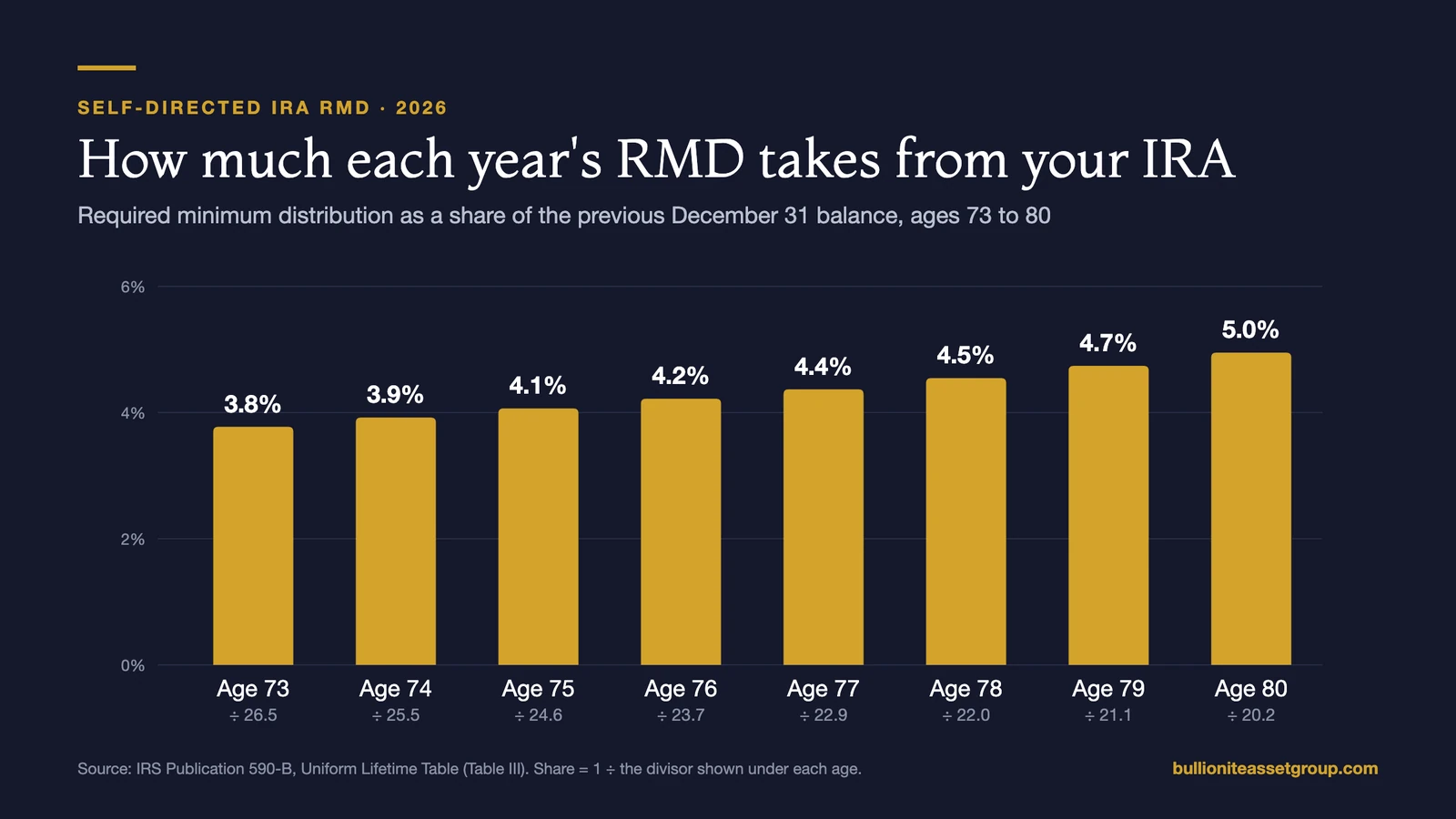
Divide the IRA's December 31 value from last year by the factor for your age this year from the Uniform Lifetime Table (Table III) in IRS Publication 590-B. If your spouse is your sole beneficiary and more than 10 years younger, you use Table II instead.
| Age in 2026 | Table III factor | Share of the balance withdrawn |
|---|---|---|
| 73 | 26.5 | 3.8% |
| 74 | 25.5 | 3.9% |
| 75 | 24.6 | 4.1% |
| 76 | 23.7 | 4.2% |
| 77 | 22.9 | 4.4% |
| 78 | 22.0 | 4.5% |
| 79 | 21.1 | 4.7% |
| 80 | 20.2 | 5.0% |
A worked example
You turn 75 in 2026. On December 31, 2025, your self-directed IRA held a rental house worth $300,000, gold worth $100,000 and $20,000 in cash, a total of $420,000. You also have a brokerage IRA worth $150,000.
| Account | December 31, 2025 value | Factor at 75 | 2026 RMD |
|---|---|---|---|
| Self-directed IRA | $420,000 | 24.6 | $17,073 |
| Brokerage IRA | $150,000 | 24.6 | $6,098 |
| Total you must withdraw | $23,171 |
Because both are IRAs, you can take the whole $23,171 from the brokerage IRA and leave the rental and the gold untouched. Its $150,000 balance could cover that for several years, and that's often the cleanest self-directed IRA real estate RMD plan there is.
Now the double-up. Say you turn 73 in 2026 with a $400,000 self-directed IRA and wait until April 1, 2027 for your first RMD of $15,094 (400,000 ÷ 26.5). If the IRA is worth $410,000 at the end of 2026, your second RMD of $16,078 (410,000 ÷ 25.5) is due by December 31, 2027. That's $31,172 of taxable income in one year, and the IRA needs the cash or an in-kind plan for both.
How are real estate, gold and private assets valued for an RMD?
They're valued at fair market value as of December 31, the same date the custodian reports to the IRS. The IRS instructions for Forms 1099-R and 5498 require custodians to report assets without a readily available market value at their December 31 value, in box 15a of Form 5498, with a code in box 15b (D is real estate).
In practice, the custodian asks you for a value early in the year:
- Real estate needs an appraisal or a broker's price opinion. Use the same approach each year so the numbers hold up.
- Gold and other metals are easy, since the custodian can price them from the market.
- Private notes, LLC interests and private funds need a statement from the issuer or a third-party valuation.
Don't treat this as paperwork. Your RMD is only as right as the value behind it, and custodians charge for late valuations: Vantage charges $125 (assessed May 1) and IRA Club $175 on their 2026 schedules.
How do you take an RMD when the IRA holds real estate?
You have four practical options, and most real estate IRA RMD plans use one or two of them together.
- Keep cash in the IRA. Rent and other income build up in the account, and the RMD comes from that cash. This works best when you plan for it from about age 70.
- Take it from another IRA. As in the example above, a liquid IRA can cover the RMDs for all of your IRAs. It doesn't work with a 401(k), which has to take its own RMD.
- Distribute part of the asset in kind. An in-kind distribution from an IRA moves the asset, or a slice of it, out to you at its fair market value, and that value is taxable income. For a house, that means deeding a percentage interest to yourself each year. For gold, it means having coins shipped to you.
- Sell the asset. Selling under deadline pressure is the expensive version, so if a sale is coming anyway, plan it a year ahead.
In-kind distributions cost money at the custodian: $100 at Vantage and IRAR Trust and $125 at Equity Trust on their 2026 schedules, plus an appraisal. Our comparison of self-directed IRA fees lists their other charges. The custodian reports the distribution on Form 1099-R, using code K for assets without a readily available market value.
A fractional deed has a catch. Once you own part of the house and your IRA owns the rest, every cost has to be split by ownership share, and you still can't use the property yourself. Our FAQ on how to get property out of a self-directed IRA covers the mechanics, and our guide to prohibited transactions explains why personal use stays off limits.
If you give to charity, there's a fifth route. A qualified charitable distribution from age 70½ counts toward your RMD and stays out of your income, up to $111,000 for 2026 under IRS Notice 2025-67. It has to go straight from the IRA to the charity, so it suits cash better than property.
What happens if you miss an RMD?
The IRS charges an excise tax of 25% of the amount you didn't take, cut to 10% if you correct it within two years. You report it on Form 5329 with your tax return.
On the $17,073 RMD from the example, a miss costs $4,268 at 25%, or $1,707 if you fix it in time. Publication 590-B also lets you ask for the tax to be waived if the shortfall came from reasonable error and you're fixing it: you attach a statement of explanation to Form 5329.
Take the missed amount out as soon as you find the problem, because the waiver depends on showing you've fixed the shortfall.
Mistakes self-directed IRA owners make with RMDs
- Waiting for the custodian to remind them. Some will, but the deadline is yours.
- Holding every dollar in one property, so there's no cash for the RMD or the tax bill on it.
- Using last year's appraisal as this year's value without checking it.
- Forgetting that delaying the first RMD to April 1 stacks two RMDs in one year.
- Taking the IRA's RMD from a 401(k), which doesn't count.
- Deeding a share of a property in kind without an appraisal, then arguing about the value later.
Get your RMD plan in place early
RMDs from property and metals are manageable when they're planned two or three years out, and stressful when they're not. Bullionite helps investors structure a self-directed IRA so the cash, the valuations and any in-kind steps are ready before the deadline. Book a consultation and bring your latest IRA statements.
This guide is general information, not tax, legal or investment advice. The rules and limits cited are current for 2026, so check your own situation with a CPA or tax attorney before you act.
FAQ
Do you have to take an RMD from a gold IRA?
Yes. A gold IRA RMD works like any traditional IRA's: you can sell metal and take cash, or take coins in kind at their market value. Our page on IRA-approved gold coins covers what happens to coins at RMD time, and our guide to gold IRA fees shows what selling or shipping them costs.
Do I need a SIMPLE IRA RMD if I’m still working?
Yes. The IRS lets workers in employer plans such as a 401(k) delay RMDs until they retire, unless they own 5% of the business. That delay doesn't apply to traditional, SEP or SIMPLE IRAs, which start at your RMD age even if you're still working.
Does a self-directed Roth IRA have RMDs?
Not while you're alive. Roth IRAs are exempt from lifetime RMDs, which makes them a good home for land bought through an IRA or property you plan to hold for decades. Your beneficiaries do face RMD rules after your death. Our comparison of self-directed and Roth IRAs covers the trade-offs.
Can I take my RMD before December 31 and reinvest it?
You can take it any time during the year, and you can invest the money outside the IRA afterward. You can't roll an RMD back into an IRA, though: Publication 590-B says required distributions aren't eligible for rollover.
Will my custodian take the RMD automatically?
Some can send it from cash on a schedule: IRA Club, for example, offers recurring ACH distributions for $5 each and includes the RMD calculation in its fees. If the IRA holds only property, there's no cash to send, so the custodian needs your instructions on what to sell or distribute.

As the Founder and Chief Investment Officer of Bullionite and Bullionite Asset Group, I’ve built my career on a simple premise understanding the intersection of macroeconomics, commodities, and digital assets to stay ahead of the curve, not under it. My focus is on navigating the complexities of the world’s largest markets spanning the US, the Middle East, and Asia to identify high-value opportunities for alternative investment.
With a specialized focus on Self-Directed IRAs (SDIRAs), I help investors move beyond traditional 401ks by integrating assets like precious metals and cryptocurrency into their retirement strategies. Based in Newport Beach, California, I am dedicated to bridging the gap between traditional finance and the evolving landscape of new age digital assets, ensuring that every strategic move is backed by deep market insight and a commitment to long-term growth.