Free 30-min consultation · No pitch, no pressure 📞 CALL: (949) 536-9733

How to Buy Land With an IRA: Rules, Steps and Real Costs
You can buy land with an IRA through a self-directed custodian. Here are the IRS rules, the eight steps to close, what holding land costs and the mistakes that end an IRA.
You can buy land with an IRA, but only through a self-directed IRA whose custodian agrees to hold real estate. The IRA owns the land, pays every bill and keeps every dollar of profit. You don't get to use it, and neither does your family.
Land is one of the simplest assets an IRA can hold, since there are no tenants to manage and nothing to repair. It's also one of the hardest on cash, because vacant land costs money every year and usually earns nothing until it's sold or leased.
Can you buy land with an IRA?
Yes. Federal law doesn't stop an IRA from owning land, and the IRS says in its retirement plan investments FAQs that "there is no list of approved investments." The tax code's IRA rules shut out two kinds of assets: collectibles and life insurance.
So when people ask "can I buy land with my IRA?" or "can I use my IRA to buy land?", the real question is whether your custodian will hold it. Most banks and brokerages won't. A self-directed IRA custodian that handles real estate will, and that's the account you'll need. If you're new to how these accounts own property, start with how a self-directed IRA holds real estate.
Can an IRA own land outright, with no LLC? Yes. The deed goes in the IRA's name, usually written as "[Custodian] FBO [your name] IRA." An IRA-owned LLC is optional, and we'll cover when it makes sense below.
What rules apply to land in a self-directed IRA?
The rules come from the prohibited transaction section of the tax code, 26 U.S.C. 4975. Their aim is simple: the IRA's land has to benefit the IRA, never you or your family personally.
- The IRA can't buy land from, sell it to, or lease it to a disqualified person. That's you, your spouse, your parents and grandparents, your children and grandchildren, and their spouses, plus businesses you own half or more of.
- Nobody on that list can use the land. That covers a weekend camp, a hunting spot, a place to park your RV and pasture for your own horses.
- You can't do the work yourself. Clearing brush, building fences or improving the lot counts as furnishing services to the IRA.
- The IRA pays every expense, from the purchase price to property tax, insurance and surveys, and every dollar of income goes back to the IRA.
- You can't pledge the land as security for a personal loan. Under section 408(e)(4), the pledged part counts as distributed to you.
Siblings are a useful exception. Section 4975(e)(6) defines family as your spouse, ancestors, lineal descendants and their spouses, so brothers, sisters, nieces and nephews aren't on the list. You could buy land from your brother at a fair, appraised price.
The penalty for breaking a rule is severe. Under section 408(e)(2), an IRA whose owner engages in a prohibited transaction stops being an IRA as of January 1 of that year, and the whole account is treated as distributed. Our guide to self-directed IRA rules and prohibited transactions lists the rest.
How to buy land with an IRA, step by step
Here's how to buy land with an IRA from start to finish. Once you've found the parcel, a self-directed IRA land purchase moves at the pace of due diligence, title work and the custodian's review.
- Open a self-directed IRA with a custodian that holds real estate. Ask whether it handles vacant land, since some only take rentals. Our page on choosing a real estate SDIRA custodian covers what to ask.
- Fund it by transfer or rollover. Move enough for the price, closing costs and at least three years of holding costs.
- Find the parcel and check it before you commit: zoning, road access, easements, flood zone, and a survey. Ask about utilities and a perc test if anyone will ever build there.
- Make the offer in the IRA's name, not yours. The buyer line reads "[Custodian] FBO [your name] IRA."
- Pay the earnest money from the IRA. Send your custodian a direction of investment and it wires the deposit. Never put down your own check, even temporarily.
- Send the contract and closing documents to the custodian. It reviews and signs them as buyer. Build its processing time into the closing date.
- Close. The IRA wires the balance, and the deed is recorded in the IRA's name. Check the recorded deed against the vesting instructions.
- Run the land through the IRA. Property tax bills and insurance go to the custodian or are paid on its direction, and any lease income flows back into the account.
If you want to sign documents and pay bills yourself, an IRA-owned LLC with checkbook control can hold the land instead. It costs more to set up and maintain, so it usually pays off only when the IRA will make many transactions. Our guide to setting up a checkbook IRA LLC explains the trade-off.
What does it cost to hold land in an IRA?
Holding land costs the IRA property tax, insurance and custodian fees every year, usually with no income to offset them. That's the part most buyers underestimate when buying land with IRA money.
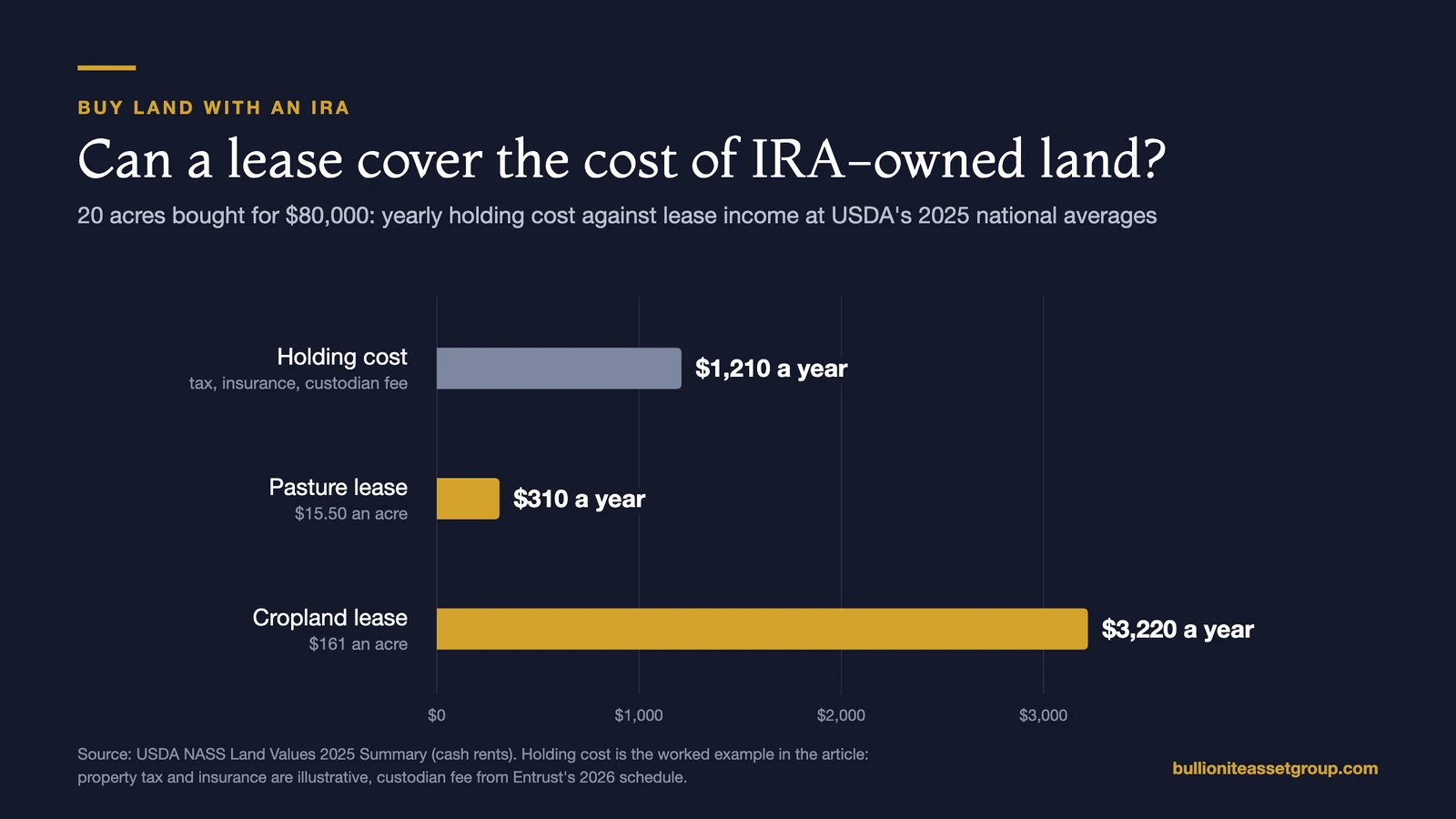
Here's an example. Your IRA buys 20 acres for $80,000 in cash. Say the county's property tax is $640 a year and a liability policy costs $300. At Entrust, a one-asset account worth $80,000 pays $219 plus 0.17% of the $30,000 above $50,000, or $270 a year.
| Cost | Amount |
|---|---|
| Purchase price | $80,000 |
| Custodian purchase fee (Entrust) | $175 |
| Holding costs each year: property tax, insurance, custodian fee | about $1,210 |
| Cash reserve for three years of holding costs | about $3,630 |
Your IRA needs roughly $84,000 plus closing costs before it buys. Running out of cash later is a real problem, because you can't pay the tax bill yourself and you can only add $7,500 a year ($8,600 at 50 or older) for 2026, according to the IRS 2026 limits announcement.
Custodians price land the same way as any other asset, and our comparison of self-directed IRA fees covers seven of them. On their 2026 schedules, IRAR Trust charges $199 a year and $175 per purchase or sale, and GoldStar Trust charges $150 a year and $100 per purchase or sale.
There's also a yearly valuation. Your custodian reports the land's December 31 fair market value on Form 5498, under code D for real estate, per the IRS instructions for Forms 1099-R and 5498. Budget for a broker's opinion or appraisal when the custodian asks.
Can your IRA earn income from land?
Yes. Your IRA can lease the land to anyone who isn't a disqualified person, and rent from real property is generally free of the unrelated business income tax under 26 U.S.C. 512(b)(3).
A farm lease is the classic way to make land pay its holding costs. The USDA's Land Values 2025 Summary puts average US cropland cash rent at $161 an acre for 2025 ($147 non-irrigated, $244 irrigated) and pasture at $15.50 an acre. Rents vary a lot by state, from $39.50 an acre for Montana cropland to $346 in California.
Back to the 20 acres. Leased as cropland at the national average, the land would bring in about $3,220 a year, more than double its $1,210 in holding costs. Leased as pasture, it would bring in $310 and still run at a loss.
Ground leases for cell towers, billboards or solar panels work the same way, as long as the tenant isn't a disqualified person. One catch: the rent exclusion doesn't cover rent based on the tenant's income or profits. A fixed cash rent, or a fixed percentage of gross receipts, keeps you inside it. Have a CPA review any profit-share or crop-share lease before your IRA signs.
Can you build on land your IRA owns?
Yes, as long as the IRA pays for everything and unrelated contractors do the work. Building something to rent out keeps you in the same position as any rental: rental income stays sheltered, unless the IRA borrowed money for it.
Building to sell is where people get caught. Section 512(b)(5) excludes gains from UBTI except on "property held primarily for sale to customers in the ordinary course of the trade or business." Subdividing a parcel into lots, putting in roads and marketing them can turn your IRA into a dealer, and dealer profits are taxed inside the IRA. Our post on SDIRA tax filing requirements covers Form 990-T, the return that tax goes on.
Holding land and selling it in one piece after it appreciates is the cleanest version. That gain stays tax-deferred in a traditional IRA, or tax-free in a Roth if you meet the Roth rules.
Is a Roth IRA better for land?
Often, yes. Land in a Roth IRA can sit for decades, because Roth owners don't take required minimum distributions during their lifetime, according to the IRS RMD FAQs. A sale inside the Roth isn't taxed, and qualified withdrawals are tax-free.
A traditional IRA has to start required minimum distributions at 73, and land pays nothing out. When that day comes you'll need cash from elsewhere in the IRA, a sale, or an in-kind distribution of part of the land at appraised value. Our FAQ on how to get property out of a self-directed IRA walks through the in-kind route.
If you're 60 and plan to hold the land for 20 years, RMDs will start while the IRA still owns it. That's when a Roth, or a clear cash plan, earns its keep.
Mistakes that can cost you the whole IRA
These are the land deals that turn into prohibited transactions:
- Buying your parents' farm, or selling the IRA's land to your daughter, at any price.
- Letting your son farm the land or hunt on it, even if he pays market rent.
- Camping on the land, storing equipment there or grazing your own animals.
- Paying the property tax bill from your checking account because the IRA was short.
- Clearing, fencing or improving the land yourself.
- Buying the lot next to your house to protect your view, which looks like a personal benefit.
Any one of these can disqualify the IRA back to January 1 of that year. If you're not sure about a deal, check it before the contract is signed, not after.
Buy the land the right way the first time
Land is a straightforward IRA investment once the structure is right and the cash plan holds up. Bullionite helps investors set up a real estate self-directed IRA, check a parcel against the prohibited transaction rules and plan the cash for holding costs. Book a consultation and bring the listing.
This guide is general information, not tax, legal or investment advice. The rules and limits cited are current for 2026, so check your own situation with a CPA or tax attorney before you act.
FAQ
Can my IRA buy land from my brother or sister?
Yes. Siblings aren't disqualified persons, because section 4975(e)(6) limits family to your spouse, ancestors, lineal descendants and their spouses. Use an independent appraisal so the price is clearly fair, and make sure no disqualified person benefits from the sale.
Can my IRA get a loan to buy land?
Only a non-recourse loan, with the land as the only collateral, and raw land is hard to finance that way. IRA lenders underwrite on rental income: First National Bank of America, for example, wants net operating income 20% to 25% above the payment. Debt-financed gains are also taxable inside the IRA under IRS Publication 598, so plan on paying cash.
Can I use a 1031 exchange for land in my IRA?
You don't need one. A sale inside your IRA isn't taxed when it happens, so the IRA can sell one parcel and buy another with the proceeds. You can't swap land between your IRA and yourself, though, because that's a prohibited exchange.
Can I buy land with my 401(k)?
Only if the plan allows it. A Solo 401(k) can hold real estate when its plan document permits. Employer 401(k)s usually offer a fixed fund menu, so people roll eligible money into a self-directed IRA first, once they've left the employer or reached an in-service withdrawal age.
How is IRA-owned land valued each year?
Your custodian asks for a December 31 value, usually supported by a broker's opinion or an appraisal, and reports it on Form 5498. Miss the deadline and some custodians charge a fee: Vantage charges $125 and IRA Club $175. An up-to-date value also matters for RMDs and in-kind distributions.

As the Founder and Chief Investment Officer of Bullionite and Bullionite Asset Group, I’ve built my career on a simple premise understanding the intersection of macroeconomics, commodities, and digital assets to stay ahead of the curve, not under it. My focus is on navigating the complexities of the world’s largest markets spanning the US, the Middle East, and Asia to identify high-value opportunities for alternative investment.
With a specialized focus on Self-Directed IRAs (SDIRAs), I help investors move beyond traditional 401ks by integrating assets like precious metals and cryptocurrency into their retirement strategies. Based in Newport Beach, California, I am dedicated to bridging the gap between traditional finance and the evolving landscape of new age digital assets, ensuring that every strategic move is backed by deep market insight and a commitment to long-term growth.