Free 30-min consultation · No pitch, no pressure 📞 CALL: (949) 536-9733


Self-Directed Roth IRA Rules: Limits, Investments and Tax-Free Withdrawals
Self-directed Roth IRA rules for 2026: who can contribute, what the account can hold, when withdrawals are tax-free, and how real estate, LLCs and conversions fit in.
Self-directed Roth IRA rules are the rules that govern every Roth IRA, applied to a much wider menu of investments. You contribute after-tax money, the account can own real estate, private companies, notes or precious metals, and qualified withdrawals come out tax-free.
What changes is how much can go wrong, because you choose the investments and the IRS holds you to every rule. Here's what the tax code allows in 2026, where the traps are, and how real estate, LLCs and Roth conversions work inside a self-directed Roth IRA.
What is a self-directed Roth IRA?
A self-directed Roth IRA is a Roth IRA held by a custodian that lets you invest in assets beyond stocks and funds. Its tax treatment comes from section 408A of the tax code, exactly as it does for a Roth at a brokerage. "Self-directed" describes the custodian's menu, not a different kind of account.
That's why the self-directed Roth IRA rules start with the ordinary Roth rules: no deduction going in, tax-free growth, and tax-free qualified withdrawals. The extra rules come from the investments themselves, meaning who the account can deal with, what it can own and how its income is taxed.
If you're weighing a self-directed Roth against a standard one, our comparison of self-directed and Roth IRAs covers the trade-offs.
What are the self-directed Roth IRA rules for contributions?
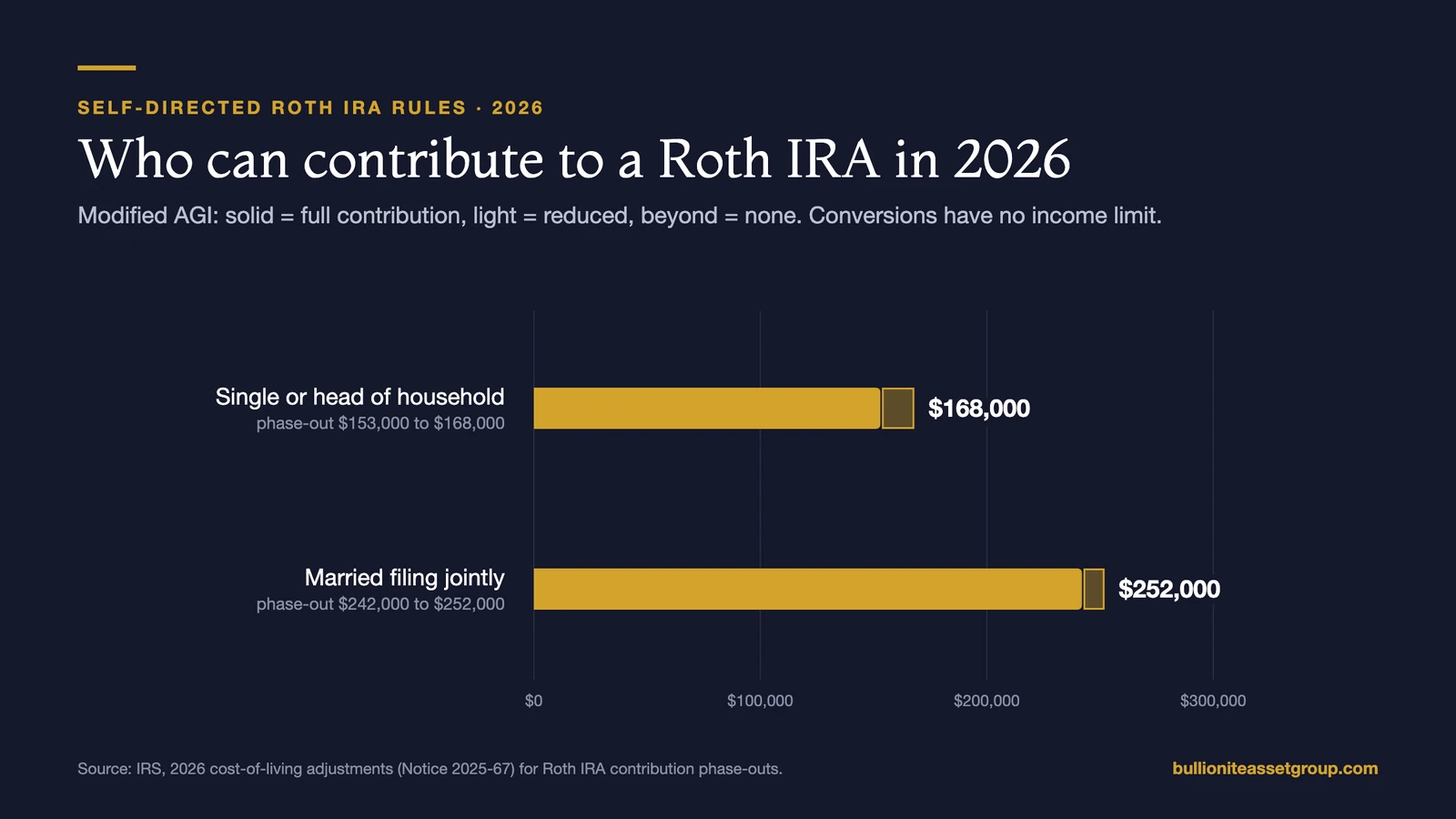
You can contribute up to $7,500 for 2026, or $8,600 if you're 50 or older, as long as you have earned income and your income is under the IRS limits. The limit is shared with any traditional IRA you fund, according to the IRS 2026 limits announcement.
| Roth IRA contribution rule | 2026 figure |
|---|---|
| Annual limit | $7,500 |
| Catch-up at 50 or older | $1,100, for $8,600 in total |
| Single or head of household, full contribution | Modified AGI under $153,000 |
| Single or head of household, reduced contribution | $153,000 to $168,000 |
| Married filing jointly, full contribution | Modified AGI under $242,000 |
| Married filing jointly, reduced contribution | $242,000 to $252,000 |
| Deadline for 2026 | April 15, 2027, with no extension |
Three more self-directed Roth IRA rules matter far more with alternative assets than with funds:
- Contributions must be cash. IRS Publication 590-A says contributions, except rollovers, must be in cash, so you can't contribute a property, a note or coins you already own.
- You need compensation, such as wages or self-employment income. If you file jointly, a spouse with no earnings can still contribute based on the working spouse's income.
- There's no age limit. Pub 590-A says you can be any age, as long as you have compensation.
What can a self-directed Roth IRA invest in?
Almost anything the tax code doesn't shut out. The IRS says in its retirement plan investments FAQs that there's no list of approved investments, so the self-directed Roth IRA investment rules mostly tell you what's barred and who you can't deal with.
With a custodian that allows them, a self-directed Roth IRA can hold rental property and land, shares in private companies and LLCs, promissory notes and private loans, IRA-eligible precious metals, cryptocurrency, and private funds or syndications. A few things are off limits:
- Collectibles, such as art, antiques, gems, most coins and alcohol, under IRC 408(m). Certain coins and bullion are exceptions, which our guide to IRA-eligible gold explains.
- Life insurance contracts.
- S corporation stock, in practice. An S corporation can't have a shareholder that isn't an individual, apart from estates, certain trusts and exempt organizations (IRC 1361(b)(1)(B)), so an IRA buying in would end the company's S election.
Who you deal with matters as much as what you buy. The Roth can't buy from, sell to, lend to or hire you, your spouse, your parents or your children, among others. Our guide to self-directed IRA rules and prohibited transactions lists every disqualified person.
When are self-directed Roth IRA withdrawals tax-free?
A withdrawal is tax-free when it's a qualified distribution: your Roth has passed its 5-year period, and you're 59½ or older, disabled, taking up to $10,000 for a first home, or the money is going to your beneficiary after your death. Under IRC 408A, the 5-year period starts on January 1 of the first year you contributed to any Roth IRA.
Before that, the ordering rules decide what's taxed. A withdrawal comes first from your contributions, then from converted amounts, and only then from earnings:
| Layer | Income tax | 10% additional tax before 59½ |
|---|---|---|
| Your contributions | Never | Never |
| Converted amounts | Never | Yes, if within 5 years of that conversion |
| Earnings | Yes, unless the withdrawal is qualified | Yes, unless an exception applies |
The conversion clock is easy to miss. IRS Publication 590-B says each conversion has its own 5-year period for the 10% additional tax, separate from the period that decides whether a withdrawal is qualified.
There are no required minimum distributions while you're alive. That matters a lot for property, because a traditional IRA has to start paying out at 73 even when its only asset is a rental. Our guide to self-directed IRA RMDs shows what that looks like.
A worked example
Say you're 52, you open a self-directed Roth IRA in 2026, and you contribute $8,600 a year for eight years, $68,800 in all, assuming the limit stays put. The Roth lends the money out on secured notes and earns $40,000 of interest by the time you're 60.
At 60, your Roth is past its 5-year period and you're over 59½, so all $108,800 can come out tax-free. If you'd needed cash at 57, you could have taken up to $68,800 of contributions with no tax or penalty. Only the $40,000 of earnings would have been exposed.
Can a self-directed Roth IRA own real estate?
Yes. Self-directed Roth IRA real estate follows the same rules as real estate in any IRA: the Roth buys and owns the property, pays every expense and collects every dollar of rent, and nobody on the disqualified list can use it. What's different is the payoff, because both the rent and the eventual gain can come out tax-free.
There are two catches. First, the Roth can only spend what's inside it, and a property bill paid from your own pocket counts as a contribution and can be a prohibited transaction. Second, a Roth isn't exempt from UBIT. If it buys with a non-recourse loan, the debt-financed share of the income is taxable, and the Form 990-T instructions list Roth IRAs among the accounts that must file.
Land works too, and a Roth suits it well because land can sit for decades with no RMDs. Our guide to buying land with an IRA covers the holding costs.
Using a self-directed Roth IRA LLC
A self-directed Roth IRA LLC is an LLC owned entirely by your Roth, with you as its manager. It lets you pay bills and sign contracts without sending each one to the custodian, which helps with rentals. It doesn't loosen any rule: the LLC's money is the Roth's money, and you can't pay yourself a salary or guarantee its loans. Our guide to setting up a checkbook IRA LLC covers the setup.
How do Roth conversions work with alternative assets?
You can convert a traditional self-directed IRA to a Roth, including assets in kind, and pay income tax on the value converted. Unlike direct contributions, conversions have no income limit.
With alternative assets, the amount converted is the asset's fair market value on the conversion date, so you'll need a defensible appraisal for property or private shares. Keep three points in mind:
- Pay the conversion tax from money outside the IRA if you can, so the whole converted amount keeps growing tax-free.
- You can't undo it. The IRS instructions for Forms 1099-R and 5498 say conversions made after 2017 can't be recharacterized.
- Each conversion starts its own 5-year clock for the 10% additional tax.
Converting while an asset's value is genuinely low, such as a property between tenants, lowers the tax bill. The value still has to be real and supported by an appraisal.
What breaks the self-directed Roth IRA rules?
The costliest mistakes are the ones that end the account's status entirely. Under IRC 408(e)(2), a prohibited transaction makes the whole IRA stop being an IRA as of January 1 of that year, and the entire account is treated as distributed. In a Roth, that can turn tax-free earnings into taxable ones, plus a 10% additional tax if you're under 59½.
These are the ways Roth owners most often get there:
- Buying property from, selling it to, or renting it to a parent, child or spouse.
- Living in the Roth's property, or vacationing there for a weekend.
- Doing repairs on the Roth's property yourself.
- Personally guaranteeing a loan to the Roth or its LLC.
- Paying one of the Roth's bills from your own account.
- Storing the Roth's gold at home.
How do you open a self-directed Roth IRA?
To open a self-directed Roth IRA, pick a self-directed Roth IRA custodian that handles the assets you want, open and fund the account, then direct each investment through it.
- Choose a custodian that holds your target assets, whether real estate, notes, metals or crypto, and compare its self-directed IRA fees before you sign.
- Open the Roth account and name your beneficiaries.
- Fund it with a 2026 contribution, a trustee-to-trustee transfer from another Roth, or a conversion from a traditional IRA. A transfer doesn't reset your 5-year clock, because that clock started with your first Roth contribution anywhere.
- Find the investment and send the custodian a direction of investment. The Roth pays for everything.
Our step-by-step guide on how to open a self-directed IRA covers the paperwork.
Get your Roth set up right from day one
A self-directed Roth IRA is the most powerful account most investors can open, and it's also the least forgiving. Bullionite helps investors set up a self-directed IRA, choose a custodian and check each deal against the self-directed Roth IRA rules before money moves. Book a consultation and bring the investment you have in mind.
This guide is general information, not tax, legal or investment advice. The rules and limits cited are current for 2026, so check your own situation with a CPA or tax attorney before you act.
FAQ
Is there an income limit for a self-directed Roth IRA?
For direct contributions, yes. In 2026 the amount you can contribute shrinks between $153,000 and $168,000 of modified AGI for single filers, and between $242,000 and $252,000 for married couples filing jointly. Conversions from a traditional IRA have no income limit.
Does a self-directed Roth IRA have required minimum distributions?
Not while you're alive. Roth IRAs are exempt from lifetime RMDs, which lets real estate or private investments stay in the account for decades. Your beneficiaries do face distribution rules after your death.
Can a self-directed Roth IRA hold cryptocurrency?
Yes, if your custodian supports it, and qualified gains come out tax-free like any other Roth growth. Our guide to the self-directed Roth IRA for crypto covers custody and exchanges.
Can I move my existing Roth IRA to a self-directed custodian?
Yes. Ask the new custodian to request a trustee-to-trustee transfer from your current one. It isn't taxed, it doesn't count toward your contribution limit, and it doesn't restart your Roth's 5-year clock.

As the Founder and Chief Investment Officer of Bullionite and Bullionite Asset Group, I’ve built my career on a simple premise understanding the intersection of macroeconomics, commodities, and digital assets to stay ahead of the curve, not under it. My focus is on navigating the complexities of the world’s largest markets spanning the US, the Middle East, and Asia to identify high-value opportunities for alternative investment.
With a specialized focus on Self-Directed IRAs (SDIRAs), I help investors move beyond traditional 401ks by integrating assets like precious metals and cryptocurrency into their retirement strategies. Based in Newport Beach, California, I am dedicated to bridging the gap between traditional finance and the evolving landscape of new age digital assets, ensuring that every strategic move is backed by deep market insight and a commitment to long-term growth.