Free 30-min consultation · No pitch, no pressure 📞 CALL: (949) 536-9733


Self-Directed IRA Contribution Limits for 2026: Every Account and Rule
Self-directed IRA contribution limits for 2026 in one place: IRA, Roth, SEP and SIMPLE limits, income caps, deadlines, and what changes when your IRA holds real estate or gold.
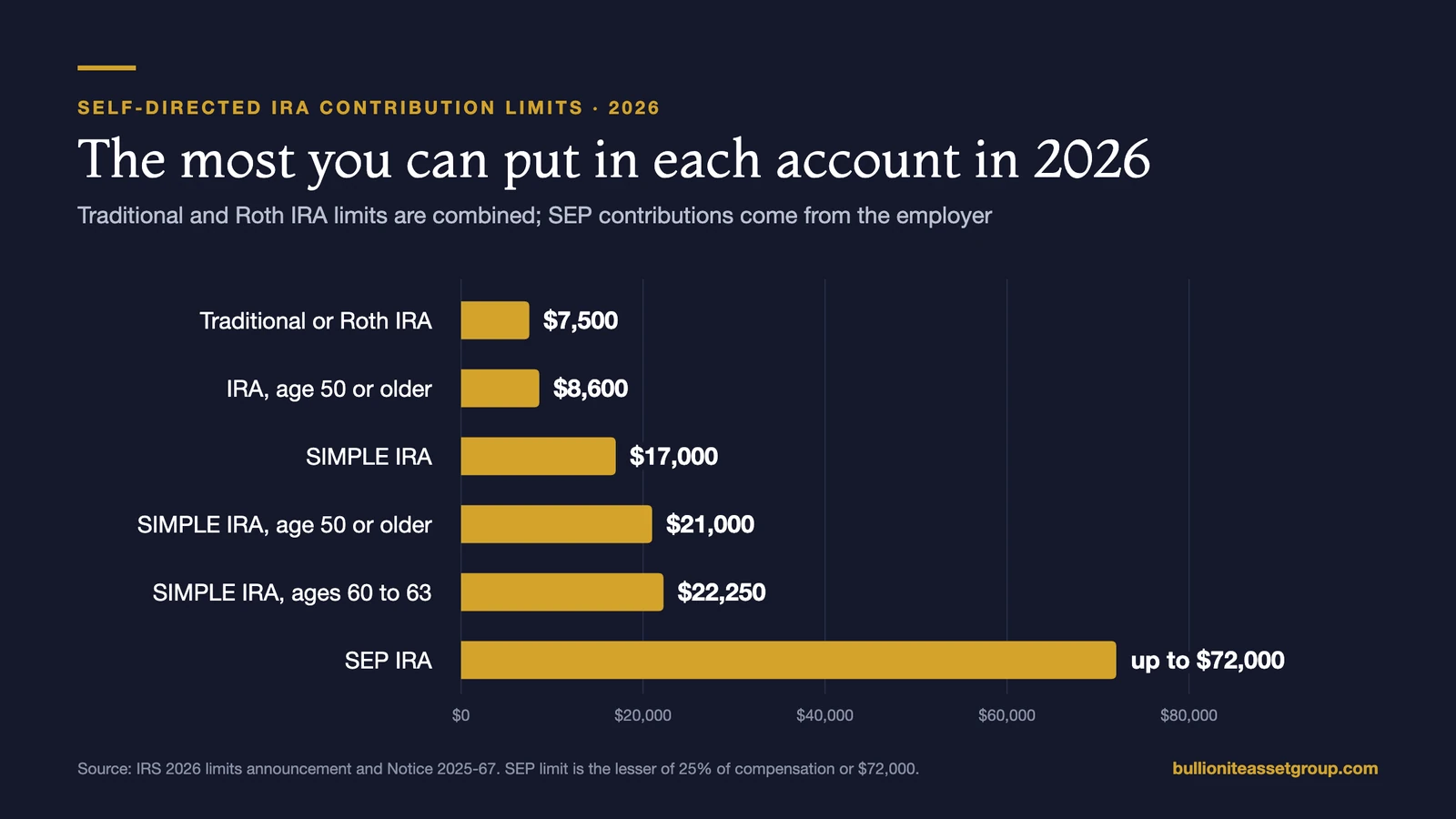
Self-directed IRA contribution limits for 2026 are the same as for any IRA: $7,500, or $8,600 if you're 50 or older, shared across all of your traditional and Roth IRAs. A self-directed IRA changes what your money can buy, not how much you can put in.
The bigger numbers come from employer-style accounts. A SEP IRA can take up to $72,000 for 2026 and a SIMPLE IRA $17,000 or more, and both can be self-directed too. Here's every 2026 figure from the IRS, plus the rules that matter once your IRA owns property or metals.
What are the self-directed IRA contribution limits for 2026?
The self-directed IRA max contribution for 2026 is $7,500, plus a $1,100 catch-up if you're 50 or older, for $8,600 in total, according to the IRS 2026 limits announcement. SEP and SIMPLE IRAs have their own, higher limits.
| Account | 2026 limit | Notes |
|---|---|---|
| Traditional IRA | $7,500 | Shared with any Roth IRA contributions |
| Roth IRA | $7,500 | Reduced at higher incomes |
| IRA catch-up, age 50 or older | $1,100 more, $8,600 in total | Indexed for inflation under SECURE 2.0 |
| SIMPLE IRA | $17,000, or $18,100 in certain plans | Your salary deferrals |
| SIMPLE IRA catch-up, age 50 or older | $4,000, or $3,850 in certain plans | On top of the deferral limit |
| SIMPLE IRA catch-up, ages 60 to 63 | $5,250 | Replaces the age-50 catch-up |
| SEP IRA | Lesser of 25% of compensation or $72,000 | Employer contributions only |
The 60-to-63 figure comes from IRS Notice 2025-67, and the SEP formula from the IRS page on SEP contribution limits.
The self-directed IRA maximum contribution is per person, not per account. Open three self-directed IRAs and you still have one $7,500 limit to split among them, and that same limit covers any Roth IRA you fund.
What is the self-directed Roth IRA contribution limit?
Self-directed Roth IRA contribution limits match the regular limits, $7,500 or $8,600 at 50 and older, but they shrink at higher incomes. For 2026 the Roth limit phases out between $153,000 and $168,000 of modified AGI for single filers and heads of household, and between $242,000 and $252,000 for married couples filing jointly. Above the top of the range, you can't contribute to a Roth directly.
Working out a reduced Roth limit
If your income lands inside the range, the IRS's Worksheet 2-2 in Pub 590-A shrinks your limit in proportion. Say you're single, 45, with 2026 modified AGI of $160,500:
- Take off the start of the range. $160,500 minus $153,000 leaves $7,500.
- Divide by the width of the range. $7,500 divided by $15,000 is 0.5.
- Multiply your normal limit by that figure. Half of $7,500 is $3,750.
- Subtract the result from your normal limit. $7,500 minus $3,750 leaves a Roth limit of $3,750.
The IRS rounds the result up to the next $10, and if it comes out above zero but under $200, you can still put in $200. For a married couple filing jointly, both 50 or older, with modified AGI of $249,000, the same steps give each spouse a self-directed Roth IRA limit of $2,580.
You can still move money into a Roth by converting a traditional IRA, which has no income limit, though the converted amount is taxed. Our comparison of self-directed and Roth IRAs covers which account fits which investor.
Are self-directed IRA contributions tax deductible?
Traditional IRA contributions are fully deductible unless you, or your spouse, are covered by a workplace retirement plan and your income is above the IRS range. Roth contributions are never deductible. For 2026, the deduction phases out over these ranges of modified AGI:
| Your situation | 2026 deduction phase-out |
|---|---|
| Single, covered by a workplace plan | $81,000 to $91,000 |
| Married filing jointly, you're covered | $129,000 to $149,000 |
| Married filing jointly, only your spouse is covered | $242,000 to $252,000 |
| Married filing separately, covered | $0 to $10,000 |
Above those ranges you can still contribute; you just can't deduct it. Keep records of those after-tax dollars on Form 8606, so you don't pay tax on them again when the money comes out.
Who can make self-directed IRA contributions?
Anyone with compensation can make self-directed IRA contributions, at any age. IRS Publication 590-A says you "can be any age," and it defines compensation as what you earn from working: wages, salaries, commissions and self-employment income. Rent from your own properties, interest, pensions and Social Security don't count.
Two rules surprise people:
- You can't contribute more than you earned. If your compensation for the year is $5,000, so is your limit.
- A spouse with little or no income can still contribute the full amount if you file jointly, based on the couple's combined compensation. Pub 590-A walks through an example where one spouse earned $3,800 and both could contribute the full limit.
When is the deadline for 2026 contributions?
You can make 2026 contributions until April 15, 2027, the due date of your federal return, and Pub 590-A says extensions don't move it. Money you send between January 1 and April 15 could count for either year, so tell your custodian in writing which year it's for.
How do contributions work when your IRA holds real estate or gold?
This is where self-directed IRA contribution limits bite hardest, because the cash going in has to cover everything the asset will ever cost. Five rules shape every plan:
- Contributions must be cash. Pub 590-A says that, except for rollovers, contributions must be in cash, which matches IRC 408(a)(1). You can't contribute a rental, land, a note or coins you already own.
- Contributions go to the custodian. If an IRA-owned LLC holds the property, the IRA funds the LLC after the contribution lands, never you directly.
- Paying an IRA bill yourself counts as a contribution. Cover a $4,000 roof repair on the IRA's rental from your checking account and that's $4,000 of your limit gone, and it can be a prohibited transaction too.
- Rollovers don't count toward the limit. Pub 590-A measures the limit on contributions "other than rollover contributions," which is why most self-directed real estate is funded by rolling over an old 401(k).
- Custodian fees paid from outside don't count either. Pub 590-A says trustees' administrative fees aren't subject to the contribution limit; our guide to self-directed IRA fees explains when that's worth doing.
Contributions alone build slowly. A couple aged 55 and 57 who each put in $8,600 add $17,200 a year, which takes almost six years to reach $100,000 before any growth. A rollover can move $300,000 in a single step without touching the limit.
That's also why reserves matter. The IRA has to keep enough cash for taxes, insurance and repairs, because topping it up is capped. Our guides to non-recourse loans and buying land with an IRA show the reserve math.
What happens if you contribute too much?
An excess contribution costs 6% a year until you fix it. Under Pub 590-A, if the excess and its earnings aren't withdrawn by your return's due date, including extensions, you owe a 6% excise tax for every year the excess stays in the IRA.
Take the excess and its earnings out in time and there's no 6% tax. You'll owe income tax on the earnings, but IRS Publication 590-B says corrective distributions made on or after December 29, 2022 aren't hit with the 10% additional tax.
Excess contributions usually come from four mistakes:
- Putting $7,500 into each of two IRAs, when the limit is shared.
- Funding a Roth when your income is above the phase-out.
- Contributing more than you earned that year.
- Paying an IRA's expenses from your own pocket.
With a property-heavy IRA, fixing an excess can need cash the account doesn't have, so check the numbers before you contribute rather than after.
Plan your contributions around your investments
Self-directed IRA contribution limits decide how fast you can build an account and how much cushion your investments will have. Bullionite helps investors fund a self-directed IRA through contributions, rollovers and transfers in the right order, and plan reserves before the IRA buys. Book a consultation and bring your latest statements.
This guide is general information, not tax, legal or investment advice. The rules and limits cited are current for 2026, so check your own situation with a CPA or tax attorney before you act.
FAQ
Do rollovers count toward the self-directed IRA contribution limits?
No. IRS Publication 590-A measures the annual limit on contributions other than rollovers, so moving an old 401(k) or IRA into a self-directed IRA doesn't use any of your $7,500. A trustee-to-trustee transfer between IRAs doesn't count either.
Can I contribute to both a traditional and a Roth self-directed IRA?
Yes, but they share one limit. For 2026 your total across all traditional and Roth IRAs can't exceed $7,500, or $8,600 if you're 50 or older, and the Roth part depends on your income.
Can I contribute to a self-directed IRA if I have a 401(k) at work?
Yes. Being covered by a workplace plan doesn't stop you from contributing to an IRA. It can limit the deduction for a traditional IRA contribution once your income passes the 2026 phase-out range.
Can I keep contributing after I start required minimum distributions?
Yes, if you still have compensation. There's no age limit on contributions, so you can contribute and take your RMD in the same year. Our guide to self-directed IRA RMDs covers the distribution side.

As the Founder and Chief Investment Officer of Bullionite and Bullionite Asset Group, I’ve built my career on a simple premise understanding the intersection of macroeconomics, commodities, and digital assets to stay ahead of the curve, not under it. My focus is on navigating the complexities of the world’s largest markets spanning the US, the Middle East, and Asia to identify high-value opportunities for alternative investment.
With a specialized focus on Self-Directed IRAs (SDIRAs), I help investors move beyond traditional 401ks by integrating assets like precious metals and cryptocurrency into their retirement strategies. Based in Newport Beach, California, I am dedicated to bridging the gap between traditional finance and the evolving landscape of new age digital assets, ensuring that every strategic move is backed by deep market insight and a commitment to long-term growth.