What’s the Difference Between Passive Real Estate Income and Being a Landlord?
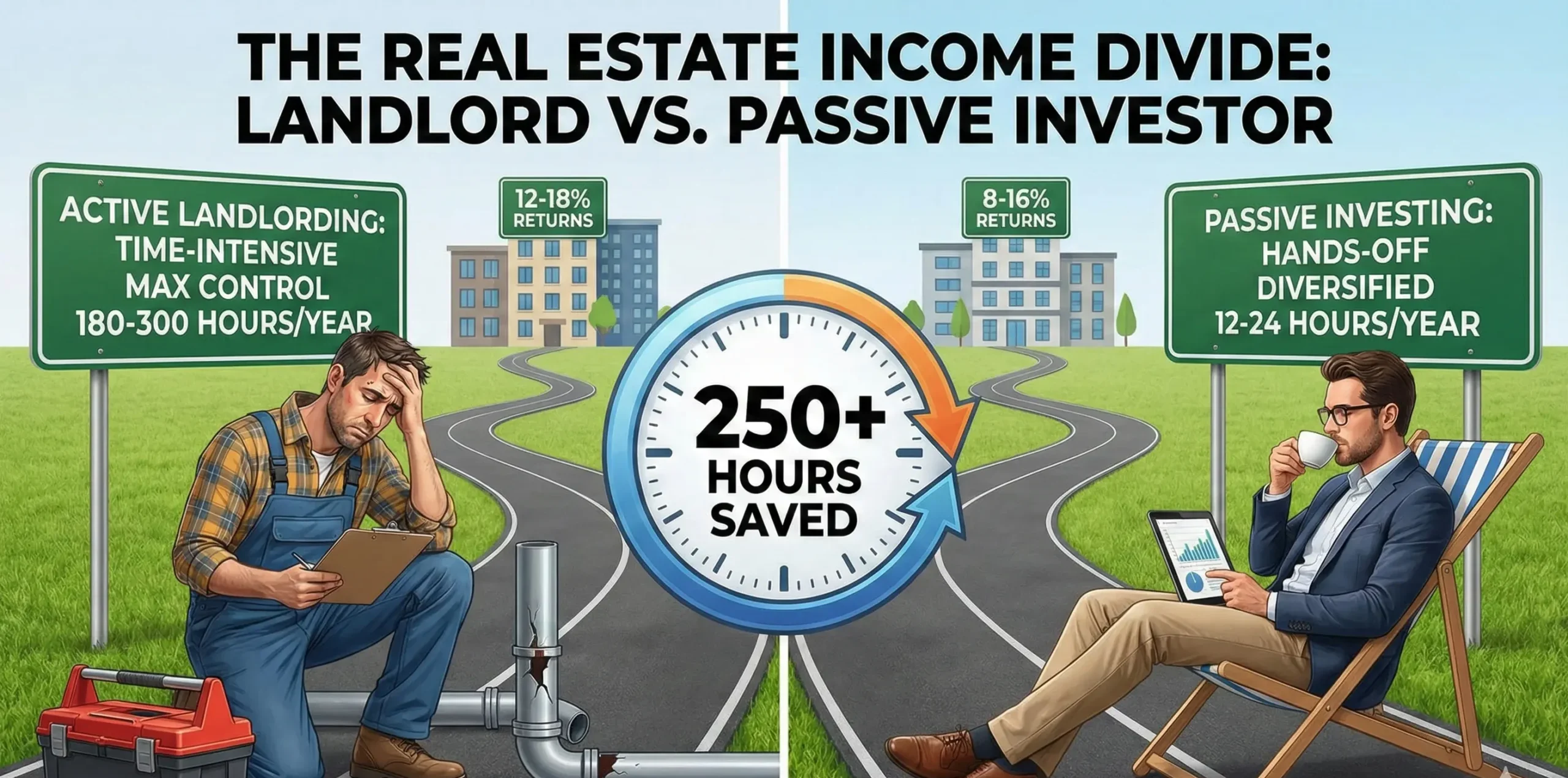
TLDR: Landlords own property directly and handle everything (15-25 hours monthly, 180-300 hours annually). Passive investors provide capital to professional operators and collect distributions without ongoing involvement (1-2 hours monthly, 12-24 hours annually). Returns differ by 2-4 percentage points, but time saved equals 250+ hours per year.
Being a landlord means you own property directly, manage tenants, handle maintenance, collect rent, deal with vacancies, and make all operational decisions. Passive real estate income means you provide capital to professional operators who handle everything while you collect distributions without touching a wrench or fielding tenant calls.
The difference isn’t subtle. One path consumes significant time and mental bandwidth. The other operates in the background while you focus on your career, business, or other priorities.
Understanding which approach fits your situation determines whether real estate investing enhances your life or becomes another demanding job.
Time Commitment: The 10x Difference
The Landlord Reality: 180-300 Hours Annually
Direct property ownership requires consistent attention even when you hire professional property managers.
Here’s where the time goes:
Monthly recurring tasks (12-18 hours monthly):
- Review property manager reports and financial statements (1-2 hours)
- Approve or decline maintenance requests over $200-$500 threshold (2-3 hours)
- Follow up on late rent collections (1-2 hours)
- Coordinate with contractors for repairs property manager can’t handle in-house (2-4 hours)
- Review market rents and adjust pricing for renewals or new listings (2-3 hours)
- Handle tenant communication escalated beyond property manager (1-2 hours)
- Accounting and expense tracking for tax preparation (2-3 hours)
Quarterly deep-dive tasks (8-12 hours quarterly):
- Inspect property in person or via video walkthrough (2-3 hours including travel)
- Meet with property manager to review performance and discuss strategy (1-2 hours)
- Review and negotiate vendor contracts for landscaping, HVAC, plumbing (2-3 hours)
- Analyze comparables and market trends for portfolio decisions (2-3 hours)
Annual intensive tasks (20-40 hours annually):
- Tax preparation and documentation gathering (8-12 hours)
- Major capital expenditure planning (roof, HVAC, renovations) and contractor bidding (6-10 hours)
- Lease renewals and rental rate negotiations (4-8 hours)
- Property manager performance review and potential replacement research (2-4 hours)
- Insurance policy review and shopping (2-4 hours)
Add it up: 144-216 hours on recurring monthly tasks, 32-48 hours on quarterly reviews, 20-40 hours on annual deep work. Total: 196-304 hours annually, even with professional property management.
Without a property manager, double these numbers. You’re handling every maintenance call, showing every unit, processing every rent payment, and coordinating every contractor visit yourself.
The Passive Investor Reality: 12-24 Hours Annually
Real estate IRA investing through syndications, crowdfunding platforms, or rental income IRA strategies requires minimal ongoing involvement.
Here’s your actual time commitment:
Initial investment phase (4-8 hours per investment):
- Research platform or sponsor (1-2 hours)
- Review offering documents and property details (1-2 hours)
- Attend investor webinar and ask questions (1 hour)
- Complete subscription agreement and fund investment (1 hour)
- Attend closing call or kickoff meeting (1-2 hours, optional)
Quarterly reviews (1-2 hours per quarter per investment):
- Read quarterly investor update email (15-30 minutes)
- Review financial performance vs. projections (15-30 minutes)
- Note any major developments or concerns (15-30 minutes)
Annual portfolio review (4-8 hours total):
- Compile K-1s and tax documents (1-2 hours)
- Analyze overall portfolio performance vs. targets (1-2 hours)
- Evaluate whether to reinvest distributions or redeploy elsewhere (1-2 hours)
- Research new opportunities for following year (1-2 hours)
For a portfolio of 5-10 passive investments: 20-40 hours initial setup in year one, then 12-24 hours annually for ongoing monitoring. That’s 10-20x less time than direct ownership.
Return Differences: What You Trade for Time
Landlord Returns: 12-18% Annually (Full Control Premium)
Direct property ownership captures the entire return stream:
Cash flow component (5-8% of property value annually):
- Rental income after all operating expenses
- Principal paydown on mortgages (if leveraged)
- Tax benefits from depreciation
Appreciation component (4-10% annually, market-dependent):
- Natural market appreciation
- Forced appreciation from renovations and improved operations
- Rent growth over time
Combined, experienced landlords in decent markets earn 12-18% annual returns. You’re capturing everything because you’re managing everything.
The math works like this: Buy a $200,000 rental property with 25% down ($50,000). Generate $12,000 annual cash flow after expenses, $3,000 annual principal paydown, and 5% appreciation ($10,000). Total annual return: $25,000 on $50,000 invested = 50% cash-on-cash return in year one, settling to 15-20% annually once you factor in maintenance variability and vacancy.
Passive Returns: 8-16% Annually (Operator Profit Share)
Passive strategies deliver 8-16% by sharing profits with operators who do the actual work.
Syndication returns (14-18% IRR target):
- 6-8% preferred return on invested capital (paid first from cash flow)
- Equity upside upon sale (typically 70/30 or 80/20 split favoring investors)
- Hold period usually 5-7 years
Crowdfunding returns (8-12% annually):
- Quarterly distributions from property cash flow
- Equity appreciation distributed upon property sale or portfolio refinancing
- Lower returns than syndications but better diversification and liquidity
REIT returns (6-10% annually):
- 3-5% dividend yield from rental income
- 3-5% share price appreciation over time
- Completely liquid (sell any day) unlike private investments
You’re giving up 2-6 percentage points compared to direct ownership. But you’re buying back 250+ hours annually.
For professionals billing $100-$200 per hour, that’s $25,000-$50,000 in opportunity cost recovered. The “lower” returns actually generate more net wealth when you factor in what you do with reclaimed time.
The Stress and Mental Bandwidth Factor
Landlord Stress: Always-On Responsibility
Direct ownership means you’re always on call:
- 2 AM maintenance emergencies (burst pipes, no heat in winter, sewage backups)
- Difficult tenant situations (late rent, noise complaints, eviction proceedings)
- Contractor coordination headaches (no-shows, cost overruns, poor quality work)
- Vacancy stress (lost income, showing units, tenant screening)
- Legal compliance (fair housing laws, local regulations, eviction procedures)
- Financial pressure (mortgage payments due regardless of occupancy)
Even with property managers handling day-to-day operations, you’re making final decisions on major issues. That mental load never fully disappears.
Some landlords thrive on this. They enjoy the problem-solving, the control, the direct involvement. If that describes you, embrace it.
But most professionals with demanding careers, young families, or other priorities find the mental bandwidth drain exceeds the financial benefit.
Passive Investor Stress: Quarterly Email Review
Passive real estate through platforms or syndications creates minimal stress:
- Quarterly updates arrive via email (read at your convenience)
- Occasional voting required on major decisions (happens maybe once per investment over 5-7 years)
- Platform handles all operational details
- Sponsor manages all tenant, contractor, and regulatory issues
- You receive distributions and tax documents automatically
The biggest “stress” is waiting 5-7 years for syndication exits and dealing with K-1 tax forms (which your CPA handles). That’s it.
When Each Strategy Makes Sense
Choose Active Landlording If:
You genuinely enjoy property management and tenant interaction. Some people love this work—if that’s you, capture the full returns.
You have local market expertise that provides competitive advantage. Knowing a neighborhood intimately helps you buy better properties, find better tenants, and respond faster to market changes.
You want maximum control over every decision. Passive investing means trusting operators—some personalities can’t delegate that level of control.
You have significant time available. Retirees, part-time workers, or those with flexible schedules can devote 15-20 hours monthly without major lifestyle impact.
You’re starting with limited capital ($25,000-$75,000) where syndication minimums price you out but a down payment on rental property is achievable.
Choose Passive Investing If:
You value time over incremental returns. The 2-4% return difference seems large until you calculate the opportunity cost of 250+ reclaimed hours.
You lack local market knowledge. You can’t personally own property in 12 different high-growth markets, but you can invest passively across those geographies.
You prefer diversification over concentration. Direct ownership usually means 1-3 properties (concentration risk). Passive platforms offer exposure to 10-50 properties across markets and property types.
You have demanding career or business. Senior professionals, business owners, and executives typically can’t spare 15-20 hours monthly for property management.
You want to invest tax-advantaged retirement accounts. Using self directed IRA to buy real estate directly requires complex compliance. Passive investments through self directed Roth IRA accounts are simpler.
The Hybrid Approach That Works
Many experienced investors combine both strategies:
Local properties for hands-on involvement: Own 1-2 rental properties within 30 minutes of your home in neighborhoods you know intimately. These properties benefit from your local knowledge and allow personal oversight without extensive travel.
Passive investments for geographic and property type diversification: Deploy additional capital into syndications or crowdfunding across markets and property types you can’t access directly. Texas multifamily, Southeast industrial, Midwest student housing—markets and property types impossible to manage from your home city.
Self-directed IRA for passive strategies: Can you buy real estate with an IRA? Yes, but direct ownership through self directed IRA real estate creates compliance complexity. Use retirement accounts for passive syndication investments where the custodian handles all regulatory requirements.
This hybrid approach captures control and maximum returns on local properties while accessing professional management and diversification through passive strategies for everything else.
What the Data Shows
According to research from the Urban Land Institute, institutional real estate investors (who essentially use the passive approach at scale) have achieved average annual returns of 9.5-11% over the past 20 years across diversified portfolios. Individual landlords often report higher returns, but this typically doesn’t account for their time investment valued at market rates.
When you factor in 250+ hours of annual labor at even modest $50/hour valuation, that’s $12,500 in implicit costs. A landlord earning 16% on $200,000 invested ($32,000) minus time costs ($12,500) nets $19,500—equivalent to 9.75% return for a passive investor who invests the same $200,000 without time commitment.
The numbers converge when you properly account for all costs, including time.
Key Takeaways:
- Landlord time commitment: 180-300 hours annually even with property managers
- Passive investor time commitment: 12-24 hours annually for portfolio monitoring
- Landlord returns: 12-18% annually (capturing full profit stream)
- Passive returns: 8-16% annually (sharing profits with operators)
- Time savings of 250+ hours annually worth $25,000-$50,000 for professionals
- Landlords handle emergencies, tenants, contractors; passive investors review quarterly emails
- Hybrid approach: own 1-2 local properties + invest passively in distant markets
- Choose based on time availability, local knowledge, and preference for control vs. delegation
- When time is valued properly, returns converge between active and passive approaches

As the Founder and Chief Investment Officer of Bullionite and Bullionite Asset Group, I’ve built my career on a simple premise understanding the intersection of macroeconomics, commodities, and digital assets to stay ahead of the curve, not under it. My focus is on navigating the complexities of the world’s largest markets spanning the US, the Middle East, and Asia to identify high-value opportunities for alternative investment.
With a specialized focus on Self-Directed IRAs (SDIRAs), I help investors move beyond traditional 401ks by integrating assets like precious metals and cryptocurrency into their retirement strategies. Based in Newport Beach, California, I am dedicated to bridging the gap between traditional finance and the evolving landscape of new age digital assets, ensuring that every strategic move is backed by deep market insight and a commitment to long-term growth.