
Can you hold crypto in an IRA? The complete 2026 guide to Bitcoin, Ethereum, and self-directed crypto IRAs
TL;DR
Can you hold crypto in an IRA? Yes. The IRS allows Bitcoin, Ethereum, and other digital assets inside an IRA, but only through a self-directed crypto IRA held by a qualified custodian, not through a standard Fidelity, Vanguard, or Schwab retirement account. You can use a Traditional structure for tax-deferred growth or a crypto Roth IRA for tax-free withdrawals after age 59½. The 2026 contribution limit is $7,000 ($8,000 if you’re 50 or older), and most investors fund the account by rolling over an old 401(k) or existing IRA. The trade-offs are real: custodian fees, transaction spreads, no FDIC coverage, and the volatility of the underlying asset. Set up properly, a self-directed crypto IRA gives you direct spot exposure to digital assets inside a tax-advantaged wrapper that a Bitcoin ETF cannot match for long holders. Set up incorrectly, a single prohibited transaction can disqualify the entire account.
Can you hold crypto in an IRA?
Yes. Can you hold crypto in an ira is a question with a clear regulatory answer: the IRS permits cryptocurrency inside an Individual Retirement Account, provided the account is structured as a self-directed IRA with a qualified custodian. This guide walks through the rule set, the account architecture, the tax outcomes, the real fees, the rollover mechanics, and the trade-offs against a Bitcoin ETF or a taxable exchange account, so you can decide whether a crypto IRA fits your retirement plan.
Bullionite Asset Group has advised clients on self-directed IRAs across precious metals, real estate, and digital assets since the early days of crypto in retirement accounts. The information below reflects current IRS guidance, real custodian fee schedules, and the operational realities our clients run into when they roll a workplace 401(k) into a self-directed crypto IRA.
Can you hold crypto in an IRA? The direct answer (and the IRS authority behind it)
Quick answer: Yes, you can hold crypto in an IRA, but only through a self-directed IRA at a qualified specialty custodian. Standard brokerages like Fidelity, Vanguard, and Schwab do not custody spot crypto. The IRS treats Bitcoin, Ethereum, Solana, XRP, and other major coins as property under Notice 2014-21, which makes them eligible IRA holdings.
Yes, you can hold crypto in an IRA. The IRS treats cryptocurrency as property, not currency, under Notice 2014-21, which placed digital assets in the same legal bucket as stocks, real estate, and precious metals for tax purposes. Property is a permissible IRA holding as long as it is not on the prohibited list in Internal Revenue Code Section 408(m), which limits collectibles like art, antiques, and most coins. Bitcoin, Ethereum, Solana, XRP, and most established cryptocurrencies are not classified as collectibles, so they qualify.
The catch is account type. A standard IRA at Fidelity, Charles Schwab, or Vanguard cannot hold spot Bitcoin or Ethereum directly. Those custodians are restricted to publicly traded securities, which means stocks, bonds, mutual funds, and lately spot Bitcoin ETFs. To hold the actual cryptocurrency, you need a self-directed IRA, which uses a specialty custodian licensed to hold alternative assets. That is the single biggest source of confusion for first-time investors searching whether they can put crypto in a Roth IRA at their existing brokerage.
For a deeper breakdown of the underlying account framework, our complete cryptocurrency self-directed IRA guide covers the legal structure in more detail.
How does a self-directed crypto IRA actually work?
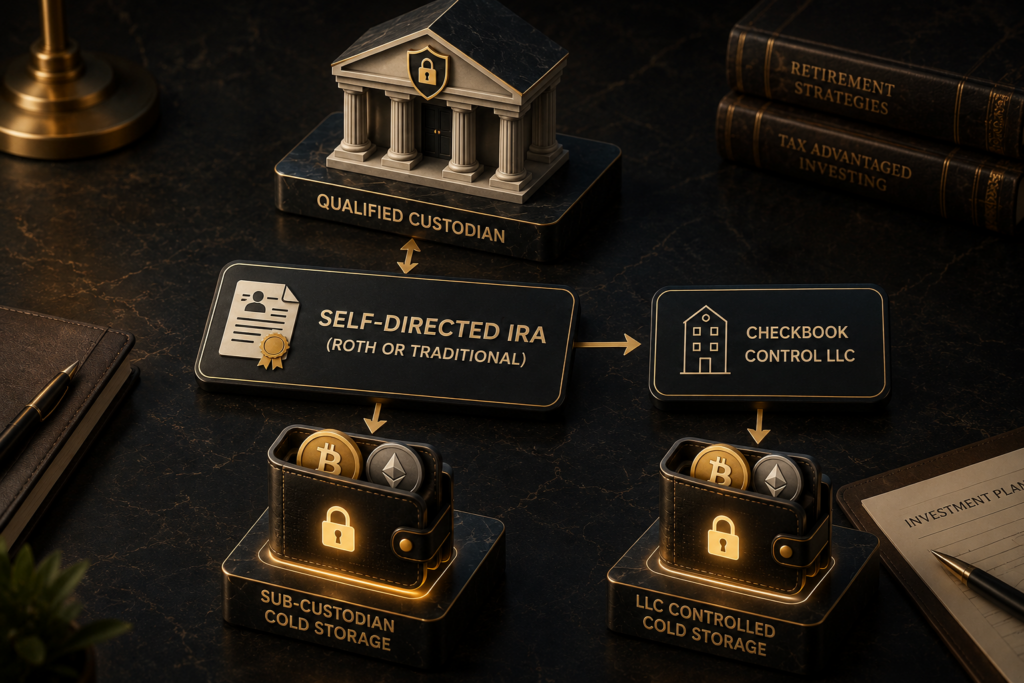
Quick answer: A self-directed crypto IRA has three layers: a qualified custodian that holds the account and files IRS paperwork, the IRA itself as the legal owner, and a wallet or trading platform where coins are bought and stored. The custodian handles compliance. You direct the trades. Sub-custodians like Fireblocks, BitGo, or Coinbase Custody hold the keys.
A self-directed crypto IRA has three moving parts: an IRS-approved custodian, the IRA itself (the legal account), and the wallet or trading platform where the digital assets are bought, sold, and stored. Understanding the chain of custody is the difference between a compliant account and a disqualified one.
The custodian layer
Every IRA, including a crypto IRA, must have a qualified custodian. The custodian holds the assets in the IRA’s name (not yours), files Form 5498 with the IRS each year, and reports distributions on Form 1099-R. For crypto, this means a specialty firm. Names like Equity Trust, iTrustCapital, Alto, BitcoinIRA, Choice, Directed IRA, and Broad Financial dominate the space, alongside trust companies that white-label crypto trading. Bullionite works with vetted custodians whose fee schedules and security audits we review on behalf of clients.
A few realities about custodians worth knowing before you sign anything:
- Annual fees typically range from $100 to $375 for a flat-rate custodian. Percentage-based custodians charge 0.5% to 1.0% of assets under management per year.
- Trade spreads are where many platforms make their real money. A “0% trading fee” platform often charges 1% to 2% as a built-in spread on each buy and sell, which is invisible on the trade ticket.
- Cold storage is the industry standard for the bulk of IRA-held crypto, with hot wallets used for active trading. Reputable custodians use multi-signature governance and qualified sub-custodians like Fireblocks, BitGo, or Coinbase Custody.
- Insurance is not FDIC. It is private crime and custody insurance, usually capped, and it does not cover loss from market volatility.
How is crypto actually stored inside an IRA?
Cold storage on multi-signature wallets held by qualified sub-custodians like Fireblocks, BitGo, or Coinbase Custody. A small portion sits in hot wallets to support active trading. The custodian controls the keys in the direct custodian model. In a checkbook control IRA, the LLC controls the keys on behalf of the IRA.
The account structure: direct custodian vs checkbook LLC
There are two operational models for a self-directed crypto IRA.
The direct custodian model is the simpler path. Your IRA opens an account on the custodian’s trading platform. You log in, place buy and sell orders for permitted coins, and the custodian executes through their integrated exchange or sub-custodian. The custodian holds the keys. This model fits investors who want a clean, hands-off setup and are comfortable with the platform’s coin list.
The checkbook LLC model gives you direct control. The IRA owns a single-member LLC, the LLC opens a wallet at any exchange or self-custody solution it chooses, and you, as non-compensated manager of the LLC, place trades. This is sometimes called a checkbook control IRA for crypto. It expands your coin universe dramatically (any coin available on Coinbase Pro, Kraken, or Binance.US becomes accessible) and slashes per-trade costs, but it raises the compliance bar. Every transaction must be at arm’s length, every wallet must be titled to the LLC, and you cannot personally hold the keys to a wallet that holds IRA assets without triggering a prohibited transaction analysis.
Bullionite typically recommends the direct custodian model for accounts under $100,000 and the checkbook LLC for larger accounts where the per-trade savings justify the legal setup cost. Our broader guide to self-directed IRA LLC checkbook control covers the LLC formation steps in full.
Who holds the keys to my crypto in an IRA?
In the direct custodian model, the custodian and its sub-custodian hold the keys. In a checkbook control IRA structure, the LLC holds the keys, and you control them on the LLC’s behalf as non-compensated manager. You cannot personally hold the keys to IRA-owned crypto in your individual capacity, regardless of the model. Doing so converts the holding into a taxable distribution.
What you cannot do inside the account
Three rules disqualify more crypto IRAs than any others:
- You cannot transfer crypto you already personally own into the IRA. All crypto inside the IRA must be purchased by the IRA, with IRA cash. Sending Bitcoin from your Coinbase wallet into your IRA’s wallet gets treated as a contribution at fair market value, and if it exceeds your annual limit, it is an excess contribution subject to a 6% annual excise tax.
- You cannot personally use IRA-owned crypto as collateral for a loan. A margin position or a DeFi lending position that posts IRA assets as collateral can be treated as a prohibited transaction under IRC §4975.
- You cannot stake IRA crypto in ways that benefit you personally outside the IRA. Staking inside the IRA is a developing area. Some custodians now offer it, with rewards flowing back into the IRA, but personal staking of IRA-owned coins on your private wallet is off-limits. Our crypto IRA loan rules page covers the borrowing constraints in detail.
The full prohibited-transaction framework lives in our self-directed IRA rules and prohibited transactions reference, which every prospective account holder should read before funding.
What cryptocurrencies can you hold in a crypto IRA?
Quick answer: Most major cryptocurrencies are eligible to hold in a self-directed crypto IRA: Bitcoin, Ethereum, Solana, Cardano, XRP, Polkadot, Avalanche, Chainlink, Litecoin, and other established coins. The exact list depends on your custodian. A checkbook control IRA expands the universe to anything available on the LLC’s chosen exchange. NFTs, security tokens with restricted-asset status, and assets the IRS classifies as collectibles are excluded.
The IRS sets the outer boundary of what a self-directed crypto IRA can hold. Your custodian sets the practical boundary inside that. The two together determine your real coin universe.
Eligible coins on most major platforms
The list below covers what is supported on the leading crypto IRA custodians (iTrustCapital, Alto, BitcoinIRA, Equity Trust, Choice, Directed IRA) as of 2026. Coverage varies by platform and is updated frequently.
|
Category |
Common eligible coins |
Typical custodian support |
|
Layer 1 majors |
Bitcoin (BTC), Ethereum (ETH) |
Universal — every major crypto IRA platform supports these |
|
Large-cap altcoins |
Solana (SOL), Cardano (ADA), XRP, Polkadot (DOT), Avalanche (AVAX), Chainlink (LINK), Litecoin (LTC) |
Most platforms (50+ coins) |
|
Mid-cap altcoins |
Polygon (MATIC), Cosmos (ATOM), Algorand (ALGO), Stellar (XLM), Near (NEAR), Tezos (XTZ) |
Broader platforms only |
|
Stablecoins |
USDC, USDT, DAI |
Most platforms — treated as cash equivalents inside the IRA |
|
DeFi tokens |
Uniswap (UNI), Aave (AAVE), Maker (MKR) |
Limited to broader platforms or checkbook LLC structures |
|
Memecoins |
Dogecoin (DOGE), Shiba Inu (SHIB) |
Hit-or-miss — varies sharply by custodian |
What is not eligible
- NFTs (non-fungible tokens). The IRS treats most NFTs as collectibles under IRC §408(m), which makes them prohibited holdings for any IRA, including a self-directed one. The IRS confirmed this in Notice 2023-27.
- Security tokens with restricted-asset status. Tokens classified as securities by the SEC face additional custody and registration requirements that most crypto IRA custodians cannot satisfy.
- Tokens not supported by your custodian’s wallet infrastructure. Even eligible coins are off-limits if the custodian cannot custody them. This is the most common practical exclusion.
- Privacy coins on certain platforms. Monero (XMR), Zcash (ZEC), and Dash (DASH) are dropped by some custodians for AML compliance reasons.
Stablecoins inside a crypto IRA
Stablecoins like USDC, USDT, and DAI are eligible on most platforms. They function as cash equivalents inside the IRA — useful for parking funds between trades, dollar-cost-averaging, or earning yield where the custodian supports stablecoin yield products. Treat stablecoin yield the same as any other staking-style return: it flows back into the IRA tax-deferred or tax-free.
How to expand your coin selection
If your custodian’s coin list does not include something you want to hold, the checkbook control IRA route opens almost the entire spot crypto market. The LLC opens an account at any major exchange (Coinbase Pro, Kraken, Binance.US, Gemini) and trades whatever that exchange supports. This is the highest-coin-count path inside an IRA, with the trade-off of more compliance overhead.
Can I hold NFTs in a crypto IRA?
No. The IRS classified NFTs as collectibles under IRC §408(m) in Notice 2023-27, which makes them prohibited IRA holdings. Buying an NFT inside your IRA triggers a deemed distribution of the purchase amount, taxable as ordinary income (Traditional) and potentially subject to the 10% early withdrawal penalty if you are under 59½.
What are the benefits of a crypto IRA?
Quick answer: A crypto IRA gives you tax-free or tax-deferred growth on Bitcoin, Ethereum, and other digital assets, direct ownership of the underlying coin, and a multi-asset retirement wrapper that can hold crypto alongside gold, silver, and real estate. The Roth structure eliminates capital gains tax on qualified withdrawals after age 59½. Additional benefits include 24/7 market access, inflation-hedge exposure, and portfolio diversification beyond stocks and bonds.
The case for a crypto IRA breaks down into six concrete benefits. Each one maps to a specific decision a long-term investor faces with crypto exposure.
Tax-free or tax-deferred growth. A crypto Roth IRA shelters every dollar of appreciation from federal and state capital gains tax. A Traditional self-directed crypto IRA defers tax until distribution. For high earners, this can mean avoiding the 23.8% federal long-term capital gains rate (20% top bracket plus 3.8% Net Investment Income Tax) on every gain inside the account.
Direct ownership of the underlying asset. Unlike a Bitcoin ETF, a self-directed crypto IRA holds the actual coin in a wallet titled to your IRA. You are not buying a paper claim on Bitcoin held by BlackRock, Fidelity, or another sponsor. You own the asset and can elect self-custody through a checkbook control IRA for crypto if you want full key control.
Portfolio diversification. Bitcoin’s correlation with the S&P 500 has historically averaged around 0.30, lower than most equity sectors. Adding 5% to 15% crypto exposure to a stock-and-bond retirement portfolio has historically improved risk-adjusted returns over multi-year holding periods. The crypto IRA wrapper lets you make that allocation without triggering taxable rebalancing.
Inflation-hedge exposure. Bitcoin’s fixed 21 million supply makes it a hard-asset hedge in the same family as gold. The 2022 inflation cycle tested this thesis with mixed results, but over multi-decade horizons, scarce-supply assets have historically preserved purchasing power better than fiat-denominated bonds.
Multi-asset wrapper. A self-directed IRA is asset-agnostic. The same account that holds Bitcoin can hold gold, silver, real estate, and private placements. You can build an entire alternative-assets retirement allocation inside one tax-advantaged structure rather than three separate accounts.
24/7 market access and Roth estate-planning advantages. Crypto markets trade continuously. Inside a self-directed crypto IRA, your custodian’s platform reflects market hours that traditional brokerages do not support. A Roth crypto IRA also has no required minimum distributions during the owner’s lifetime, which makes it a powerful estate-planning vehicle for heirs subject to the SECURE Act 10-year rule.
Many of these benefits apply across asset classes. See our broader alternative assets IRA guide for the diversification framework, and the crypto IRA pros and cons page for the full benefit-vs-trade-off picture.

Roth or Traditional: which type of IRA is best for holding crypto in 2026?
Quick answer: A self-directed Roth crypto IRA is best for long-term Bitcoin and Ethereum holders because qualified withdrawals after 59½ are completely tax-free. A Traditional self-directed crypto IRA suits high-bracket earners who want a current-year deduction and expect to be in a lower tax bracket in retirement. The 2026 contribution limit for both is $7,000, or $8,000 if you are 50 or older.
You can hold crypto in either a Traditional or a Roth IRA, and the choice has a multi-decade tax consequence. The right answer depends on your current tax bracket, your time horizon, and how bullish you actually are on the asset.
The Roth case for crypto
A crypto Roth IRA is the structure most long-term Bitcoin holders end up choosing. You fund it with after-tax dollars, the assets grow tax-free, and qualified withdrawals after age 59½ (with the account open at least five years) are completely tax-free. If Bitcoin appreciates 10x over 20 years inside a Roth, the entire gain is yours. No capital gains tax. No income tax. No Net Investment Income Tax, ever.
This is the strongest argument for holding crypto in any IRA. A taxable Bitcoin position triggers capital gains tax at every sale, and for high earners those gains can hit 23.8% federally before state tax. The same position inside a Roth never sees that bill. Our deep-dive on the Bitcoin Roth IRA covers the math with concrete examples.
How much of my retirement should I allocate to a crypto IRA?
Most advisors cap crypto exposure at 5% to 15% of total retirement assets due to volatility. The 2026 IRA contribution limit caps fresh contributions at $7,000 to $8,000 per year. Investors with larger crypto allocations typically build them through a 401(k) rollover from prior employers rather than fresh annual contributions. Your specific allocation should reflect your time horizon and risk tolerance.
The Traditional case for crypto
A Traditional self-directed crypto IRA gives you a current-year deduction (subject to income limits) and tax-deferred growth. You pay ordinary income tax when you take distributions in retirement. This structure suits investors in a high current bracket who expect to be in a lower bracket in retirement, or who plan to fund the account primarily through a 401(k) rollover where converting to Roth would trigger a big tax bill today.
Side-by-side: Roth vs Traditional crypto IRA in 2026
|
Feature |
Self-Directed Roth Crypto IRA |
Self-Directed Traditional Crypto IRA |
|
2026 contribution limit (under 50) |
$7,000 |
$7,000 |
|
2026 catch-up (50 and older) |
$8,000 |
$8,000 |
|
Contributions |
After-tax |
Pre-tax (deductible if eligible) |
|
Growth treatment |
Tax-free |
Tax-deferred |
|
Withdrawal tax (qualified) |
$0 |
Ordinary income |
|
Required Minimum Distributions |
None during owner’s lifetime |
Starting at age 73 |
|
Income limit (single, 2026) |
Phase-out $150,000–$165,000 |
No income limit |
|
Best for |
Long-term crypto bulls |
High-bracket earners |
|
Conversion from 401(k) |
Allowed via Roth conversion (taxable) |
Direct rollover (no current tax) |
Our full self-directed IRA vs Roth IRA complete comparison and the more crypto-specific Roth crypto IRA vs traditional crypto IRA comparison cover the trade-offs in full.
How are crypto IRA gains, distributions, and staking rewards taxed?
Quick answer: Inside a Traditional crypto IRA, all trades and growth are tax-deferred until you take distributions, which are taxed as ordinary income. Inside a crypto Roth IRA, trades and growth are tax-free, and qualified withdrawals after age 59½ owe nothing. Staking rewards generally flow back into the IRA tax-deferred or tax-free. The wash-sale rule does not currently apply to crypto. Leveraged crypto inside an IRA can trigger UBIT.
Tax treatment is the central reason most investors use a crypto IRA in the first place. The mechanics shift depending on the account type, the activity inside the account, and whether the IRA uses leverage.
Capital gains inside the account
Every crypto trade you make inside a self-directed crypto IRA is exempt from capital gains tax in the year of the trade. There is no short-term versus long-term distinction inside the IRA. You can rebalance, harvest gains, and rotate between Bitcoin, Ethereum, and other major coins without triggering a tax event. This is the core operational benefit over a taxable exchange account.
Distribution taxation
Distributions from a Traditional self-directed crypto IRA are taxed as ordinary income at your marginal rate in the year you take them. Qualified distributions from a crypto Roth IRA (after age 59½ and the 5-year clock) are completely tax-free. Non-qualified Roth distributions tax only the earnings portion. Required minimum distributions begin at age 73 for Traditional accounts and never apply to Roth accounts during the owner’s lifetime.
Staking rewards
Some crypto IRA custodians now offer staking on Ethereum, Solana, and other proof-of-stake assets. When staking happens inside the IRA, rewards flow directly back into the account and are treated like any other appreciation: tax-deferred in a Traditional structure, tax-free in a Roth. The IRS has not issued definitive guidance on staking rewards inside a retirement account, so most custodians follow the conservative approach of treating rewards as account growth rather than current-year income to the holder.
Are crypto IRA staking rewards taxable when earned?
Inside the IRA, no. Rewards flow back into the account and compound tax-deferred (Traditional) or tax-free (Roth). You owe tax only on distributions, following the normal IRA distribution rules. This differs sharply from staking on a taxable exchange, where rewards are ordinary income at fair market value when earned.
The wash-sale rule and crypto
As of 2026, the IRS wash-sale rule does not apply to cryptocurrency, because the rule covers stocks and securities and the IRS classifies crypto as property. You can sell a position at a loss and immediately repurchase it without losing the deduction in a taxable account. Inside an IRA the rule is moot regardless, since there is no tax-loss harvesting available to retirement accounts. Congress has proposed extending the wash-sale rule to digital assets several times, so it is worth tracking.
UBIT and leveraged crypto
Unrelated Business Income Tax (UBIT) and Unrelated Debt-Financed Income (UDFI) can apply to a self-directed IRA that uses leverage to acquire crypto, similar to how UBIT applies to leveraged real estate inside an IRA. Most retail crypto IRAs do not use leverage and so do not trigger UBIT. Sophisticated checkbook control structures that borrow against IRA assets need a tax advisor’s review.
For the broader retirement-account tax framework, see our self-directed IRA tax filing requirements reference.
How much of your retirement should be in a crypto IRA?
Quick answer: Most financial advisors cap crypto exposure at 5% to 15% of total retirement assets due to volatility. Younger investors with longer time horizons and higher risk tolerance can justify the upper end of that range. Investors within five years of retirement typically stay below 5%. A self-directed crypto IRA wraps that allocation in a tax-advantaged structure, which is more efficient than holding the same exposure in a taxable account.
Allocation is the question advisors get asked more than any other on a first crypto IRA call. The honest answer depends on three inputs: your time horizon, your risk tolerance, and how much of your existing retirement assets you can afford to see drop 70% without changing your retirement plan.
Common allocation frameworks
- Conservative: 1% to 3% of retirement assets, suitable for investors within 10 years of retirement or with low risk tolerance.
- Moderate: 5% to 10% of retirement assets, the most commonly cited range for diversified portfolios. This is the band most major wealth managers reference when they discuss crypto allocations at all.
- Aggressive: 10% to 15% of retirement assets, suitable for younger investors with 20+ year horizons and high risk tolerance.
- Above 15%: outside most advisor frameworks. Concentration risk dominates. If this is your conviction allocation, the crypto IRA wrapper still applies, but consider the impact on overall retirement outcomes if the position drops 70%.
Why a crypto IRA wraps the allocation efficiently
If you are going to hold a 5% to 15% crypto position for retirement anyway, the choice is between holding it in a taxable account (paying capital gains on every rebalance and 23.8% on every realized gain at sale) or holding it in a self-directed crypto IRA (zero current tax on trades, zero tax on Roth withdrawals). The IRA wrapper is the more efficient structure for any allocation you plan to hold for five-plus years.
Should I put my entire retirement into a crypto IRA?
No. Concentration in a single highly volatile asset class violates the basic logic of retirement planning. A crypto IRA is a wrapper for a diversification slice of your retirement portfolio, not a replacement for it. Most investors hold a crypto IRA alongside a Traditional 401(k), a Roth IRA in equities, and possibly a precious metals or real estate IRA.
If you are weighing crypto against other alternative-asset retirement options, our crypto IRA vs gold IRA, crypto IRA vs real estate IRA, and crypto IRA vs stock IRA comparisons walk through the trade-offs.
Self-directed crypto IRA vs Bitcoin ETF vs holding crypto on an exchange: which is better?
Quick answer: A self-directed crypto IRA gives you the actual coin, broad coin selection, and tax-advantaged growth. A Bitcoin ETF gives you a paper claim on Bitcoin held by BlackRock or another sponsor, plus a 0.20% to 0.95% expense ratio. A taxable exchange gives you full custody but no tax shelter. For long holders, the self-directed IRA usually wins on cost and ownership after five-plus years.
A common question from new investors: if a Bitcoin ETF is now available inside a regular IRA at Fidelity or Schwab, why bother with a self-directed crypto IRA at all?
The short answer: an ETF gives you a paper claim on Bitcoin held by BlackRock, Fidelity, or another sponsor. A self-directed crypto IRA gives you the actual coin, in a wallet titled to your IRA, with your choice of which assets to hold beyond just Bitcoin.
|
Feature |
Self-Directed Crypto IRA |
Bitcoin ETF in Standard IRA |
Crypto on Taxable Exchange |
|
Direct ownership of coin |
Yes |
No (paper claim) |
Yes |
|
Coin selection |
50+ on most platforms |
BTC and ETH only (2026) |
Hundreds |
|
Tax-free growth (Roth) |
Yes |
Yes |
No |
|
Annual ETF expense ratio |
None (custodian fees apply) |
0.20%–0.95% |
None |
|
Trade spreads |
0.5%–2% |
Standard ETF bid/ask |
0.1%–1% |
|
Self-custody / private keys |
Optional (checkbook LLC) |
Never |
Yes |
|
Counterparty risk |
Custodian + sub-custodian |
ETF sponsor + custodian |
Exchange |
|
Staking eligible |
On select coins, via custodian |
No |
Yes |
|
Capital gains on sale |
None inside IRA |
None inside IRA |
Yes, every trade |
Our dedicated comparisons cover each angle: Bitcoin ETF vs Bitcoin IRA, crypto IRA vs holding crypto on an exchange, crypto IRA vs taxable brokerage account, and the full landscape view in crypto IRA vs alternatives.
For investors choosing between asset classes, we also cover crypto IRA vs gold IRA, crypto IRA vs real estate IRA, crypto IRA vs REIT self-directed IRA, crypto IRA vs stock IRA, and crypto IRA vs 401k. For investors weighing DeFi yield against IRA tax shelter, see crypto IRA vs DeFi staking yield outside an IRA.
How do you open a crypto IRA in 2026? The step-by-step process
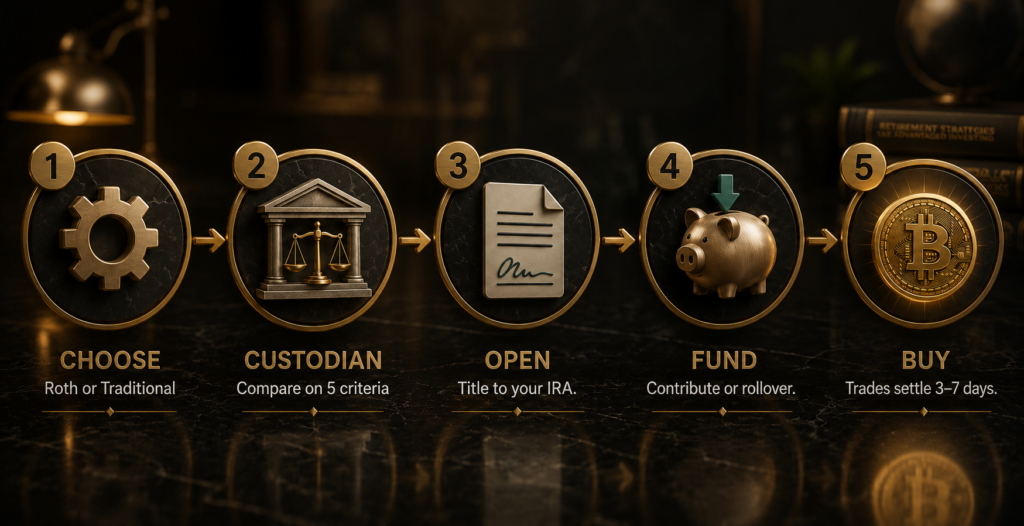
Quick answer: Opening a self-directed crypto IRA takes 7 to 21 business days. Pick the account type (Roth or Traditional). Select a qualified custodian and compare on annual fee, trade spread, supported coin list, and security architecture. Open and title the account in the IRA’s name. Fund it with a direct contribution or a 401(k) rollover. Place your first trade once funds settle.
Opening a self-directed crypto IRA is a five-step process that most investors complete in 7 to 21 business days, depending on whether you fund with cash or a rollover.
Step 1. Choose the account type
Decide between a Roth and a Traditional structure based on the framework above. If you are funding from an old 401(k) or pre-tax IRA, a direct rollover into a Traditional crypto IRA carries no current tax. A Roth conversion is allowed but taxable in the year of conversion.
Step 2. Select a custodian
Compare custodians on four dimensions: annual fee, trade spread, supported coin list, and security architecture. Bullionite’s best self-directed IRA custodian comparison covers the leading options. For most investors, the right custodian is the one whose total annual cost (fees plus spreads on your expected trade volume) is lowest, not the one with the most marketing.
Step 3. Open and title the account
The custodian opens the IRA in your name. You complete a Customer Identification Program (CIP) check, designate beneficiaries, and choose your account funding method. If you elect the checkbook control IRA for crypto structure, this is also when you form the single-member LLC and open its bank account and exchange account.
Step 4. Fund the account
You have three funding paths:
- A direct contribution of up to $7,000 ($8,000 if 50 or older) for 2026, subject to income limits for Roth.
- A direct rollover from an old employer 401(k) or another IRA, with no tax impact when handled trustee-to-trustee.
- A 60-day indirect rollover, where you take possession of the funds and redeposit them within 60 days. This carries withholding and penalty risk. Read our 60-day self-directed IRA rollover rule guide before you go this route.
For investors with workplace plans, the most common path is the 401k rollover self-directed IRA workflow, and specifically the roll over 401k to crypto IRA sequence.
How long does a 401k to crypto IRA rollover take?
7 to 21 business days for a direct trustee-to-trustee rollover. The legacy 401(k) plan administrator typically takes 5 to 10 business days to release funds, and the new custodian takes 2 to 5 business days to credit and clear them. Indirect 60-day rollovers move slower because of mandatory 20% federal withholding and the strict 60-day redeposit window.
Step 5. Buy the crypto
Once funds settle (typically 3 to 7 business days after a rollover), you place trades through the custodian’s platform. The custodian or its sub-custodian moves the purchased coin into the IRA’s wallet, with a hot wallet for actively traded positions and cold storage for the bulk of long-term holdings. Typical time to settle a crypto trade in an IRA is minutes to a few hours for major coins, depending on blockchain confirmation times and the custodian’s internal sweep schedule.
Many platforms support dollar-cost averaging through scheduled buys (weekly, bi-weekly, or monthly) once your account is funded — useful after a 401k rollover when you want to deploy a large lump sum gradually rather than all at once. Some custodians also offer DCA bots and auto-rebalancing tools. Best apps for crypto IRA trading overnight typically include mobile push alerts so you can react to price action even when the underlying market trades 24/7.
For a generic walkthrough that applies to any asset class, see our how to open self-directed IRA guide.
How to vet a crypto IRA custodian (security, audits, and insurance)
Quick answer: Vet a crypto IRA custodian on five dimensions: regulatory licensing (state trust charter or federal banking authority), independent SOC 2 audits, sub-custodian quality (Fireblocks, BitGo, Coinbase Custody, Anchorage Digital), insurance scope (private crime and custody insurance with named coverage limits), and a complete written fee schedule with no hidden trade spreads. Avoid custodians that cannot produce a current SOC 2 report or name their cold-storage sub-custodian.
The 2022 collapses of FTX, Celsius, and BlockFi taught the crypto industry an expensive lesson: “trust me” custody is not custody. Vetting your crypto IRA custodian properly is the single highest-impact decision you will make on this account.
Regulatory licensing
A legitimate crypto IRA custodian operates under a state trust charter (most commonly South Dakota, Nevada, Wyoming, or New Hampshire) or a federal banking authority. Confirm the charter on the state regulator’s website. iTrustCapital, for example, partners with a Nevada-chartered trust company. Equity Trust holds its own state charter. Trust-charter status means the custodian is examined regularly by a state banking department.
SOC 1 and SOC 2 audits
Ask for the most recent SOC 1 (financial controls) and SOC 2 (security controls) audit reports. SOC 2 Type II is the gold standard. If the custodian cannot produce a current report, walk away. Reputable platforms publish their SOC 2 status publicly or share it on request under NDA. The audit firm matters too. Big Four (Deloitte, EY, PwC, KPMG) audits carry more weight than boutique-firm audits.
Sub-custodian quality
Most crypto IRA custodians do not hold the keys themselves. They contract with institutional sub-custodians like Fireblocks, BitGo, Coinbase Custody, or Anchorage Digital. Confirm the sub-custodian by name and verify they hold their own SOC 2 certification, segregated cold storage, and multi-signature governance. A custodian that will not name its sub-custodian is a custodian to avoid.
Platform-level security features
Beyond institutional sub-custody, look for platform-level security features: biometric login on iOS and Android apps, hardware security key support (YubiKey or similar), role-based permissions on the crypto IRA dashboard for joint accounts or advisor access, and read-only access setup for view-only third-party reporting tools like CoinTracking or Orion integration. These features matter most for accounts holding more than $100,000 or for accounts shared with a financial advisor. Some custodians charge a small request fee for a hardware security key; confirm before requesting.
Insurance scope and limits
Crypto IRAs do not have FDIC or SIPC coverage. They have private crime and custody insurance through carriers like Lloyd’s of London or Marsh. Read the policy details: cyber crime coverage versus physical theft, hot-wallet versus cold-wallet limits, per-event caps, and aggregate caps across all clients. “Up to $250 million in insurance” is meaningless if it caps the entire client base, not your account.
Are my crypto IRA assets insured?
Yes, but not by FDIC or SIPC. Crypto IRA insurance is private custody and crime insurance, capped at policy limits, with limited cyber-theft coverage and no market-loss coverage. Read the actual policy schedule before funding. The insurance industry treats crypto custody coverage very differently from bank deposit insurance.
Fee transparency
A reputable crypto IRA custodian publishes a complete fee schedule including trade spreads, not just custodial fees. “0% trading fee” platforms typically embed 1% to 2% as a hidden spread on each buy and sell. Demand a written fee schedule with all in-scope and out-of-scope charges, including LLC formation, wire fees, and account-termination fees, before you fund.
Can you switch crypto IRA custodians? (Transfer process, fees, and downtime)
Quick answer: Yes. You can transfer a crypto IRA from one custodian to another through a direct trustee-to-trustee transfer, which is not a taxable event and does not count against the once-per-year rollover limit. Watch for account-termination fees ($50 to $250), out-going wire fees, and forced-liquidation costs if the new custodian does not support every coin in your current portfolio. The full transfer typically takes 10 to 30 business days.
Most crypto IRA holders eventually consider switching custodians. Reasons include better fees on a larger account, broader coin selection, stronger security architecture, or dissatisfaction with the platform’s user experience. The mechanics matter, because crypto transfers between IRA custodians are not automatic.
How a crypto IRA custodian transfer works
A direct trustee-to-trustee transfer is initiated by the receiving custodian. You complete an account application and a transfer authorization form. The new custodian sends the form to your current custodian, which validates it and either ships the assets in-kind (rare for crypto) or liquidates them and wires the proceeds. The new custodian receives the cash, credits your IRA, and you place fresh trades to rebuild the position.
In-kind vs cash transfers
In-kind transfers move the actual coin from one custodian’s wallet to the new custodian’s wallet without selling. These are still rare for crypto IRAs because they require both custodians to support the same coins and hold compatible wallet infrastructure. Most transfers are forced cash transfers: the old custodian sells, the new custodian buys. This means you eat the trade spread on both sides (typically 1% to 4% combined) and absorb any price movement during the gap. Volatility risk during the transfer window is real.
Fees to expect on a custodian switch
- Account termination fee at the old custodian: $50 to $250
- Outgoing wire or ACH fee: $25 to $35
- Trade spread on liquidation (cash transfers): 0.5% to 2% of asset value
- Trade spread on repurchase at new custodian: 0.5% to 2% of cash transferred
- Account setup fee at new custodian: $0 to $75
- LLC re-titling (checkbook control IRA only): $200 to $500
On a $50,000 account, a forced-liquidation custodian switch can cost $1,500 to $2,500 all-in. Negotiate the transfer with both custodians before initiating. Some receiving custodians waive their setup fee and reimburse the sending custodian’s termination fee for accounts above a threshold.
Tax treatment of a custodian switch
A direct trustee-to-trustee transfer is not a taxable event and is not reported on Form 1099-R. The IRS treats it as the same account moving between providers. This is different from a 60-day indirect rollover, which has stricter rules and a once-per-12-months limit across all your IRAs.
What does a crypto IRA actually cost in 2026?
Quick answer: A $50,000 self-directed crypto IRA typically costs $250 to $1,500 per year all-in. The components are an annual custodian fee of $100 to $375 flat (or 0.5% to 1% of assets), a 0.5% to 2% trade spread embedded in buy and sell prices, and small per-transaction network fees. Checkbook LLC structures add $400 to $1,500 in setup plus $100 to $400 in annual maintenance.
Fees are where the “free” advertising on most crypto IRA platforms breaks down. Here is what a $50,000 self-directed crypto IRA actually costs to operate in 2026, on average across the major custodians.
|
Cost Item |
Typical Range |
What It Covers |
|
Account setup |
$0–$75 (one-time) |
KYC, account opening, beneficiary setup |
|
Annual custodian fee |
$100–$375 flat OR 0.5%–1.0% AUM |
Recordkeeping, IRS reporting, support |
|
Trade spread |
0.5%–2% per trade |
Embedded markup on buy and sell prices |
|
Transaction / network fee |
$0.50–$30 per trade |
Blockchain gas plus custodian processing |
|
LLC formation (checkbook) |
$400–$1,500 (one-time) |
Legal setup of single-member LLC |
|
Annual LLC maintenance |
$100–$400 |
Registered agent and state filing |
|
Wire / ACH |
$0–$30 per outgoing |
Bank transfer fees |
|
Account termination |
$50–$250 |
One-time close-out fee |
A $50,000 account that trades once a quarter on a flat-fee custodian typically runs $250 to $500 per year all-in. The same account on a percentage-fee custodian runs $250 to $500 in custodial fees plus the embedded spread, which can add another $1,000 or more over a year of active trading. Read every fee schedule line by line. The crypto IRA pros and cons page covers the recurring traps.
Two cost items often missed in published fee schedules: blockchain network fees (Ethereum gas can spike to $20 to $30 per transaction during congestion; Solana swap fees stay under $1) and stablecoin yield product spreads if your custodian offers USDC or USDT yield. Maker-taker fees on platforms that route through their own exchange may also apply. Ask the custodian for a worked example of total cost on a typical trade in your target coins, including all crypto IRA trading fees, before funding. “0% trading fee” is a marketing claim that almost always conceals a 1% to 2% built-in spread.
Are crypto IRA fees worth it compared to a taxable account?
For a buy-and-hold investor over five-plus years, generally yes. Capital gains tax on a taxable crypto position can hit 23.8% federally for high earners. A self-directed Roth crypto IRA eliminates that bill entirely on qualified withdrawals. The annual custodian fees are usually a small fraction of the tax saved on a single major appreciation event.
What are the real risks of holding crypto in an IRA?
Quick answer: The biggest risks are price volatility (Bitcoin has had 70% drawdowns), custodian and platform failure (FTX, Celsius, BlockFi precedents), the absence of FDIC and SIPC coverage, and prohibited-transaction risk that can disqualify the entire IRA. Withdrawals before age 59½ trigger a 10% penalty plus ordinary income tax on the distribution. None of these can be insured away.
A self-directed crypto IRA is not free money. The risks are substantive and worth weighing honestly.
Volatility risk. Bitcoin has had multiple drawdowns of 70% or more in its history. In a retirement account you cannot tax-loss harvest, and you cannot deduct losses against other income. A 70% drawdown is just a 70% drawdown.
Custodian and platform risk. A self-directed crypto IRA depends on the solvency and security of the custodian and its sub-custodians. The 2022 collapse of FTX and the bankruptcies of Celsius and BlockFi exposed how exchange-held crypto can become unrecoverable for years. The safest accounts use cold storage with audited sub-custodians, but no setup is risk-free. Our Bitcoin digital IRA risks page covers the threat model in full.
No FDIC, no SIPC. A bank account has FDIC up to $250,000. A brokerage account has SIPC. A crypto IRA has private crime insurance, usually capped well below the full balance, with limited coverage of cyber theft and no coverage of market loss.
Prohibited-transaction risk. A single self-dealing transaction (using IRA crypto as personal collateral, sending coins to a personal wallet, transacting with a disqualified person) can disqualify the entire IRA, triggering immediate taxation of the full account balance and a possible 10% early withdrawal penalty if you are under 59½.
Liquidity risk. Withdrawals from a Traditional IRA before 59½ trigger a 10% penalty plus ordinary income tax on the distribution. This is true for crypto IRAs the same as for any other IRA. Volatility does not change that math.
For a brutally honest counter-perspective, our Bitcoin IRA bad idea analysis lays out when it is the wrong move.
What happens to your crypto IRA when you die? (Beneficiaries, inherited Roth, and key recovery)
Quick answer: Your crypto IRA passes to the beneficiary you name on the custodian’s beneficiary form, bypassing probate. A spouse beneficiary can roll the account into their own IRA. A non-spouse beneficiary opens an inherited IRA and follows the SECURE Act 10-year distribution rule. The custodian handles key recovery and account transfer, since you never personally hold the keys to a self-directed crypto IRA in your individual capacity.
Crypto IRA inheritance combines standard IRA beneficiary rules with one crypto-specific concern: key recovery. The structure mostly insulates beneficiaries from the lost-key disasters that plague self-custodied crypto, but the rules around distribution timing changed significantly under the 2019 SECURE Act.
Beneficiary designation
Your crypto IRA passes by beneficiary designation, not by will. The form you complete with the custodian at account opening (and update as your situation changes) overrides any conflicting estate document. Name a primary beneficiary and at least one contingent beneficiary. Spouse, children, a trust, or a charity can all be beneficiaries. The designation transfers the account outside of probate, which is faster and avoids state probate fees.
Spouse beneficiary rules
A surviving spouse has the most flexibility. They can roll the inherited crypto IRA into their own self-directed crypto IRA and treat it as their own, deferring required minimum distributions until age 73 (Traditional) or never (Roth). This is the most tax-efficient inheritance path and is unique to spouses.
Non-spouse beneficiary rules and the SECURE Act
Non-spouse beneficiaries (children, grandchildren, others) inherit under the SECURE Act 10-year rule for accounts inherited after January 1, 2020. The full balance must be distributed within 10 years of the original owner’s death. There is no annual minimum within those 10 years, but the entire account must be empty by the end of year 10. For an inherited Roth crypto IRA, those distributions are tax-free if the original 5-year clock was met. For an inherited Traditional crypto IRA, distributions are taxed as ordinary income to the beneficiary.
Key recovery and operational continuity
Because the custodian or sub-custodian holds the private keys (in the direct custodian model) or the LLC holds them (in a checkbook control structure), there is no “lost key” risk for beneficiaries. The custodian transfers the assets in the IRA’s name to the inherited account once the death certificate, beneficiary form, and probate documents (if applicable) are processed. This is one of the strongest arguments for institutional custody over self-custody for crypto held in retirement accounts.
What if I have a checkbook control IRA and I die unexpectedly?
Your beneficiaries inherit the LLC, not the wallet directly. The LLC’s operating agreement should designate a successor manager. Without that, the beneficiaries must apply to be appointed as new manager and gain control of the wallet. A clear operating agreement and a sealed key-recovery document with your estate attorney are essential for checkbook structures.
Can you hold crypto alongside gold or real estate in a self-directed IRA?
Quick answer: Yes. A self-directed IRA is asset-agnostic. The same account can hold Bitcoin, gold, silver, real estate, private placements, and notes, subject to each asset class’s specific rules. This multi-asset capability is one of the structural advantages over an ETF and lets you build a diversified retirement portfolio inside a single tax-advantaged wrapper.
A self-directed IRA is asset-agnostic. The same account that holds Bitcoin can hold gold, silver, real estate, and private placements, subject to each asset class’s specific rules. This is one of the structural advantages over an ETF, and it allows for a meaningful diversification play within a single tax-advantaged wrapper.
If you are interested in combining digital and physical alternative assets in the same retirement plan, see can you hold gold and cryptocurrency in a self-directed IRA and our broader alternative assets IRA guide on diversifying retirement beyond stocks and bonds.
For altcoin and ETF specifics, our coverage extends to XRP ETF vs XRP IRA and the crypto IRA vs traditional stock IRA comparison.
Which crypto IRA is the best in 2026? (How to choose, not a vendor ranking)
Quick answer: The best crypto IRA depends on your account size, trade frequency, coin preferences, and security priorities. For accounts under $100,000 with infrequent trading, a flat-fee custodian usually wins on total cost. For larger or more active accounts, a checkbook control IRA with a fee-only custodian and self-managed exchange access often wins. Compare on five criteria: fee structure, supported coins, security architecture, account-type fit, and customer support quality.
“Which crypto IRA is the best?” is the most-searched decision-stage query in this space, and the honest answer is that no single platform is best for everyone. The best crypto IRA for a buy-and-hold Bitcoin investor with $40,000 looks nothing like the best crypto IRA for an active altcoin trader with $400,000. The framework below is how Bullionite advisors walk clients through the choice.
The five-criteria selection framework
Score each candidate custodian on these dimensions, weighted by how much each one matters for your situation.
- Fee structure. Flat-rate custodians (typically $100 to $375 per year) win on accounts that grow large. Percentage-based custodians (0.5% to 1.0% AUM) hurt as the balance scales. Trade spreads matter more than the headline annual fee for active traders. Get the complete written fee schedule — including the spread — before signing.
- Supported coins. Bitcoin and Ethereum are universal. If you want broad altcoin exposure (Solana, Avalanche, Polkadot, mid-caps), confirm the coin list. Memecoins and DeFi tokens vary sharply by platform. If your wishlist exceeds the platform’s list, you need a checkbook control IRA for crypto.
- Security architecture. SOC 2 Type II audit, cold storage with named institutional sub-custodians (Fireblocks, BitGo, Coinbase Custody, Anchorage Digital), multi-signature governance, and disclosed insurance coverage. A custodian missing any of these four is a non-starter regardless of fees.
- Account-type fit. Confirm support for the structure you actually need: Roth, Traditional, SEP, SIMPLE, Solo 401(k) rollover, inherited IRA. Most platforms support Roth and Traditional; SEP and SIMPLE are less universal.
- Customer support quality. Phone support with a real human, dedicated account rep for accounts above a threshold, and clear documentation. Test the support channels before you fund. The first time you need help is not the first time you should learn how the platform handles support.
Best-fit profiles
Best for buy-and-hold Bitcoin investors: A flat-fee direct custodian with strong security audits and a simple coin list. Pay $200 to $300 per year, hold Bitcoin, ignore the noise. This is the lowest-friction setup.
Best for active traders: A checkbook control IRA for crypto with a fee-only custodian. Lower per-trade costs, broader coin access, but higher compliance bar. Worth it above $100,000 or above ~10 trades per year.
Best for altcoin diversification: Either a broad-coin direct custodian (50+ supported coins) or a checkbook LLC. Match the coin list to your target portfolio before signing.
Best for first-time IRA investors: A direct custodian with strong customer support, a clean web interface, and a published fee schedule. Pay slightly more for support quality. The savings on operational mistakes more than offset higher fees.
Best for large accounts ($250,000+): Checkbook control LLC structure or a flat-fee custodian. Avoid percentage-based pricing at this scale — the math turns punishing fast.
What’s the cheapest crypto IRA in 2026?
On a pure annual-fee basis, flat-rate custodians charging $100 to $200 per year are the cheapest. But cheapest on the headline does not mean cheapest in total. A platform with a low annual fee and a 2% trade spread can cost more than a platform with a higher annual fee and a 0.5% spread, depending on your trade frequency. Compute total annual cost on your expected trade volume.
Bullionite’s best self-directed IRA custodian comparison evaluates the leading platforms across all five dimensions for 2026.
Is a crypto IRA right for you? A decision framework
Quick answer: A crypto IRA is right for you if you have a 5-plus year time horizon, can tolerate 50%+ drawdowns without panic-selling, are in (or expect to be in) a tax bracket where Roth or Traditional shelter materially helps, plan to hold under 15% of retirement assets in crypto, and accept that the account has no FDIC or SIPC backstop. If three or more of those don’t fit your situation, the answer is probably no — at least not yet.
This is the question every reader actually wants answered behind “can you hold crypto in an ira.” The legal answer is yes. The personal answer depends on five factors. Walk through each honestly before you fund.
The 5-question decision framework
- Time horizon. Do you have at least 5 years before you’ll need to draw on this account? Bitcoin’s worst drawdowns have lasted 2 to 3 years from peak to recovery. A short horizon means you’ll likely be forced to sell into weakness, which defeats the tax-shelter advantage.
- Risk tolerance. Can you watch your account balance drop 50% to 70% without selling? Bitcoin has done this multiple times. If a drawdown of that magnitude would change your retirement plans or your sleep, the position size is wrong — or the asset class is.
- Tax situation. Are you in a high enough current bracket that the Traditional deduction or the Roth tax-free growth materially helps? If your marginal rate is below 22%, the tax shelter is worth less and a taxable account becomes more competitive. If you’re at 32% or higher, the shelter is doing serious work.
- Allocation room. Do you have room within a 5% to 15% crypto allocation of total retirement assets? If you’re already over-exposed to crypto in taxable accounts, adding more in an IRA increases concentration risk. If you’re under-exposed and you want to start, the IRA is the most tax-efficient place to do it.
- Insurance comfort. Are you genuinely comfortable with no FDIC, no SIPC, and capped private custody insurance? If the answer is “I’d rather have a brokerage backstop,” a Bitcoin ETF inside a standard IRA may suit you better than a self-directed crypto IRA.
Profiles where a crypto IRA is clearly right
- You’re 30 to 50 years old, have a 15+ year horizon, and want tax-free Bitcoin growth — a crypto Roth IRA is a strong fit.
- You have an old 401(k) from a former employer, you want crypto exposure, and you’re already comfortable holding Bitcoin in a taxable account — a roll over 401k to crypto IRA into a self-directed structure is a clean upgrade.
- You’re a high earner (32%+ federal bracket) who owns crypto and is paying capital gains tax on every rebalance — moving the allocation into a crypto IRA eliminates that drag immediately.
Profiles where a crypto IRA is probably wrong
- You’re within 5 years of retirement, drawing income within 10 years, and cannot afford a 70% drawdown on this slice.
- You don’t already own crypto and aren’t sure why you want exposure — start with a small taxable position before committing to a tax-advantaged wrapper.
- You’re in a low marginal tax bracket and the shelter isn’t doing enough work to justify the custodian fees and operational complexity.
- You want self-custody control over the keys in your individual capacity — that’s incompatible with IRA ownership rules. Hold those coins in a personal cold wallet instead.
The bottom line
If you have a long time horizon, can stomach the volatility, are in a tax bracket where the shelter pays, and have allocation room, a self-directed crypto IRA is one of the most powerful retirement structures available for digital-asset exposure. If those conditions aren’t all true, it’s worth waiting until they are or scaling the position smaller. Bullionite advisors run the framework with clients on consultation calls and can model the math against your specific tax bracket and existing retirement balance.
Key takeaways
- Yes, you can hold crypto in an IRA, but only inside a self-directed crypto IRA at a qualified specialty custodian, not at a standard Fidelity, Vanguard, or Schwab retail IRA.
- The IRS treats crypto as property under Notice 2014-21, which makes Bitcoin, Ethereum, and most major coins eligible. Coins classified as collectibles are excluded.
- A self-directed Roth crypto IRA is the most powerful structure for long-term Bitcoin and Ethereum holders, because qualified withdrawals are completely tax-free.
- Two operational models exist: a direct custodian model (simpler, fits most accounts under $100,000) and a checkbook control LLC model (more flexibility, fits larger or more active accounts).
- 2026 contribution limits are $7,000 ($8,000 if 50 or older), the same as any IRA. Most investors fund through a 401(k) or IRA rollover rather than fresh contributions.
- Real annual cost on a $50,000 account runs $250 to $1,500+ depending on custodian fee structure and trade frequency. Trade spreads are the hidden expense most investors miss.
- Prohibited transactions are the largest risk. Using IRA crypto as personal collateral or transacting with disqualified persons can disqualify the entire account.
- A self-directed crypto IRA gives you the actual coin. A Bitcoin ETF gives you a paper claim. For long holders, the self-directed structure usually wins on cost and control after 5+ years.
- Diversification within one wrapper is a structural advantage. The same self-directed IRA can hold crypto alongside gold, silver, and real estate.
- Book a Bullionite consultation before you fund. The right account structure, custodian, and rollover sequence depend on your existing retirement assets, tax bracket, and time horizon.
Bullionite Asset Group is a self-directed IRA consulting firm. We do not custody assets directly. We help clients structure compliant self-directed IRAs across precious metals, real estate, and digital assets, working with vetted third-party custodians. This article is educational and is not tax, legal, or investment advice. Consult your CPA and a licensed advisor before making retirement account decisions. Last reviewed: May 2026.
Authoritative sources for further reading
IRS Notice 2014-21, the foundational IRS guidance treating cryptocurrency as property: irs.gov/pub/irs-drop/n-14-21.pdf
IRS Publication 590-A, IRA contribution rules and income limits: irs.gov/publications/p590a
IRS Publication 590-B, IRA distribution rules and required minimum distributions: irs.gov/publications/p590b
IRC §4975, the prohibited transactions framework: law.cornell.edu/uscode/text/26/4975
CFTC Bitcoin Basics, the federal regulator perspective on digital asset commodities: cftc.gov/Bitcoin
GAO Report on Cryptoassets in Retirement Accounts (GAO-23-105159): gao.gov
FAQ's
Can you hold crypto in a Roth IRA?
Yes, through a self-directed Roth IRA at a specialty custodian. Standard Roth IRAs at Fidelity, Vanguard, and Schwab cannot hold spot crypto, though some now allow Bitcoin ETFs. A self-directed Roth holds the actual coin and offers tax-free growth and qualified withdrawals.
Can you hold crypto in an IRA at Fidelity?
Fidelity offers a workplace 401(k) Bitcoin sleeve and Bitcoin ETF access in standard IRAs. Direct spot Bitcoin and Ethereum ownership inside a Fidelity retail IRA is not currently supported. To hold the actual coin, you need a self-directed crypto IRA at a specialty custodian.
Do you pay taxes on Bitcoin in an IRA?
Inside a Traditional IRA, you pay no tax on trades or growth. You pay only on distributions in retirement, taxed as ordinary income. Inside a Roth IRA, you pay no tax on trades, no tax on growth, and no tax on qualified withdrawals after age 59½, provided the account has been open at least five years.
What is the contribution limit for a crypto IRA in 2026?
The 2026 IRA contribution limit is $7,000 if you are under 50 and $8,000 if you are 50 or older. These limits apply across all your IRAs combined, not per account. Roth contributions phase out at higher incomes. See IRS Publication 590-A for current thresholds.
Can you stake crypto in an IRA?
Some custodians now offer staking on Ethereum, Solana, and select proof-of-stake coins, with rewards flowing back into the IRA. Staking is a developing area. The IRS has not issued definitive guidance on staking rewards inside an IRA, though most custodians treat them as tax-deferred (Traditional) or tax-free (Roth) growth, the same as any other appreciation inside the account.
Can I roll over my 401(k) into a crypto IRA?
Yes. A direct trustee-to-trustee rollover from an old 401(k) into a self-directed crypto IRA is the most common funding method. There is no current-year tax if the funds move directly between custodians and the destination account is the same type (Traditional 401(k) to Traditional IRA, Roth 401(k) to Roth IRA). A Roth conversion is allowed but taxable.
Is iTrustCapital legitimate? Are crypto IRAs safe?
iTrustCapital is a registered IRA custodian platform with a Nevada-chartered trust company partner. Like all custodians, its safety depends on its trust partner, its sub-custody arrangements, and its insurance policies. “Safe” in a crypto IRA context means well-custodied, audited, and insured against cyber crime. It does not mean immune to market volatility. Always verify the custodian’s regulatory status and read its security audit before funding.
How does a crypto IRA work?
A crypto IRA works like any IRA on the legal and tax side: it is a tax-advantaged retirement account with annual contribution limits and rules around withdrawals. It differs operationally because the assets are cryptocurrency held in wallets controlled by a specialty custodian or by an LLC owned by the IRA, rather than stocks held by a brokerage.
What cryptocurrencies can I hold in an IRA?
Most major coins are eligible: Bitcoin, Ethereum, Solana, Cardano, XRP, Polkadot, Avalanche, Chainlink, and Litecoin are commonly supported. The exact list depends on your custodian. A checkbook control IRA expands the list to anything available on the LLC’s chosen exchange. Coins classified as collectibles under IRS rules are excluded.
Can I move crypto I already own into an IRA?
No. All crypto inside an IRA must be purchased by the IRA with IRA funds. Sending personally owned Bitcoin into your IRA wallet gets treated as a contribution at fair market value, and if it exceeds your annual limit, it triggers a 6% excise tax on the excess. Sell the personal position first if needed, then contribute cash to the IRA.
Have Questions About Your Self-Directed IRA?
Schedule a free 30-minute consultation with Bullionite Asset Group. No pitch, no pressure, no referral commissions.

As the Founder and Chief Investment Officer of Bullionite and Bullionite Asset Group, I’ve built my career on a simple premise understanding the intersection of macroeconomics, commodities, and digital assets to stay ahead of the curve, not under it. My focus is on navigating the complexities of the world’s largest markets spanning the US, the Middle East, and Asia to identify high-value opportunities for alternative investment.
With a specialized focus on Self-Directed IRAs (SDIRAs), I help investors move beyond traditional 401ks by integrating assets like precious metals and cryptocurrency into their retirement strategies. Based in Newport Beach, California, I am dedicated to bridging the gap between traditional finance and the evolving landscape of new age digital assets, ensuring that every strategic move is backed by deep market insight and a commitment to long-term growth.