How is a Self-Directed IRA (SDIRA) Different from a 401k?
TL;DR
Self-directed IRA vs 401k comes down to seven concrete differences in 2026, not one. A 401(k) is employer-sponsored, capped at $24,500 in employee deferrals ($32,000 with the 50+ catch-up, $35,750 with the SECURE 2.0 super catch-up for ages 60–63), often includes employer matching subject to vesting, allows participant loans up to $50,000 or 50% of balance, and limits you to the plan’s curated fund menu. A self-directed IRA is opened independently with a specialized custodian, capped at $7,500 in contributions ($8,600 if 50+), funded mostly by rollover, and lets you hold real estate, precious metals, cryptocurrency, private equity, mortgage notes, and tax liens. The biggest structural asymmetry: 401(k)s are exempt from UDFI tax on debt-financed real estate under IRC §514(c)(9); IRAs are not. The serious investor answer is usually “use both.” All 2026 limits per IRS Notice 2025-67.
Self-Directed IRA vs 401(k): The 7 Differences That Actually Matter in 2026
The self-directed IRA vs 401k question is the most common retirement-account decision investors get wrong, because the headline comparison (“401(k) for the match, SDIRA for the alternative assets”) hides seven concrete structural differences that change the math entirely. This guide walks through each, with 2026 contribution figures, IRC citations, and a clear decision framework for when each account wins and when sophisticated investors run both in parallel. For the broader explainer on how a self-directed account actually works, see our complete guide to self-directed IRAs and how they work.
The Core Difference in One Sentence
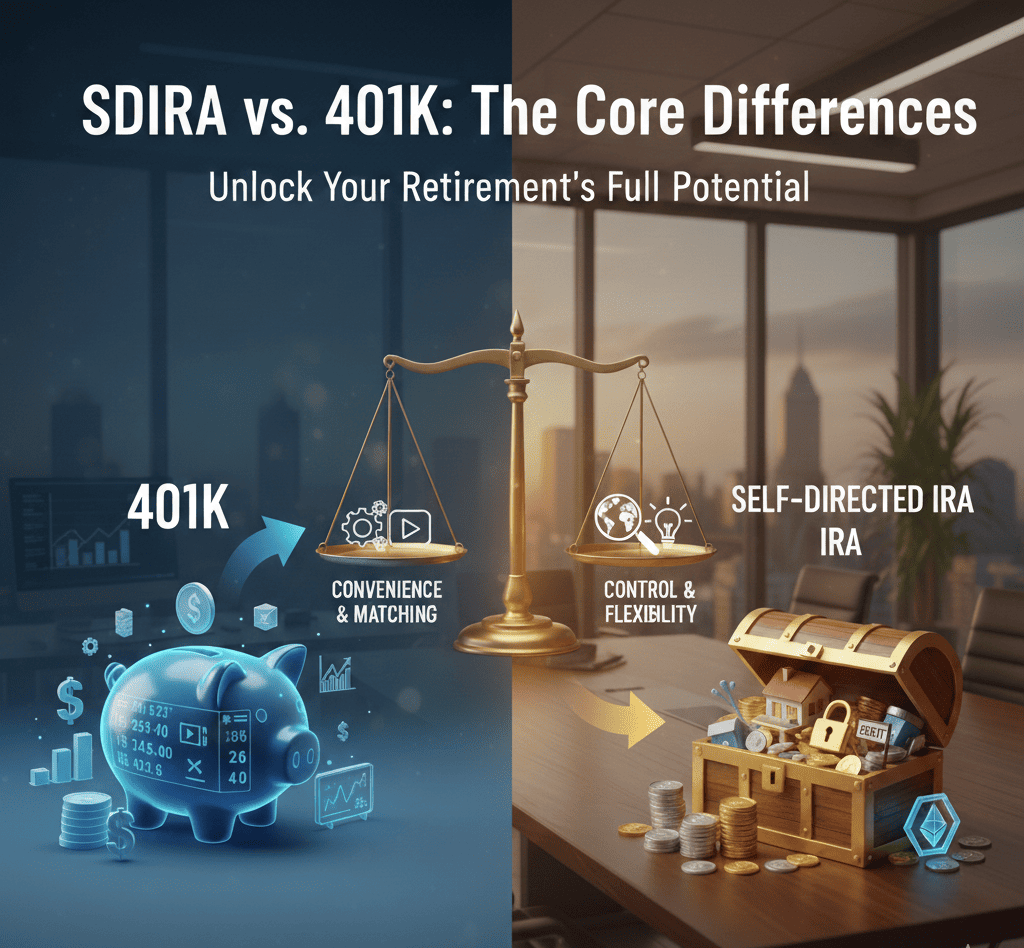
A 401(k) is an employer-sponsored qualified retirement plan governed by IRC §401(k) with a curated investment menu, higher contribution capacity, and access to employer matching. A self-directed IRA is an individual retirement account under IRC §408 opened with a specialized custodian that permits alternative assets like real estate, metals, and crypto, with lower contribution limits and no employer involvement.
Everything else flows from those two definitions.
Self-Directed IRA vs 401(k): 2026 Side-by-Side
| Factor | 401(k) | Self-Directed IRA |
|---|---|---|
| Account type | Employer-sponsored qualified plan | Individual retirement account |
| 2026 employee contribution | $24,500 | $7,500 |
| 2026 catch-up (50+) | +$7,500 = $32,000 | +$1,100 = $8,600 |
| 2026 super catch-up (60–63) | +$11,250 = $35,750 | Not available |
| Employer matching | Often, subject to vesting | None |
| Investment menu | 15–30 funds chosen by employer | Anything the IRS allows |
| Alternative assets | Almost never | Real estate, metals, crypto, private equity, notes, liens |
| Custodian | Plan recordkeeper (Fidelity, Empower, Vanguard) | Specialized SDIRA custodian (Equity Trust, IRA Financial, Madison, Entrust) |
| Participant loans | Yes, up to $50,000 or 50% of vested balance | Not allowed |
| UDFI on leveraged real estate | Exempt under §514(c)(9) | Owed (Form 990-T) |
| In-service rollover before 59½ | Plan-dependent; usually restricted | Not applicable |
| Roth option | Roth 401(k) increasingly standard | Roth SDIRA available |
| Required Minimum Distributions | Age 73 (or working-employee exception) | Age 73 (no working exception) |
| Required filing | Plan files Form 5500 | Custodian files 5498/1099-R; IRA files 990-T if UBIT/UDFI owed |
All 2026 contribution figures from IRS Notice 2025-67.
The 7 Differences That Actually Matter Between a Self-Directed IRA and a 401(k)
1. Contribution Capacity Is Roughly 3× Higher in a 401(k)
The 2026 employee deferral limit on a 401(k) is $24,500, more than 3× the $7,500 annual IRA cap. With the 50+ catch-up, the 401(k) gap widens to $32,000 vs $8,600. With the SECURE 2.0 super catch-up for ages 60–63, a participant can defer $35,750 in a single year. Add employer matching and total contributions can hit the §415(c) limit of $70,000 ($77,500 with catch-up).
For high earners trying to shelter the most income, the 401(k) wins on raw capacity. For everyone else, contribution capacity is a smaller factor than what you can do with the money once it is inside.
2. Employer Match Is Free Money, Subject to Vesting
Roughly 86% of 401(k) plans offer some form of employer match (typically 3%–6% of compensation). The match is contributed by the employer on top of your deferral, which is why “max the match first” is the standard advice. A self-directed IRA has no employer and no match.
The catch: vesting schedules. Many plans use a 3-year cliff or 6-year graded vesting schedule on the employer match. If you leave before fully vested, you forfeit the unvested portion. Always check your Summary Plan Description before leaving for a new job or rolling over.
3. The Investment Menu Is the Whole Game
A 401(k) limits you to whatever the employer selected when they set up the plan. Most plans hold 15–30 mutual funds, a stable value fund, a target-date series, and sometimes company stock. The fund menu reflects what the plan sponsor and recordkeeper wanted to offer, not what you might want to buy.
A self-directed IRA opens the full universe of IRS-allowed assets:
- Real estate. Rentals, commercial, raw land, mortgage notes, tax liens. See self-directed IRA real estate rules and can I invest in real estate with my IRA or 401(k)?
- Precious metals. IRS-eligible gold, silver, platinum, palladium. See what is a gold and silver IRA.
- Cryptocurrency. Bitcoin, Ethereum, and other digital assets through compliant custodians. See self-directed crypto IRA explained.
- Private equity and private placements. Direct LLC or LP interests, startup equity.
- Mortgage notes and tax liens. Your IRA becomes the lender.
For the case for moving beyond Wall Street’s menu, see alternative assets in an IRA: diversifying beyond stocks and bonds and IRAs with the most investment flexibility.
4. The UDFI Exemption That Most People Have Never Heard Of
This is the single biggest structural asymmetry, and most comparison articles miss it entirely.
Under IRC §514, if a retirement account uses a non-recourse loan to buy real estate, the debt-financed share of the rental income and the sale gain are taxable inside the account. The calculation is (average debt / average basis) × net income, paid via Form 990-T.
The exception is §514(c)(9), which exempts “qualified organizations” including 401(k) plans (both regular and Solo 401(k)s) from UDFI on real estate. IRAs are not qualified organizations. So:
- Same property, same loan, same rent, same investor
- Inside a 401(k) or Solo 401(k): zero UDFI tax owed
- Inside a self-directed IRA: UDFI tax owed annually on the debt-financed portion
For a self-employed investor planning to use non-recourse leverage on rental property, the Solo 401(k) is structurally superior to any IRA, full stop. See our SD401(k) vs SDIRA for precious metals breakdown for the parallel analysis on metals.
5. 401(k) Loans Are Allowed; IRA Loans Are Not
A 401(k) participant can borrow up to the lesser of $50,000 or 50% of vested balance from the plan, with up to 5 years to repay (longer for a primary home purchase). The loan is not a distribution and not taxable, provided repayment terms are met.
You cannot borrow from an IRA, period. Any “loan” from an IRA is treated as a prohibited transaction under IRC §4975 and disqualifies the entire account. Indirect rollovers give you a 60-day use-of-funds window before the money must redeposit, but that is the closest thing to “IRA borrowing” that exists. See our 60-day rollover rule explainer.
6. Roth Treatment Is Available Inside Both, but the Rules Differ
A Roth 401(k) has no income phase-out. Anyone can contribute up to the full $24,500 (or $32,000 / $35,750 with catch-up) regardless of income. Required Minimum Distributions on Roth 401(k) balances were eliminated for tax years after 2023 under SECURE 2.0.
A Roth IRA phases out direct contributions at modified AGI of $153K–$168K (single) and $242K–$252K (MFJ) for 2026. Above the phase-out, the “backdoor Roth” (non-deductible Traditional IRA contribution converted to Roth) is the standard workaround. Roth IRAs have no RMDs during the original owner’s lifetime.
Practical takeaway: if your employer offers a Roth 401(k) option and you are above the Roth IRA income phase-out, the Roth 401(k) is the cleaner high-income path to tax-free retirement income. For the Roth-specific structural breakdown, see SDIRA vs Roth IRA comparison.
7. Fee Structures Are Almost Opposite
A typical 401(k) charges no account-level fee to the participant directly. The plan sponsor and recordkeeper earn fees through the fund expense ratios (often 0.30%–0.80% of assets per year) and a plan administration fee that may show up as a basis-point asset charge.
A self-directed IRA charges direct, transparent fees:
- Setup: $50–$300 one-time
- Annual recordkeeping: $200–$500 flat or 0.10%–0.50% of assets
- Transaction fees: $25–$150 per wire
- Form 990-T preparation if owed: $300–$1,000
- IRA-LLC setup if used: $600–$1,500
- State LLC franchise tax: $0–$800/year
For accounts holding alternative assets that compound at 8%+ annually, the explicit SDIRA fee is often lower than the bundled 401(k) expense ratio. For accounts holding only target-date funds, the 401(k) is usually cheaper. The break-even depends on account size and asset performance. See our best self-directed IRA custodian comparison for 2026.
When a 401(k) Beats a Self-Directed IRA
The 401(k) wins when:
- You have access to a plan with an employer match. The match is an instant 50%–100% return on your deferral. No alternative asset returns that fast.
- You are a high earner trying to shelter the most income annually. The $24,500 deferral and the path to $70,000 total via the §415(c) limit dwarf the IRA cap.
- You value simplicity. The plan menu has been curated, the recordkeeper handles every transaction, and you cannot easily commit a prohibited transaction.
- You want plan loans as a backstop. The ability to borrow $50,000 against the balance is a real liquidity feature.
- Your plan offers a Roth 401(k) option and you are above the Roth IRA income phase-out.
When a Self-Directed IRA Beats a 401(k)
The self-directed IRA wins when:
- You have conviction in a specific alternative asset class (real estate, metals, crypto, private equity) and no public-market vehicle gives you the exposure you want.
- You have rollover-eligible balances sitting in old 401(k)s, 403(b)s, or traditional IRAs that the annual $7,500 cap could never replicate.
- You want direct ownership of an income asset. A rental property held in a self-directed Roth IRA produces tax-free rent and tax-free appreciation for life. See is a self-directed IRA a good idea?
- Your current employer’s 401(k) menu is poor and you want to redeploy capital into something you actually understand.
- You are between jobs and want to take control of the old 401(k) rather than leaving it in a former employer’s plan. Read how to roll over a 401(k) into a self-directed IRA.
Why Most Sophisticated Investors Use Both a 401(k) and a Self-Directed IRA
There is no rule forcing you to choose. The IRS lets you contribute to a 401(k) and a Traditional or Roth IRA in the same year, subject to each account’s separate limit. The combined 2026 contribution capacity for a 50-year-old wage earner: $32,000 (401(k) with catch-up) + $8,600 (IRA with catch-up) = $40,600, plus employer match. For self-employed investors running a Solo 401(k) alongside a Traditional or Roth SDIRA: $77,500 + $8,600 = $86,100.
The standard sophisticated-investor playbook:
- Max the 401(k) employer match (free money first).
- Continue 401(k) deferrals up to the $24,500 limit if cash flow allows.
- Open a self-directed IRA in parallel for alternative-asset exposure that the 401(k) menu cannot offer.
- On every job change, roll the prior employer’s 401(k) into the self-directed IRA to consolidate and unlock the alternative-asset menu.
- For self-employed years or side income, fund a Solo 401(k) to capture the §514(c)(9) UDFI exemption on any leveraged real estate.
How to Move Money From a 401(k) Into a Self-Directed IRA
The mechanics are simple once you understand the two paths:
- Direct (trustee-to-trustee) rollover. The 401(k) plan administrator sends the funds directly to the new self-directed IRA custodian. No 60-day clock. No 20% mandatory withholding. This is the path 95%+ of investors should use.
- Indirect rollover. The 401(k) administrator sends a check to you, withholding 20% federal income tax. You have 60 days to redeposit the full pre-withholding amount (including replacing the withheld 20% out of pocket) into the new IRA, or the entire distribution becomes taxable plus the 10% early withdrawal penalty if you are under 59½.
When you can roll: after leaving the employer, after the plan’s normal retirement age, or via an in-service distribution if the plan permits it (most commonly available after age 59½ for the portion of the balance attributable to employer contributions and rollovers from prior plans).
Step-by-step:
- Open the self-directed IRA at your chosen custodian. See how to open a self-directed IRA: complete guide.
- Get the new account’s rollover instructions (wire instructions, FBO vesting language, custodian’s federal Tax ID).
- Contact the 401(k) recordkeeper and request a direct rollover. They will require a Letter of Acceptance from the new custodian and a completed distribution form.
- Allow 5–15 business days for the transfer to complete.
- Once funds settle in the SDIRA, begin directing the first investment.
For the deeper rollover walkthrough see how to roll over a 401(k) into a self-directed IRA: complete guide and our 403(b) rollover guide.
Frequently Asked Questions
What is the main difference between a self-directed IRA and a 401(k)?
A 401(k) is employer-sponsored with a curated fund menu, employer matching, and higher contribution limits. A self-directed IRA is independent, lets you hold alternative assets (real estate, metals, crypto, private equity, notes, liens), has lower contribution limits, and gets no employer match. Most serious investors use both, not one.
Can I have a 401(k) and a self-directed IRA at the same time?
Yes. The IRS treats them as separate accounts with separate contribution limits. A 50-year-old can contribute up to $32,000 to a 401(k) and $8,600 to a Traditional or Roth IRA in the same year in 2026.
Is a self-directed IRA better than a 401(k)?
Neither is universally better. A 401(k) wins on contribution capacity, employer matching, and simplicity. A self-directed IRA wins on investment flexibility, alternative-asset access, and what you can hold inside it. The right answer depends on your employment status, income, and asset-class conviction.
Can I roll my 401(k) into a self-directed IRA while still employed?
Sometimes. Plan-dependent. After age 59½, most plans allow an in-service rollover of employee deferrals, employer matches, and prior rollovers into an IRA. Before 59½, the in-service rollover is usually limited to the rollover-source portion of the balance, if any. Check your Summary Plan Description.
Are 401(k) loans available in a self-directed IRA?
No. IRA loans are prohibited under IRC §4975. Any attempt to borrow from an IRA disqualifies the entire account. 401(k) loans up to $50,000 or 50% of vested balance are allowed in plans that permit them.
What is the 2026 contribution limit for a 401(k) vs a self-directed IRA?
401(k): $24,500 employee deferral, $32,000 with 50+ catch-up, $35,750 with the SECURE 2.0 super catch-up for ages 60–63. Self-directed IRA: $7,500, $8,600 with 50+ catch-up. Limits per IRS Notice 2025-67.
Why do 401(k) plans avoid UDFI tax that IRAs owe?
Under IRC §514(c)(9), qualified pension and 401(k) plans are exempt from Unrelated Debt-Financed Income tax on real estate. IRAs are not qualified plans under §401, so they do not get the exemption. This is the single biggest structural reason self-employed investors choose a Solo 401(k) over an IRA for leveraged real estate.
Do I lose my 401(k) employer match if I leave before vesting?
You lose the unvested portion. Cliff vesting (typically 3 years) means 0% vested before the cliff and 100% after. Graded vesting (typically 6 years) means a percentage vests each year. Your own deferrals are always 100% yours. The Summary Plan Description spells out your plan’s schedule.
Can a self-directed IRA hold mutual funds and stocks?
Yes. A self-directed IRA can hold anything the IRS allows, including everything a standard brokerage IRA can hold. The “self-directed” label just means the custodian also permits alternative assets. Most investors who open an SDIRA do so for the alternative-asset access, not to replicate a brokerage account.
Does Bullionite Asset Group help with rollover sequencing?
Yes. Bullionite Asset Group offers a free, no-obligation consultation for investors evaluating a self-directed IRA vs 401k strategy, including in-service rollover timing, custodian selection, and which assets fit which account. Visit bullioniteassetgroup.com to schedule.
Key Takeaways
- A 401(k) is an employer-sponsored qualified plan under IRC §401(k). A self-directed IRA is an individual retirement account under IRC §408 opened with a specialized custodian.
- 2026 contribution limits per IRS Notice 2025-67: 401(k) $24,500 ($32,000 with 50+ catch-up, $35,750 with super catch-up at ages 60–63); SDIRA $7,500 ($8,600 with catch-up). 401(k) capacity is roughly 3× larger.
- Employer matching is free money but subject to vesting. Most plans use 3-year cliff or 6-year graded vesting on the match.
- The investment menu is the whole game. A 401(k) limits you to 15–30 curated funds. A self-directed IRA opens real estate, metals, crypto, private equity, mortgage notes, and tax liens.
- The biggest structural asymmetry: 401(k) plans are exempt from UDFI tax on leveraged real estate under §514(c)(9). IRAs are not.
- 401(k) loans up to $50,000 or 50% of vested balance are allowed in plans that permit them. IRA loans are prohibited transactions under IRC §4975 and disqualify the entire account.
- Most sophisticated investors run both: max the 401(k) match for free money, fund a self-directed IRA for alternative-asset exposure, and roll over old 401(k) balances on every job change.
- The right answer to “self-directed IRA vs 401k” is usually “yes,” not “either / or.”
How is a SEP IRA different from a 401k?
A SEP IRA (Simplified Employee Pension) is designed for self-employed people and small business owners. Unlike a 401k where employees can contribute their own money, only the employer makes contributions to a SEP IRA. SEP IRAs have simpler administration and lower setup costs than 401ks, but they lack features like loans and Roth options. For 2026, SEP IRA contributions are limited to the lesser of 25% of compensation or $69,000, which can be higher than 401k limits for high earners. If you’re self-employed, a SEP IRA might be easier to set up, but a Solo 401k often allows higher total contributions.
How does an Sdira work?
You open an SDIRA through a specialized custodian that allows alternative investments (regular IRA custodians typically don’t). You contribute money just like any IRA (same contribution limits apply), then direct the custodian to purchase your chosen investments. All income and gains flow back into the IRA tax-deferred. You’re responsible for finding deals, doing due diligence, and ensuring you don’t violate prohibited transaction rules. The custodian handles paperwork and holds the assets, but they don’t provide investment advice or vet your choices. When you reach retirement age, you can take distributions according to normal IRA rules.
What is the downside of SEP IRA?
The main downside is that SEP IRAs only allow employer contributions, so if you’re self-employed, you can’t make separate employee deferrals like you could with a Solo 401k. You also must contribute the same percentage for all eligible employees, which gets expensive if you have staff. There’s no loan provision like 401ks have, and you can’t do Roth contributions. SEP IRAs also have more restrictive eligibility rules that might force you to include part-time or seasonal workers. For maximizing contributions as a self-employed person with no employees, a Solo 401k usually works better because it allows both employer and employee contributions, potentially getting you to higher total savings
Can I retire at 62 with $400,000 in 401k?
Whether you can retire at 62 with $400,000 depends entirely on your expenses and other income sources. Using the common 4% withdrawal rule, $400,000 would give you $16,000 per year, or about $1,333 per month. If you have Social Security (though it’s reduced if you claim before full retirement age), a pension, or other income, this might work. If $400,000 is your only retirement money and you need to cover housing, healthcare, and living expenses, it’s probably not enough unless you have very low expenses or plan to work part-time. Healthcare costs until Medicare kicks in at 65 are a major consideration. Run the numbers based on your actual spending, factor in inflation, and consider whether you’ll have other income streams before deciding if early retirement is realistic.
Have Questions About Your Self-Directed IRA?
Schedule a free 15-minute consultation with Bullionite Asset Group. No pitch, no pressure, no referral commissions.

As the Founder and Chief Investment Officer of Bullionite and Bullionite Asset Group, I’ve built my career on a simple premise understanding the intersection of macroeconomics, commodities, and digital assets to stay ahead of the curve, not under it. My focus is on navigating the complexities of the world’s largest markets spanning the US, the Middle East, and Asia to identify high-value opportunities for alternative investment.
With a specialized focus on Self-Directed IRAs (SDIRAs), I help investors move beyond traditional 401ks by integrating assets like precious metals and cryptocurrency into their retirement strategies. Based in Newport Beach, California, I am dedicated to bridging the gap between traditional finance and the evolving landscape of new age digital assets, ensuring that every strategic move is backed by deep market insight and a commitment to long-term growth.