Free 30-min consultation · No pitch, no pressure 📞 CALL: (949) 536-9733


Self-Directed IRA Fees: What 7 Custodians Charge in 2026
Self-directed IRA fees from seven custodians' own 2026 schedules, priced for three account sizes and a rental purchase, plus the costs that never appear on a fee page.
Self-directed IRA fees usually run $150 to $2,300 a year in custodian charges, plus $0 to $250 every time your IRA buys or sells something. Where you land depends less on the custodian's headline price than on how its fees are built, because the same account can cost several times as much at one custodian as at another.
The figures here come from seven custodians' published 2026 schedules, read on their own sites in October 2026, and they're priced for three account sizes and a rental purchase. Schedules change, so treat this as a snapshot and ask for the current PDF before you open an account.
How much does a self-directed IRA cost?
Most people pay a one-time setup fee of $0 to $100, an annual fee of $150 to $2,300, and $0 to $250 each time the IRA buys or sells an asset. Closing the account costs $250 at five of the custodians below and $325 at IRA Club.
That's a wide spread, and the self-directed IRA cost for your account depends on three things: how many assets you hold, what they're worth and how often you trade. Here's what each custodian publishes:
| Custodian | Setup | Annual fee | How the annual fee is set | Real estate purchase or sale |
|---|---|---|---|---|
| The Entrust Group | $50 | $219 to $2,299 | $219 for one asset or $329 for two or more, plus 0.17% of asset value over $50,000 (cash excluded), capped at $2,299 | $175, or $250 with a non-recourse loan |
| Equity Trust | $50 online | $225 to $2,250 | Tiers by total account value | None listed |
| IRA Financial | $0 | $495 | Flat | Included |
| IRA Club | Membership due at opening | $195 plus $195 per holding | Per holding | $175, plus $75 for an earnest money deposit |
| IRAR Trust | $100 | $199 plus $75 per extra asset | Per asset | $175, earnest money and loan included |
| Vantage | $50 | $450 per asset, up to $2,250 | Per asset, plus $150 a year per mortgage | $175 |
| GoldStar Trust | $50 | $150 | Flat | $100 |
None of these is a recommendation. They're here because they publish full schedules, which makes a fair comparison possible. If you're new to how the custodian fits in, our explainer on how a self-directed IRA works covers the roles.
What fees does a self-directed IRA custodian charge?
Self-directed IRA custodian fees fall into five groups, and the typical fees for self-directed IRA accounts look much the same on every schedule:
| Fee | What it pays for | Range on these seven schedules |
|---|---|---|
| Setup | Opening the account | $0 to $100, once |
| Annual fee | Holding the assets, IRS reporting on Forms 5498 and 1099-R, statements | $150 to $2,299 a year |
| Transaction fee | Each purchase, sale or exchange | $0 to $250 per transaction |
| Service fees | Wires, checks, overnight mail, rush work, research | Wires $25 to $50, checks $10 to $15, overnight mail $30 to $75 |
| Exit fee | Closing the account or moving it | $250 to $325, plus $100 for an outgoing transfer at Vantage |
The annual fee gets the attention, but transaction fees vary just as much. Entrust charges $105 to buy most private investments, $175 for real estate and nothing for precious metals. IRA Financial includes unlimited purchases in its $495.
A low annual fee can also sit next to wire and check charges that add up fast if your IRA pays a lot of bills. Price the whole year, not the headline.
Which fee model is cheapest for your account?
It depends on the account. Per-asset pricing wins for small, simple accounts, flat pricing wins for large ones, and value-based pricing gets expensive as the balance grows. A self-directed IRA fees comparison only makes sense once you price your own account under each model.
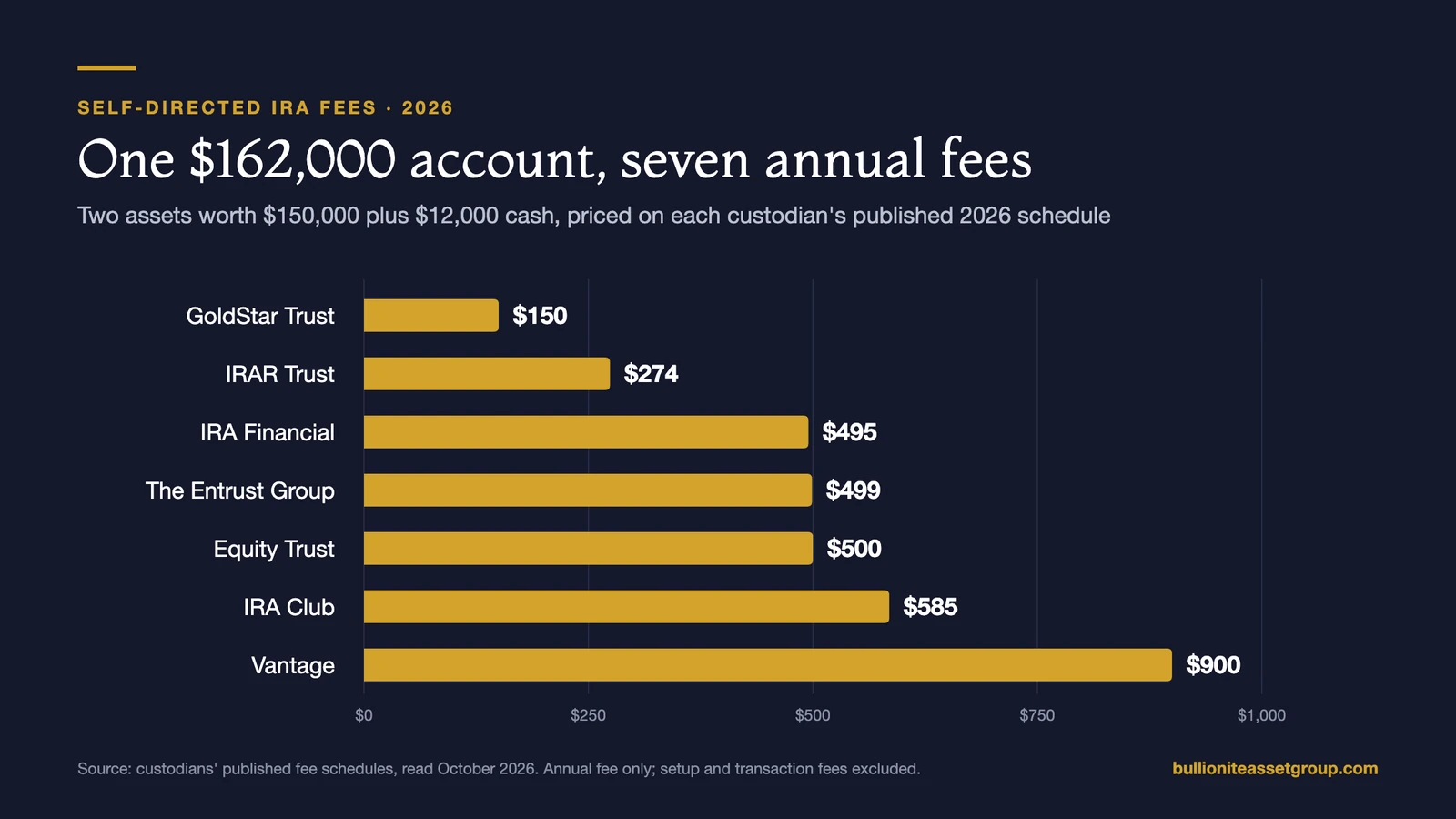
Here are three accounts priced under each custodian's 2026 schedule (annual fee only, before setup and transaction fees):
| Custodian | $40,000 in one asset | $150,000 in two assets plus $12,000 cash | $480,000 in three assets plus $20,000 cash |
|---|---|---|---|
| The Entrust Group | $219 | $499 | $1,060 |
| Equity Trust | $350 | $500 | $1,750 |
| IRA Financial | $495 | $495 | $495 |
| IRA Club | $390 | $585 | $780 |
| IRAR Trust | $199 | $274 | $349 |
| Vantage | $450 | $900 | $1,350 |
| GoldStar Trust | $150 | $150 | $150 |
The middle column is Entrust's own worked example: $329 for two assets plus 0.17% of the $100,000 above $50,000, which comes to $499. In the last column, Equity Trust's fee jumps from $1,075 to $1,750 once the account crosses $500,000, so a value-based tier can cost you more just for having a good year.
So the low fee self-directed IRA for a $40,000 account isn't the same as the one for a $500,000 account. The lowest cost self-directed IRA on paper may also lack things you'll need, such as fast real estate closings or a choice of metals depositories, and a cheap custodian that's slow to close can cost you a deal.
What does it cost to buy real estate in a self-directed IRA?
Self-directed IRA real estate fees come in two layers: the custodian's charge for each purchase and sale ($0 to $250), and the annual fee on a high-value asset. Buying with a non-recourse loan usually costs more, and so does buying through an LLC.
Here's the cost of buying a $200,000 rental with cash, holding it five years and selling it. The account keeps $10,000 in cash for repairs, and the property's value stays flat to keep the math simple:
| Custodian | Year 1 (setup, annual fee, purchase) | Five-year total, including the sale |
|---|---|---|
| The Entrust Group | $699 | $2,770 |
| Equity Trust | $750 | $3,550 |
| IRA Financial | $495 | $2,475 |
| IRA Club | $640 | $2,375 |
| IRAR Trust | $474 | $1,445 |
| Vantage | $675 | $2,650 |
| GoldStar Trust | $300 | $1,000 |
Wires, checks and the property's own costs (taxes, insurance, repairs) come on top. If the IRA borrows, Entrust's purchase fee rises to $250, IRA Club adds $225 for leveraged real estate, and Vantage charges $150 a year for each mortgage.
The checkbook LLC route
A checkbook IRA LLC trades higher setup costs for lower transaction costs, because the LLC pays bills and closes deals without asking the custodian each time. IRA Financial charges $999 to set one up, then $495 a year plus a $299 "Compliance Shield" from year two. IRA Club charges $995 to set up, $325 a year per LLC and $100 each time money moves between the IRA and the LLC.
The state adds its own fees. California charges every LLC organized or doing business there an $800 annual tax, whether or not the LLC earns anything. Our guide to setting up a checkbook IRA LLC covers when the structure pays for itself, and choosing a real estate SDIRA custodian covers processing speed.
What costs don't show up on the fee schedule?
The costs people miss sit in the account agreement or get charged by someone other than the custodian:
- Idle cash earns money for someone. Vantage's schedule says its custodian keeps all income earned on undirected cash as a "Custodial Fee." GoldStar sweeps cash to an affiliated bank and keeps the difference between that bank's rate and what it credits you. Every 1% of interest on $20,000 of idle cash is $200 a year.
- IRA Financial and IRA Club both require a minimum of $500 in cash. IRA Club charges $100 at renewal if you fall short.
- Valuations have deadlines. For assets with no market price, the custodian must report a December 31 fair market value on Form 5498, per the IRS instructions for Forms 1099-R and 5498. Miss the deadline and Vantage charges $125 (assessed May 1) and IRA Club $175.
- Some IRAs owe a tax return. An IRA with $1,000 or more of gross unrelated business income files Form 990-T, according to the Form 990-T instructions. That's common with leveraged real estate or an operating business, and the preparer bills the IRA. Our post on SDIRA tax filing requirements explains when it applies.
- Appraisals, property management, LLC registered agents and depository storage for metals all come from outside the custodian.
Should you pay self-directed IRA fees from inside or outside the account?
Pay the annual fee from outside if you can, especially for a Roth, and pay everything tied to an asset from inside.
IRS Publication 590-A says "trustees' administrative fees aren't subject to the contribution limit." You can pay the custodian's annual fee from your checking account without using up your $7,500 contribution for 2026. Brokers' commissions are different: Pub 590-A counts them toward the limit, so pay transaction-type charges from the IRA.
Don't expect a deduction either way. Pub 590-A says you can't deduct separately billed trustee fees as an itemized deduction. The suspension of miscellaneous itemized deductions in IRC 67(h) used to end after 2025, but the 2025 tax law removed the end date. Our FAQ on whether self-directed IRA fees are tax deductible has more detail.
Here's why a Roth owner should care. Say your annual fee is $495 and your Roth earns 7% a year. Paying that fee from outside for 20 years leaves about $20,300 more inside the Roth, all of it tax-free. In a traditional IRA the fee comes out of pre-tax money, so paying it from the account is usually fine.
One hard line: property taxes, repairs, HOA dues and other asset expenses must come out of the IRA. Paying them yourself can count as a contribution or a prohibited transaction. Our guide to the prohibited transaction rules explains why.
How to compare self-directed IRA fees, step by step
- Get each custodian's current fee schedule as a dated PDF. Websites lag behind the schedule you'll sign.
- Write down what your account will hold over five years: how many assets, roughly what they're worth, and how many purchases, sales, wires and checks a year.
- Price that plan under each schedule, including setup, five annual fees, every transaction and the exit fee.
- Read the cash section. Ask who keeps the interest on uninvested cash and whether there's a minimum balance.
- Ask how valuations work for your assets and what a late one costs.
- Ask how long a real estate purchase or a wire takes. A custodian that's $200 cheaper but misses your closing date isn't cheaper.
Run step 3 with the tables above and a pattern shows up: for one or two properties, a per-asset or flat schedule beats a value-based one by hundreds of dollars a year.
Get your fees priced before you open the account
Price matters, but so does whether the custodian can handle your assets without delays. Bullionite helps investors set up a self-directed IRA, match it to a custodian that fits the plan and price the first five years before any money moves. Book a consultation and bring your list of planned investments.
This guide is general information, not tax, legal or investment advice. Fees come from each custodian's published schedule as of October 2026 and change over time, so confirm them before you open an account.
FAQ
Can you get a no annual fee self-directed IRA?
Not among the seven schedules above: the lowest annual fee is GoldStar's $150. Alto IRA charges $0 a quarter only while the account has no money invested, then $37.50 a quarter below $30,000 invested and $100 a quarter above that, according to its pricing page. An account with no annual fee has to make money somewhere, usually on transactions or your idle cash.
Do custodians charge to take a required minimum distribution?
Some don't. Vantage waives its $10 check or ACH fee for RMDs, and IRA Club includes RMD calculations at no charge. Distributing an asset in kind, such as a deed or a note, costs more: Vantage and IRAR Trust each charge $100. Our guide to self-directed IRA RMDs covers the in-kind route.
What does it cost to move a self-directed IRA to another custodian?
Expect a $250 termination fee at most custodians, or $325 at IRA Club, and Vantage adds $100 for the outgoing transfer. Each non-cash asset also has to be re-registered to the new custodian, which Equity Trust prices at $100 per asset. The receiving custodian may charge its own setup and transfer-in fees.
Are self-directed IRA fees higher than a regular IRA’s?
Yes. A brokerage IRA holding stocks and funds often has no annual fee, because the broker earns money in other ways. A self-directed IRA custodian has to hold deeds, notes and private fund records, value them every year and process each purchase by hand, which is why the annual fee exists.

As the Founder and Chief Investment Officer of Bullionite and Bullionite Asset Group, I’ve built my career on a simple premise understanding the intersection of macroeconomics, commodities, and digital assets to stay ahead of the curve, not under it. My focus is on navigating the complexities of the world’s largest markets spanning the US, the Middle East, and Asia to identify high-value opportunities for alternative investment.
With a specialized focus on Self-Directed IRAs (SDIRAs), I help investors move beyond traditional 401ks by integrating assets like precious metals and cryptocurrency into their retirement strategies. Based in Newport Beach, California, I am dedicated to bridging the gap between traditional finance and the evolving landscape of new age digital assets, ensuring that every strategic move is backed by deep market insight and a commitment to long-term growth.