Free 30-min consultation · No pitch, no pressure 📞 CALL: (949) 536-9733


UBIT in a Self-Directed IRA: When Your IRA Owes Tax and How to Cut It
UBIT in a self-directed IRA explained: what triggers it, how it's calculated at 2026 trust rates, when the IRA files Form 990-T, and legal ways to reduce or avoid it.
UBIT in a self-directed IRA is the tax your IRA pays when it earns business income instead of investment income. Rent, interest, dividends and capital gains normally grow tax-sheltered, but income from running a business, or from property bought with borrowed money, can be taxed inside the IRA at trust rates that reach 37%.
Most investors never owe it. The ones who do are usually caught by surprise, because the custodian doesn't watch for it and the bill can arrive years later with penalties. Here's how UBIT in an IRA works, what triggers it, what it costs in 2026 and how to keep it small.
What is UBIT for an IRA?
UBIT, the unrelated business income tax, is a tax on an IRA's unrelated business taxable income (UBTI). An IRA is a tax-exempt trust, and tax-exempt organizations owe tax on income from a trade or business that isn't part of their exempt purpose. For an IRA, almost any active business income qualifies.
IRS Publication 598 sets out the rules. The IRA pays the tax from its own money, at the rates that apply to trusts, after a $1,000 specific deduction. So when people ask what is UBIT for an IRA, the short answer is a trust-rate tax on business income that the IRA's tax shelter doesn't cover.
What triggers UBIT in a self-directed IRA?
Three things trigger UBIT in a self-directed IRA: owning part of an operating business through a pass-through entity, buying an asset with borrowed money, and buying and selling property like a dealer. Ordinary investment income is excluded.
Pub 598 excludes dividends, interest, annuities and similar investment income, rents from real property, and most gains on selling property. It then pulls three kinds of income back in:
| Investment | UBIT exposure | Why |
|---|---|---|
| Rental property bought with cash | Generally none | Rents from real property are excluded |
| Rental bought with a non-recourse loan | Partly | The debt-financed share is taxable |
| Private loans and promissory notes | Generally none | Interest is excluded, unless a company the IRA controls pays it |
| Stocks, REIT shares, C corporation shares | None | Dividends and gains are excluded |
| LLC or partnership running a business | Yes, on the IRA's share | Partnership business income flows through |
| Publicly traded partnerships | Often | They issue K-1s with business income |
| Fix-and-flip houses or subdivided lots | Possibly | Dealer gains aren't excluded |
The partnership rule catches the most people. Pub 598 says an exempt organization must treat its share of a partnership's business income as if it ran the business itself, with no difference between limited and general partners or between managing and non-managing LLC members. Being a passive investor doesn't help.
UDFI in a self-directed IRA
UDFI in a self-directed IRA is unrelated debt-financed income: the part of a property's income and gain that the loan paid for. Under IRC 514, the taxable share is the average loan balance divided by the property's average adjusted basis. Our post on the non-recourse loan IRA works through a $400,000 rental from purchase to sale.
The dealer rule comes from IRC 512(b)(5), which excludes gains except on inventory and "property held primarily for sale to customers." Holding a rental for years is investing. Subdividing land into lots and marketing them, or flipping house after house, can make the IRA a dealer, a risk our guide to buying land with an IRA covers.
How is UBIT calculated?
Start with the IRA's gross unrelated business income, subtract the expenses connected to it, then subtract the $1,000 specific deduction. What's left is taxed at the unrelated business income tax rate for trusts, which for 2026 runs from 10% to 37%, according to the IRS 2026 Form 1041-ES.
| 2026 trust bracket | Rate |
|---|---|
| Up to $3,300 | 10% |
| $3,300 to $11,700 | 24% |
| $11,700 to $16,000 | 35% |
| Over $16,000 | 37% |
Those brackets climb fast. A single person doesn't reach 37% until income is many times higher, but an IRA gets there at $16,000. Long-term capital gains get trust capital-gain rates instead, which top out at 20% above $16,250.
A worked example
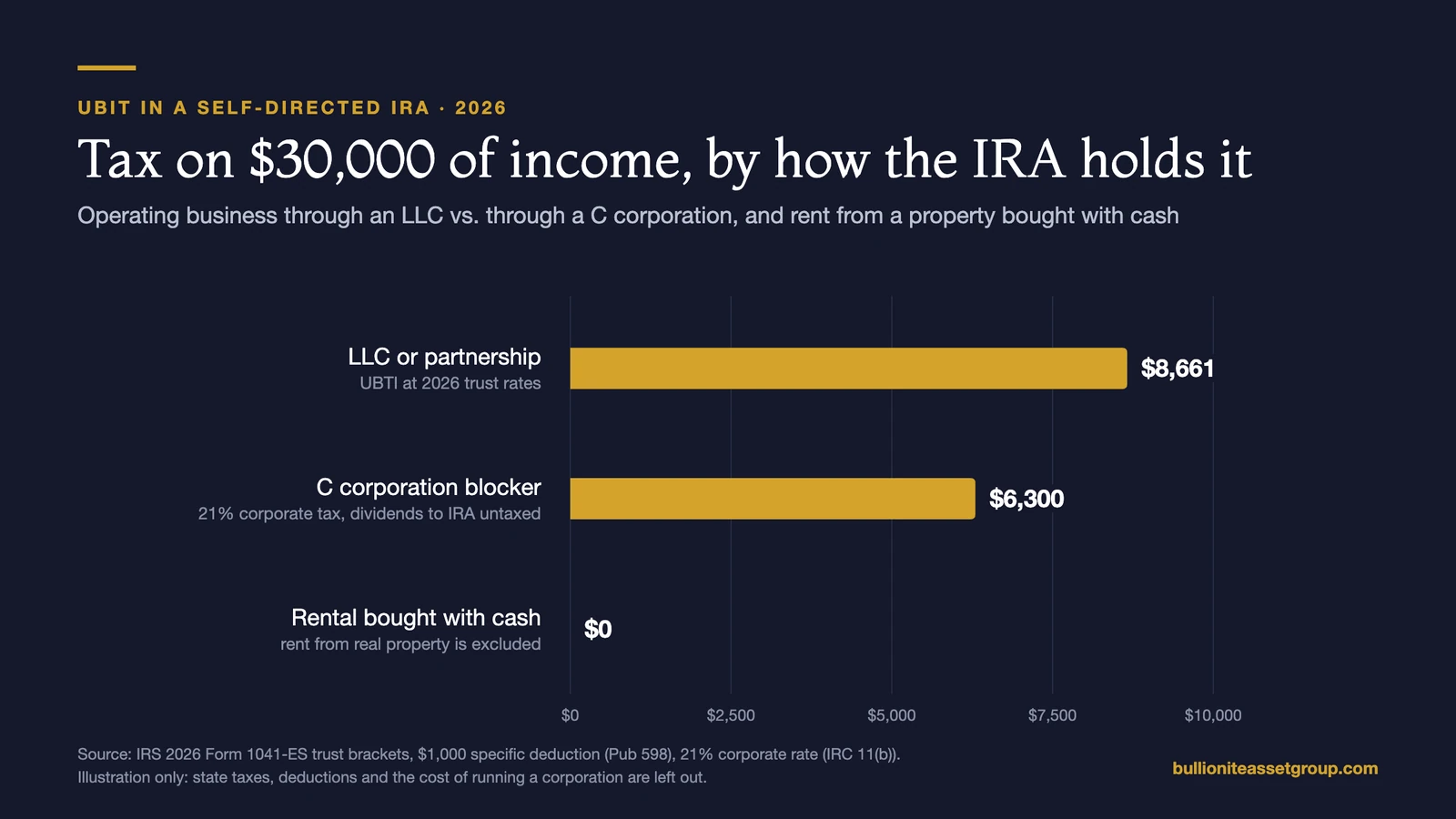
Say your IRA owns 10% of an LLC that runs a chain of car washes, and its K-1 shows $30,000 of business income for 2026. The IRA's taxable UBTI is $29,000 after the $1,000 specific deduction.
| Slice of the $29,000 | Rate | Tax |
|---|---|---|
| First $3,300 | 10% | $330 |
| Next $8,400 | 24% | $2,016 |
| Next $4,300 | 35% | $1,505 |
| Last $13,000 | 37% | $4,810 |
| Total UBIT | $8,661 |
That's about 30% of the $29,000, paid from the IRA. The same business held through a C corporation would pay 21% corporate tax under IRC 11(b), or $6,300, and its dividends to the IRA aren't UBTI.
When does a self-directed IRA file Form 990-T?
An IRA files Form 990-T once it has $1,000 or more of gross unrelated business income for the year, even if deductions bring the tax to zero. The Form 990-T instructions treat the IRA's custodian as its trustee, require the IRA to have its own employer identification number, and set the due date as the 15th day of the fourth month after the year ends, which is April 15 for most IRAs.
Four practical points about Form 990-T for an IRA:
- The IRA pays the tax from its own cash. Paying it from your pocket counts as a contribution and can be a prohibited transaction.
- The instructions call for quarterly estimated tax payments if the IRA expects to owe $500 or more.
- Your custodian probably won't spot the income for you. Watch every K-1 and every loan, and tell the custodian early.
- A preparer usually bills for the return, which our guide to self-directed IRA fees counts among the costs that never show up on a fee schedule.
For the full list of forms a self-directed IRA files, see our guide to SDIRA tax filing requirements.
Does a Roth IRA owe UBIT?
Yes. UBTI in a Roth IRA is taxed exactly like UBTI in a traditional IRA, and the Form 990-T instructions list Roth IRAs among the accounts that must file. A Roth's tax-free status covers qualified withdrawals, not business income earned inside the account.
That makes UBIT more painful in a Roth. The tax comes out of money that would otherwise have grown completely tax-free.
How can you reduce UBIT in a self-directed IRA?
You can usually shrink or avoid UBIT in a self-directed IRA by changing how the IRA holds an investment rather than whether it holds it. These moves stay within the rules:
- Buy rentals with cash, or pay the loan down before selling. Pub 598 treats property as debt-financed for a sale only if there was debt on it in the 12 months before. Pay the loan off and wait a year, and none of the gain is UDFI.
- Hold operating businesses through a C corporation "blocker." The corporation pays 21%, and its dividends to the IRA are excluded. It brings its own costs, such as a corporate tax return and possibly state tax, so it pays off mainly on larger amounts of income.
- Lend instead of owning. Interest on a promissory note is generally excluded, but Pub 598 says interest, rents and royalties from a company the IRA controls aren't.
- Use a Solo 401(k) for leveraged real estate if you qualify. IRC 514(c)(9) exempts certain real estate debt for qualified retirement plans, which covers a Solo 401(k) but not an IRA.
- Ask every sponsor two questions before investing: does the deal use debt, and does it pass business income through on a K-1?
Owning a business inside an IRA raises prohibited transaction questions on top of the tax ones. Our guide to self-directed IRA business ownership covers both, and our guide to prohibited transactions covers the rest.
Mistakes that turn UBIT into a bigger bill
- Not filing because the custodian didn't mention it. The duty sits with the IRA, and late returns bring penalties and interest.
- Paying the tax from personal funds, which turns a tax bill into a possible prohibited transaction.
- Ignoring a K-1 because the investment lost money. A loss still may need reporting, and the instructions let it carry forward to offset later income.
- Forgetting state returns. Some states tax UBTI too, so ask your preparer about every state where the investment operates.
- Running a checkbook LLC like an operating business. An IRA-owned LLC that buys and sells actively can create the dealer income it was meant to avoid.
Get UBIT checked before you invest
UBIT is easiest to manage before money goes in, when the structure can still change. Bullionite helps investors review deals, structures and K-1 exposure inside a self-directed IRA before the IRA signs. Book a consultation and bring the offering documents.
This guide is general information, not tax, legal or investment advice. The rules and rates cited are current for 2026, so check your own situation with a CPA or tax attorney before you act.
FAQ
Is rental income in an IRA subject to UBIT?
Usually not. Pub 598 excludes rents from real property, so a rental your IRA bought with cash generally creates no UBTI. The exceptions are the debt-financed share when the IRA borrowed, rent from personal property, and rent based on the tenant's profits.
What is the unrelated business income tax rate for an IRA in 2026?
IRAs pay at trust rates: 10% up to $3,300 of taxable UBTI, 24% to $11,700, 35% to $16,000 and 37% above that. Long-term capital gains get trust capital-gain rates, topping out at 20% above $16,250.
Who files Form 990-T for my IRA?
The IRA files it, with the custodian signing as trustee and the IRA using its own EIN. In practice you or a tax preparer complete the return from the K-1s and loan records, and the custodian files it and pays the tax from the IRA's cash.
Does UBIT apply to a Solo 401(k)?
Yes for business income, which is taxed the same way. The difference is debt: IRC 514(c)(9) excludes certain real estate debt for qualified plans, so a Solo 401(k) can often buy property with a loan without the UDFI tax an IRA would owe.

As the Founder and Chief Investment Officer of Bullionite and Bullionite Asset Group, I’ve built my career on a simple premise understanding the intersection of macroeconomics, commodities, and digital assets to stay ahead of the curve, not under it. My focus is on navigating the complexities of the world’s largest markets spanning the US, the Middle East, and Asia to identify high-value opportunities for alternative investment.
With a specialized focus on Self-Directed IRAs (SDIRAs), I help investors move beyond traditional 401ks by integrating assets like precious metals and cryptocurrency into their retirement strategies. Based in Newport Beach, California, I am dedicated to bridging the gap between traditional finance and the evolving landscape of new age digital assets, ensuring that every strategic move is backed by deep market insight and a commitment to long-term growth.