Free 30-min consultation · No pitch, no pressure 📞 CALL: (949) 536-9733


1031 Exchange IRA Rules: Can Your IRA Do a Like-Kind Exchange?
1031 exchange IRA rules explained: why your IRA doesn't need a like-kind exchange, why you can't swap a rental into one, and how the taxes compare on a real sale.
A 1031 exchange IRA plan usually means one of two things: running a like-kind exchange inside a self-directed IRA, or swapping a rental you own into one. The first isn't needed, because your IRA doesn't pay tax when it sells property. The second isn't allowed, because IRA contributions must be cash and your IRA can't buy property from you.
You can still use both tools, each for a different pot of money. This guide covers the rules for each, then runs the tax on a real $450,000 sale both ways.
What is a 1031 exchange?
A 1031 exchange lets you sell investment real estate and buy more without paying tax on the gain yet. Under IRC 1031, no gain is recognized when you exchange real property held for business or investment solely for like-kind real property held the same way.
The rules are strict:
- You must identify the replacement property within 45 days of selling the old one and receive it within 180 days, or by your tax return's due date if that comes first.
- Only real property qualifies since the Tax Cuts and Jobs Act, according to the IRS page on like-kind exchanges. Property held primarily for sale, such as a flip, doesn't.
- US real estate isn't like-kind to real estate outside the US.
- If you receive cash or other property along with the new real estate, you're taxed on your gain up to that amount.
- You report the exchange on Form 8824.
The tax isn't forgiven. Under section 1031(d), the new property takes over the old one's basis, so the deferred gain waits inside it until you sell without exchanging. In a delayed exchange, a qualified intermediary usually holds the sale cash, because taking the money yourself can break the exchange. Our look at whether a 1031 exchange is bad for a seller covers the trade-offs.
Can you do a 1031 exchange in an IRA?
There's usually no reason to. A 1031 exchange for IRA real estate would defer a tax the IRA doesn't owe. Under IRC 408(e), an IRA is exempt from income tax apart from the tax on unrelated business income, and IRS Publication 598 excludes most gains on selling property from that tax.
So when your self-directed IRA sells a rental, the proceeds go back into the IRA, and the IRA buys the next property whenever it's ready. You don't face a 45-day list, a 180-day deadline or an intermediary. The cash can sit in the IRA for a month or a year.
Two exceptions can make an IRA's sale taxable:
- If the IRA bought with a non-recourse loan, part of the gain is unrelated debt-financed income. Pub 598 counts any debt in the 12 months before the sale, so paying the loan off a year ahead removes it. Whether a 1031 exchange could defer that taxable share is a question for your CPA, because Pub 598 doesn't address it.
- If the IRA acts like a dealer, its gains aren't sheltered. Pub 598 doesn't exclude gains on property held for sale to customers, so buying, fixing and flipping house after house inside an IRA can turn the profits into taxable business income. Our guide to buying land with an IRA covers the same risk for subdividing lots.
Can you do a 1031 exchange into an IRA?
No. You can't move a rental you own into an IRA through a 1031 exchange or any other way. These rules block a 1031 exchange into an IRA:
- Contributions must be cash. IRS Publication 590-A says contributions, other than rollovers, must be in cash, so you can't contribute a property.
- Selling the property to your IRA is a prohibited transaction. You're a disqualified person, and IRC 4975(c)(1)(A) bans any sale or exchange of property between your IRA and a disqualified person, at any price.
- A 1031 exchange only defers tax when you receive the replacement property yourself. If your IRA ends up owning it, you haven't exchanged anything. You've sold.
Getting this wrong is expensive. A prohibited transaction ends the account's IRA status as of January 1 of that year, and the whole balance is treated as distributed to you. Our guide to prohibited transactions covers the related traps.
What works instead is keeping the two pots of money apart. Your personal rentals can keep moving through 1031 exchanges, while your IRA, funded with cash contributions or a 401(k) rollover, buys different properties from unrelated sellers.
Can you take property out of an IRA and exchange it?
Yes, but the move out of the IRA is taxed first. When a self-directed IRA hands you a property, the custodian reports its fair market value on the date of distribution as the amount distributed, as the Form 1099-R instructions require.
From a traditional IRA, that value is generally ordinary income for the year, plus a 10% additional tax if you're under 59½ and no exception applies. A $400,000 house could add $400,000 to your taxable income in one year.
After that, the property is yours, and you can exchange it later like any other investment property as long as you hold it for investment. Your basis generally starts at the value you were taxed on, so an exchange right away would defer very little.
Taking a property out works best from a Roth IRA once withdrawals qualify. The distribution is tax-free, and Publication 590-B sets your basis at the property's fair market value that day. It can also cover a required minimum distribution when a traditional IRA is short of cash. Our FAQ on getting property out of a self-directed IRA walks through the steps.
How do a 1031 exchange, self-directed IRA and Roth IRA compare on tax?
A 1031 exchange defers tax on real estate you own, while a self-directed IRA shelters the whole investment for as long as the money stays inside. Here's how the three compare:
| Your own name, using 1031 exchanges | Traditional self-directed IRA | Roth self-directed IRA | |
|---|---|---|---|
| Depreciation deductions | Yes, over 27.5 years for residential rentals | None | None |
| Tax on rent each year | Yes, after expenses and depreciation | None, unless the IRA borrowed | None, unless the IRA borrowed |
| Tax when you sell | Deferred if every 1031 rule is met | None | None |
| Reinvesting deadlines | 45 days to identify, 180 to close | None | None |
| Mortgages | Any loan, including ones you guarantee | Non-recourse loans only | Non-recourse loans only |
| Money in | No limit | Capped contributions, cash only; rollovers don't count | Capped and income-limited; conversions allowed |
| Money out | Yours to use any time | Ordinary income; 10% extra before 59½ | Tax-free once withdrawals qualify |
| At your death | Heirs get a stepped-up basis | Heirs pay income tax as they withdraw | Heirs generally withdraw tax-free |
| Personal use | Allowed, but it can end 1031 eligibility | Never | Never |
A worked example
Say you bought a rental for $300,000 ten years ago, with $240,000 of that for the building, and you sell it for $450,000.
In your own name, you'd have deducted about $8,727 a year, because IRS Publication 527 depreciates residential rentals over 27.5 years. That's $87,273 over ten years, which cuts your basis to $212,727 and makes your gain $237,273.
| Piece of the $237,273 gain | Rate | Federal tax |
|---|---|---|
| $87,273 of depreciation (unrecaptured section 1250 gain) | Up to 25% | Up to $21,818 |
| $150,000 of appreciation | 15% or 20% | $22,500 or $30,000 |
| Net investment income tax on the whole gain, at higher incomes | 3.8% | $9,016 |
| Total | $44,318 to $60,834 |
IRS Topic 409 caps the depreciation share at 25%, and the net investment income tax applies above $200,000 of modified AGI for single filers and $250,000 for joint filers. The range uses the full 25% on the depreciation and leaves out selling costs and state tax.
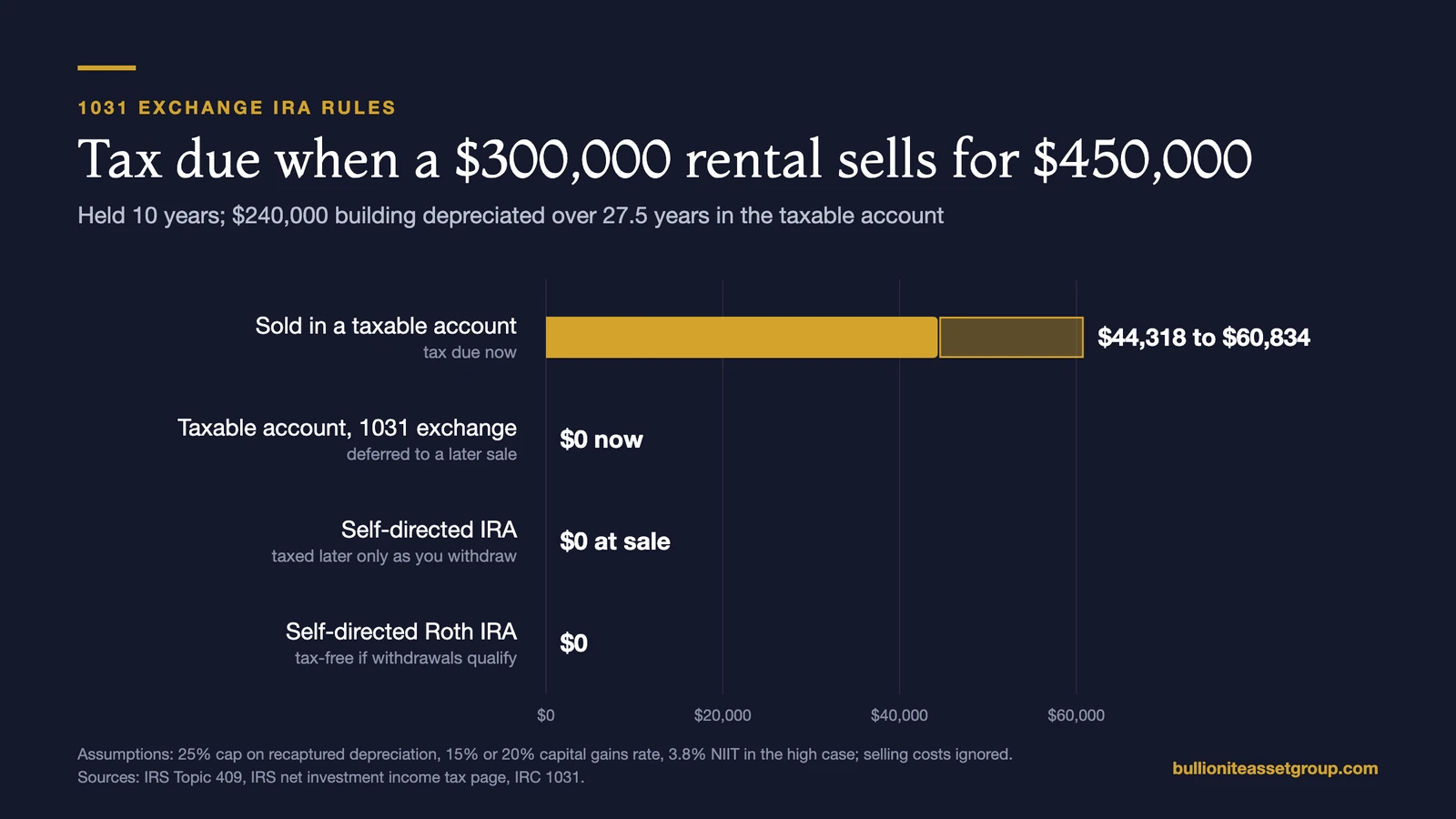
With a 1031 exchange, none of that is due now. The gain moves into the replacement property's basis and waits. If you keep exchanging and hold until death, IRC 1014 resets the basis to fair market value for your heirs, and the deferred gain generally goes untaxed.
Inside a self-directed IRA that bought the rental with cash, the same sale owes nothing at the time, and with no depreciation claimed there's nothing to recapture. The cost shows up on the way out. Withdrawals from a traditional IRA are taxed as ordinary income, at rates up to 37%, while qualified Roth withdrawals are tax-free.
So the 1031 exchange IRA comparison comes down to where the money starts. Rentals you already own can't move into an IRA, so for them the 1031 path is the deferral you have. Retirement money can't buy property in your name without being withdrawn and taxed, so for it the self-directed IRA is the natural home.
Can you use a 1031 exchange and an IRA in the same deal?
Not on the same property. Your IRA can't fund your replacement property, lend you the shortfall, buy the property you're giving up or sell you one. Each of those is a deal between your IRA and a disqualified person.
Splitting one property between you and your IRA is a gray area. Even when you both buy at the same closing from an unrelated seller, every later bill, repair and decision has to be shared exactly in proportion, and any benefit to you is prohibited. Get advice on the specific deal before you try it.
Running both strategies side by side does work: your personal rentals move through 1031 exchanges, and your IRA buys separate properties for cash or with a non-recourse loan. Our guide to self-directed IRAs for real estate covers the IRA side.
Which approach fits your situation?
A 1031 exchange usually fits better when:
- you already own appreciated rentals in your own name
- you want depreciation deductions and conventional mortgages now
- you plan to hold real estate for life so your heirs get the stepped-up basis
A self-directed IRA usually fits better when:
- your money sits in a 401(k) or IRA and you want it in real estate
- you don't need the rental income until retirement
- you'd rather not race a 45-day clock every time you sell
- you can buy with cash, or accept non-recourse terms and some tax on the debt-financed share
If you have both kinds of money, nothing stops you using both, as long as the two never deal with each other.
Mistakes that turn either strategy into a tax bill
- Selling a personal rental to your IRA, or buying the IRA's property yourself, on the theory that a fair price makes it acceptable. It's prohibited at any price.
- Missing the 45-day identification deadline, which turns the exchange into a taxable sale.
- Taking the sale proceeds yourself in a 1031 exchange instead of leaving them with the intermediary.
- Paying an IRA property's bills from your own pocket. It counts as a contribution and can be a prohibited transaction.
- Forgetting the debt-financed share of an IRA sale when the property carried a loan in the last 12 months.
- Flipping houses inside an IRA and assuming the profits are sheltered.
Plan where each property should sit
It's far easier to decide whether a property belongs in your name or in an IRA before you buy than after. Bullionite helps investors weigh 1031 exchange IRA questions, set up a real estate self-directed IRA, and structure purchases and loans so the IRA side stays clear of your personal exchanges. Book a consultation and bring a list of the properties you own and your latest retirement statements.
This guide is general information, not tax, legal or investment advice. The rules and rates cited are current for 2026, so check your own situation with a CPA or tax attorney before you act.
FAQ
Can I use IRA money to buy my 1031 replacement property?
No. Using your IRA's money to buy property you'll own, or lending it to you, is a prohibited transaction. For the exchange to work, you have to buy the replacement property yourself, with your own money or a loan.
Is depreciation recapture an issue in a self-directed IRA?
Not on a property your IRA bought with cash. Its rent and gains aren't taxed, so there's no depreciation deduction to recapture when it sells. The trade-off is that traditional IRA withdrawals are taxed as ordinary income, and a property bought with a loan brings the UDFI rules into play.
What happens to deferred 1031 gain when the owner dies?
Under IRC 1014, your heirs' basis is the property's fair market value at your death. That generally wipes out the gain you deferred through every exchange, depreciation included, so they can sell soon after with little or no tax.
Do I need a qualified intermediary when my IRA sells a property?
No. The proceeds go straight back into your IRA through the custodian, and the IRA generally owes no tax on the gain, so there's no exchange to protect. Intermediaries matter only for 1031 exchanges of property you own in your own name.

As the Founder and Chief Investment Officer of Bullionite and Bullionite Asset Group, I’ve built my career on a simple premise understanding the intersection of macroeconomics, commodities, and digital assets to stay ahead of the curve, not under it. My focus is on navigating the complexities of the world’s largest markets spanning the US, the Middle East, and Asia to identify high-value opportunities for alternative investment.
With a specialized focus on Self-Directed IRAs (SDIRAs), I help investors move beyond traditional 401ks by integrating assets like precious metals and cryptocurrency into their retirement strategies. Based in Newport Beach, California, I am dedicated to bridging the gap between traditional finance and the evolving landscape of new age digital assets, ensuring that every strategic move is backed by deep market insight and a commitment to long-term growth.